Introduction
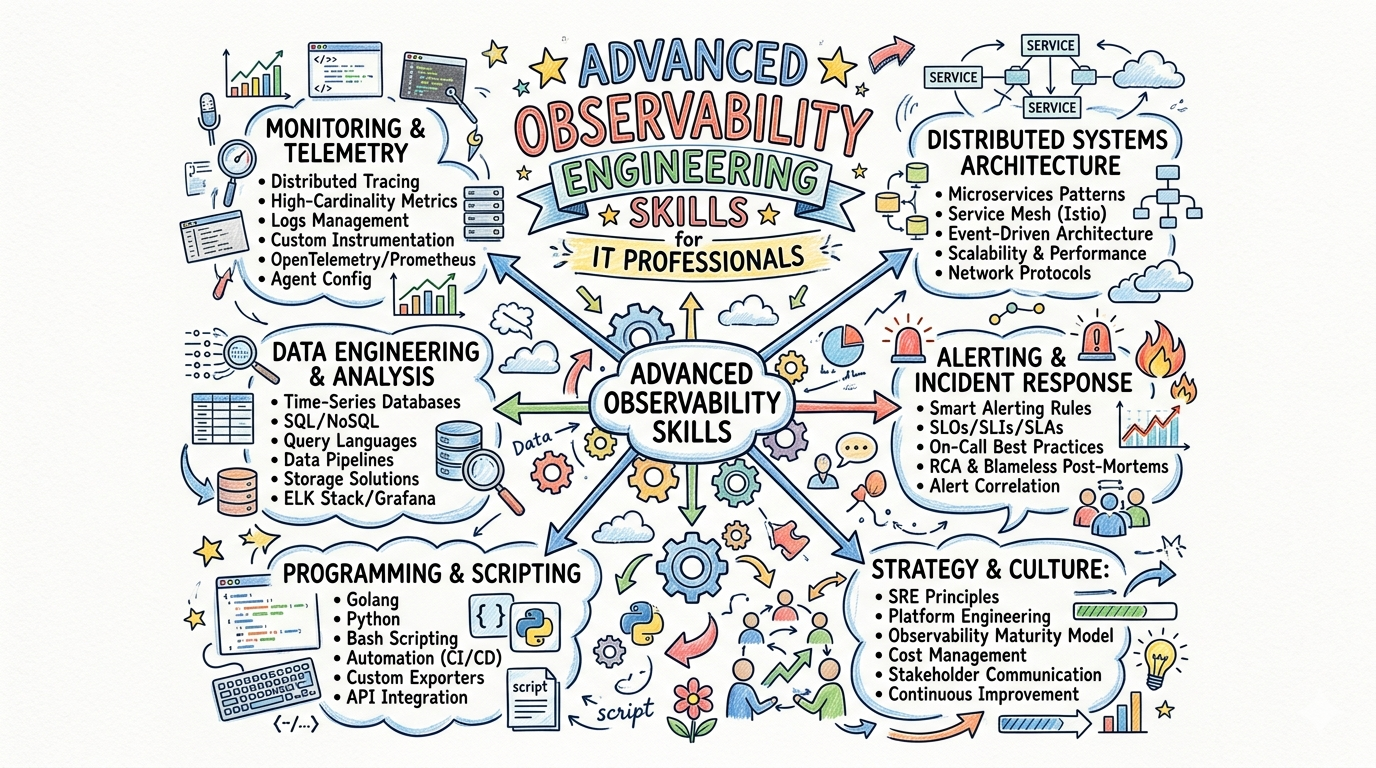
Observability has moved from a luxury to an absolute necessity in modern distributed systems. As systems become more complex and ephemeral, the ability to understand internal states through external outputs defines the difference between a high-performing engineer and one struggling with constant firefighting. This guide provides a comprehensive roadmap for those looking to Master in Observability Engineering. Whether you are a seasoned SRE or a developer stepping into platform engineering, you will find the clarity needed to navigate this specialization. We explore the core tenets of the discipline, map out professional pathways, and help you evaluate how this expertise aligns with your career trajectory in the broader ecosystems taught by experts at aiopsschool and their partners.
What is the Master in Observability Engineering?
The Master in Observability Engineering represents a professional standard for engineers who manage the health, performance, and reliability of complex software architectures. It is not merely about learning a specific monitoring tool; it is about mastering the methodology of collecting, aggregating, and analyzing logs, metrics, and traces to understand system behavior. This program focuses on production-grade implementation, emphasizing how to turn massive datasets into actionable insights during critical incidents. It aligns directly with the needs of modern enterprises, where traditional monitoring often fails to capture the nuances of microservices and cloud-native environments. By focusing on root-cause analysis and proactive system tuning, it prepares professionals to maintain stability in high-scale environments.
Who Should Pursue Master in Observability Engineering?
This program is designed for a broad spectrum of technical professionals currently operating in or aspiring to join highly available engineering teams. Software engineers who want to build more resilient applications will find the data-driven insights essential for writing better code. SREs and platform engineers, who are the primary architects of system reliability, will find the advanced telemetry and alerting strategies critical for their day-to-day operations. Security professionals can leverage these skills for detecting anomalies and potential threats within the infrastructure. Furthermore, managers and team leads will gain the technical perspective required to make informed decisions regarding tooling, observability costs, and team culture. It is equally relevant for professionals in India’s growing tech hubs and those operating in global, distributed teams.
Why Master in Observability Engineering
As infrastructure shifts toward serverless and containerized environments, the complexity of debugging has skyrocketed, making observability skills highly marketable and durable. Unlike specific tool certifications that may become obsolete, the principles of instrumentation and data correlation remain fundamental regardless of the underlying stack. This certification provides a high return on investment by positioning engineers as key decision-makers who can reduce Mean Time to Resolution (MTTR) significantly. It helps professionals stay relevant by focusing on the “how” and “why” of system behavior, ensuring they can adapt to future platform shifts. For enterprises, certified engineers represent a direct reduction in downtime costs and a significant boost in operational efficiency.
Master in Observability Engineering Certification Overview
The program is delivered via and hosted on devopsschool. The certification process is designed to bridge the gap between theoretical knowledge and practical execution in real-world scenarios. Candidates are assessed on their ability to design, implement, and maintain observability stacks that provide deep visibility into system performance. The structure is broken down into modules that build upon each other, ensuring that foundational concepts of telemetry are mastered before tackling advanced topics like distributed tracing or anomaly detection. The certification is recognized as a benchmark for technical competence in building resilient, observable systems within an enterprise context.
Master in Observability Engineering Certification Tracks & Levels
The certification is structured into distinct tiers to cater to different levels of expertise and career goals. The foundation level focuses on the essential concepts of monitoring versus observability and basic instrumentation techniques. As candidates progress to the professional level, the curriculum dives deeper into complex data correlation, alerting strategies, and integrating observability into CI/CD pipelines. The advanced level targets high-level architectural decisions, cost optimization of observability data, and complex debugging scenarios. Specialization tracks allow engineers to focus on areas like SRE, DevOps, or DataOps, ensuring that the certification is directly applicable to their specific job function and technical environment.
Complete Master in Observability Engineering Certification Table
| Track | Level | Who it’s for | Prerequisites | Skills Covered | Recommended Order |
| Foundations | Level 1 | Junior Engineers | Basic Linux/Cloud | Telemetry Basics | First |
| Implementation | Level 2 | SRE / DevOps | Level 1 | Tooling & Pipelines | Second |
| Advanced Architecture | Level 3 | Architects / Leads | Level 2 | Design & Optimization | Third |
Detailed Guide for Each Master in Observability Engineering Certification
Master in Observability Engineering – Foundations
What it is
This certification validates a baseline understanding of telemetry data, including the differences between metrics, logs, and traces. It establishes the groundwork for effective system monitoring.
Who should take it
Junior engineers, recent graduates, or developers who have spent limited time managing production infrastructure and want to understand how observability fits into the SDLC.
Skills you’ll gain
- Understanding the three pillars of observability
- Implementing basic instrumentation in applications
- Setting up threshold-based alerts
- Navigating observability dashboards
Real-world projects you should be able to do
- Instrument a simple containerized application to export basic metrics
- Create a central log aggregation point for a small set of services
- Configure basic notifications for service availability
Preparation plan
- 7–14 days: Focus on core theory and basic tool documentation.
- 30 days: Build small labs using local container runtimes.
- 60 days: Review case studies and attempt practice assessments.
Common mistakes
Focusing too much on a single vendor tool instead of learning the vendor-neutral concepts of instrumentation and data types.
Best next certification after this
- Same-track: Master in Observability Engineering – Implementation
- Cross-track: Certified DevOps Professional
- Leadership: Engineering Management Fundamentals
Choose Your Learning Path
DevOps Path
The DevOps path focuses on integrating observability into the CI/CD pipeline, ensuring that every deployment is measured for impact. It emphasizes automated instrumentation and the shift-left approach to monitoring. You will learn to treat observability as code, ensuring your pipeline tests performance metrics before promotion.
DevSecOps Path
This path integrates security telemetry into your observability stack. You will learn to detect security anomalies through logs and traces, effectively turning your observability platform into a security monitoring tool. This is essential for identifying unauthorized access and potential data exfiltration attempts in real-time.
SRE Path
The SRE path is the most rigorous, focusing on error budgets, SLOs, and incident response. You will learn to correlate observability data with reliability targets, ensuring that your system performance aligns with user expectations. This path teaches you to balance feature velocity with system stability.
AIOps Path
The AIOps path focuses on leveraging machine learning to automate the analysis of observability data. You will learn to move beyond static alerting to predictive analysis, identifying issues before they impact the end user. This is crucial for environments with massive scale.
MLOps Path
The MLOps path is specifically concerned with monitoring the health of machine learning models in production. You will learn to track model drift, feature performance, and resource utilization for high-compute AI workloads. This ensures that models remain accurate and reliable over time.
DataOps Path
The DataOps path focuses on the observability of data pipelines and transformation processes. You will learn to track data quality, lineage, and latency as data moves through your architecture. This is vital for maintaining the integrity of data lakes and warehouses.
FinOps Path
The FinOps path deals with the cost of observability. You will learn how to optimize the storage and ingestion of telemetry data to prevent massive cloud bills. This is a critical skill for managing large-scale infrastructure without overspending.
Role → Recommended Master in Observability Engineering Certifications
| Role | Recommended Certifications |
| DevOps Engineer | Implementation, Foundations |
| SRE | Advanced Architecture, Implementation |
| Platform Engineer | Advanced Architecture, Implementation |
| Cloud Engineer | Foundations, Implementation |
| Security Engineer | DevSecOps, Foundations |
| Data Engineer | DataOps, Foundations |
| FinOps Practitioner | FinOps, Foundations |
| Engineering Manager | Advanced Architecture, Foundations |
Next Certifications to Take After Master in Observability Engineering
Same Track Progression
Once you have mastered observability, the next logical step is to pursue deep specialization in the specific platforms you use. This might involve advanced professional certifications from major cloud providers or specialized vendors like Datadog, New Relic, or Prometheus-focused certifications.
Cross-Track Expansion
If you started in observability, expand your horizons into cloud-native security (like CKS) or advanced infrastructure automation (like Terraform professional certifications). This broadens your technical utility and makes you a versatile asset for any platform team.
Leadership & Management Track
For those aiming for management, consider certifications in technical leadership, agile management, or organizational change. These certifications focus on people management, strategy, and business alignment rather than deep-dive technical implementation.
Training & Certification Support Providers for Master in Observability Engineering
DevOpsSchool is a premier provider focusing on real-world, hands-on training that prepares professionals for immediate impact.
Cotocus delivers high-end training programs focused on cloud-native technologies and modern infrastructure practices for enterprises.
Scmgalaxy provides specialized training in configuration management and modern deployment practices, complementing observability skills perfectly.
BestDevOps focuses on delivering comprehensive curriculum and mentoring for professionals looking to excel in modern engineering roles.
devsecopsschool offers specialized training at the intersection of security and development, ideal for those focusing on secure infrastructure.
sreschool provides deep technical training on reliability engineering, error budgets, and complex system management.
aiopsschool bridges the gap between infrastructure operations and artificial intelligence, teaching automation and predictive monitoring.
dataopsschool focuses on the complex challenge of managing data pipelines and ensuring data reliability at scale.
finopsschool provides education on managing cloud costs and operational efficiency in large-scale environments.
Frequently Asked Questions (General)
- What is the difficulty level of this program?The program is designed for working professionals and assumes a baseline knowledge of IT infrastructure, making it moderately difficult but highly rewarding.
- How much time should I invest weekly?We recommend dedicating 8 to 10 hours per week to effectively cover the theory and practical labs provided in the curriculum.
- Are there any specific prerequisites for enrollment?While not strictly enforced, having a basic understanding of Linux, cloud platforms, and basic programming is highly recommended for success.
- Is this certification recognized globally?Yes, the certification is designed to align with industry-standard practices recognized by global technology companies and enterprise teams.
- Can I pursue this while working full-time?Absolutely, the curriculum is structured to be flexible, allowing working professionals to learn at their own pace without disrupting their jobs.
- Does the program include hands-on lab sessions?Yes, the program emphasizes practical implementation through guided lab sessions that mimic real-world production environments.
- How does this improve my ROI in my career?By mastering observability, you become a go-to person for troubleshooting, which directly impacts system stability and business revenue.
- What if I fail the certification assessment?The program allows for retakes after a short cooling-off period and provides additional resources to help you bridge your knowledge gaps.
- How often is the content updated?The curriculum is reviewed periodically to ensure that it reflects the latest trends in observability and modern infrastructure.
- Is there a community to support learners?Yes, you will gain access to a community of like-minded professionals and mentors to discuss challenges and share insights.
- Does the program cover specific vendor tools?The focus is on vendor-neutral principles, though practical implementation uses common industry tools to illustrate these concepts.
- What is the final outcome of this certification?You will graduate with the skills to design, deploy, and optimize high-scale observability systems that drive operational excellence.
FAQs on Master in Observability Engineering
- What is the primary difference between monitoring and observability?Monitoring tells you when something is wrong; observability lets you understand why it is wrong through deep data interrogation.
- Do I need to know programming to master observability?Basic scripting or programming knowledge is essential for instrumenting code and automating your observability pipelines.
- How does observability help with FinOps?Observability helps you identify and eliminate unnecessary data collection, significantly reducing your cloud observability costs.
- Is distributed tracing a core part of the syllabus?Yes, distributed tracing is critical for understanding the flow of requests in microservices-based architectures.
- Can I use these skills for legacy systems?Absolutely, the principles of telemetry can be applied to legacy systems to improve visibility, even if they lack modern instrumentation.
- How do SLOs relate to observability?SLOs define your reliability goals, and observability provides the data needed to measure and maintain those goals.
- Is there a focus on alerting fatigue?Yes, a major part of the training is dedicated to creating smart, actionable alerts to reduce noise for the engineering team.
- How does this certification impact my SRE career?It elevates you from a reactive operator to a proactive architect who can build self-healing, highly observable systems.
Final Thoughts: Is Master in Observability Engineering Worth It?
If you are serious about advancing your career in the cloud-native, SRE, or platform engineering space, this path is highly recommended. Observability is not a passing trend; it is the fundamental way we manage modern, complex systems. The return on investment comes from the immediate ability to solve problems faster, design better systems, and communicate reliability to business stakeholders. Avoid the trap of thinking that a single tool can solve your problems; instead, focus on the methodology. This program provides that focus. Approach it with the intent to build and break things in the lab, and you will find yourself in a much stronger position in the job market.