Introduction
Canada remains a land of unparalleled opportunity, attracting thousands of talented professionals, families, and students every year. But how does the country select the people who will help its economy thrive? The answer lies in the Canada PR points calculator and the Express Entry system.
For an immigration aspirant, the CRS (Comprehensive Ranking System) score is not just a number; it is your “ticket” into the Express Entry pool. Whether you are an IT professional looking to pivot your career or a family planning a permanent move, understanding how these points are tallied is your first step toward success. This guide provides an authoritative, expert-level breakdown of the 2026 immigration landscape, designed to help you plan your journey with precision.
What Is the Canada PR Points Calculator?
The Canada PR points calculator is an essential instrument used to estimate your CRS score. When you create an Express Entry profile, the system evaluates your background—age, education, language proficiency, and work history—and assigns you a score out of 1,200.
The Purpose of the CRS
Canada uses this system to rank candidates against one another. If you have a higher score, you have a significantly better chance of receiving an Invitation to Apply (ITA) for permanent residency during periodic IRCC draws.
Important Distinction: Your Eligibility Score (the 67-point pass for Federal Skilled Workers) allows you into the pool, but your CRS Score determines if you are actually invited to become a permanent resident.
How Canada PR Points System Works
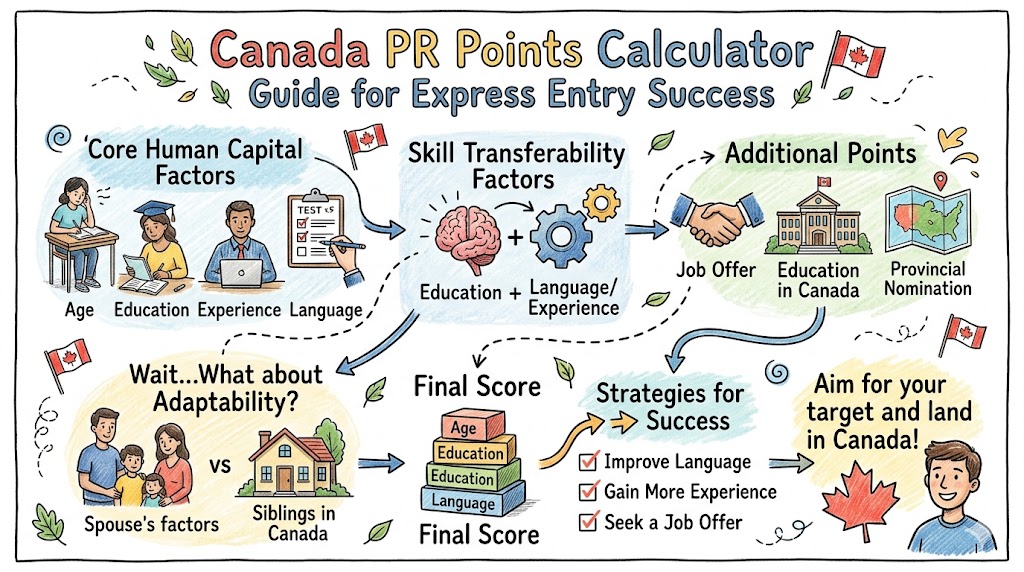
Your CRS score is built upon several pillars. Understanding the weight of each factor is the key to strategic planning.
Table 1: Core CRS Score Breakdown (Single Applicant)
| Factor Category | Maximum Points | Impact |
| Age | 110 | Peaks between ages 20–29; decreases after 30. |
| Education | 150 | Higher credentials like Master’s/PhD yield maximum points. |
| Language | 160 | Proficiency in English/French is the highest weighted factor. |
| Canadian Experience | 80 | Vital for those who have worked inside Canada. |
| Skills Transferability | 100 | Combined bonuses for education + language/experience. |
Canada Express Entry System: The 2026 Landscape
In 2026, the Express Entry system has shifted heavily toward targeted category-based draws. It is no longer just about having the highest “general” score. IRCC now frequently issues invitations to specific groups, such as healthcare workers, French speakers, and STEM professionals.
Primary Pathways:
- Federal Skilled Worker Program (FSWP): The standard route for skilled professionals with foreign experience.
- Canadian Experience Class (CEC): The primary pathway for those already working within Canada.
- Provincial Nominee Program (PNP): The most powerful tool for those needing an immediate 600-point boost.
Step-by-Step Example Calculation
Let’s calculate the score for a hypothetical candidate: A 29-year-old Software Engineer.
- Age (29): 110 points.
- Education (Master’s): 135 points.
- Language (CLB 9): 124 points.
- Work Experience (3 years): 140 points.
- Total Estimated CRS: 509 points.
At 509, this candidate is highly competitive for both general draws and category-based selection.
Strategic Ways to Improve Your CRS Score
If your score is below the 500-point threshold, these strategies are your best path forward:
- Language Proficiency: Moving from CLB 8 to CLB 9 can add over 50 points to your score. Invest in professional coaching.
- Learn French: Achieving an NCLC 7 in French can grant you a 50-point bonus, making you eligible for dedicated French-language draws.
- Provincial Nomination (The Game Changer): Receiving a nomination from a province (like Ontario, Alberta, or BC) adds 600 points to your total. This effectively guarantees an ITA.
- Canadian Education: Completing a 1-year or 2-year post-secondary program in Canada provides crucial extra points and improves your adaptability score.
Table 2: High-Impact Strategies for Score Improvement
| Strategy | Estimated Point Gain | Effort Level |
| Provincial Nomination | +600 | High |
| Improve Language (CLB 7 to 9) | +50 to +70 | Medium |
| French Language (NCLC 7) | +50 | High |
| Sibling in Canada | +15 | Low |
| 1 Year Additional Work Experience | +13 to +25 | High |
Provincial Nominee Programs (PNPs)
PNPs are “enhanced” streams that work with Express Entry. If a province needs your specific skills—such as a developer in BC or a nurse in Ontario—they may issue a “Notification of Interest.” Once you accept, your profile is essentially fast-tracked, bypassing the federal cut-off.
Common Mistakes to Avoid
- Incorrect NOC Selection: Your job duties must match the National Occupational Classification codes. Misalignment can lead to application rejection.
- Expired Credentials: Always ensure your ECA (Educational Credential Assessment) and IELTS/CELPIP results are valid at the time of submission.
- Ignoring the “Spouse” Factor: If you are married, your spouse’s credentials can add up to 20 points. Calculate your score both as a single and married applicant to see which is more beneficial.
Real-Life Case Studies
Case 1: The IT Professional
A developer with a CRS of 440. By retaking the IELTS and achieving CLB 10, their score jumped to 495, successfully landing them an invitation in a STEM-based draw.
Case 2: The Married Couple
A couple initially scored 430. By including the spouse’s Master’s degree and English proficiency, they gained 20 points, pushing them to 450, enough to be picked up by a provincial stream.
Case 3: The Healthcare Worker
A nurse in the Express Entry pool with a score of 410. They applied for an Ontario PNP stream tailored for healthcare and received a 600-point boost, resulting in an ITA within 30 days.
FAQs (Frequently Asked Questions)
- What is a good CRS score? Anything above 480 is generally considered safe.
- How many points for Canada PR? There is no fixed “pass” mark; it depends on the cut-off for each draw.
- Is IELTS mandatory? Yes, it is the standard way to prove language proficiency.
- Can I apply without a job offer? Yes, the FSWP does not require a job offer.
- Does age affect the score? Yes; points drop significantly after age 30.
- Are spouses included? Yes, they can add points to your profile.
- What is the easiest province? It varies based on your specific occupation.
- How long is the process? Usually 6–12 months.
- Can I change my NOC code? Only if your actual duties change.
- What is a “category-based” draw? Targeted draws for specific sectors.
- Do I need a lawyer? Not required, but helpful for complex cases.
- What if my score is low? Focus on language tests or provincial nominations.
Conclusion: Take Action Today
Your journey toward Canadian permanent residency is a marathon, not a sprint. Success in the Express Entry system favors those who plan proactively. By utilizing the Canada PR points calculator, you have already taken the first step toward understanding your standing.
Do not let a low initial score discourage you. With targeted improvements—like refining your language skills, exploring provincial streams, or gaining relevant experience—you can significantly shift your odds. The Canadian government is actively looking for skilled workers who are prepared and motivated. Stay informed on the latest draws, keep your documentation impeccable, and remain consistent in your efforts. Your future in Canada is a strategic endeavor; start building your advantage today.