Introduction
There is a distinct fragrance that has the power to pull you backward through time before you even step into the kitchen. For many, it is the sharp, earthy aroma of toasted cumin seeds hitting hot mustard oil, the slow, sweet scent of caramelized onions simmering for a Sunday stew, or the unmistakable warmth of cinnamon and roasted apples baking on a rainy afternoon. Without warning, a single scent can transport you back to a worn wooden stool beside a grandmother’s knee, a crowded holiday table, or a quiet weekday evening when the world felt simple and safe. Some of the most meaningful family recipes are never found in formal cookbooks, shiny culinary magazines, or polished restaurant menus. Instead, they live in quieter spaces. They reside in someone’s memory, scrawled across stained notebook pages, or captured on scraps of paper tucked inside kitchen drawers. These culinary treasures are passed down through informal conversations, tactile demonstrations, and shared meals.
Family Recipes Are More Than Cooking Instructions
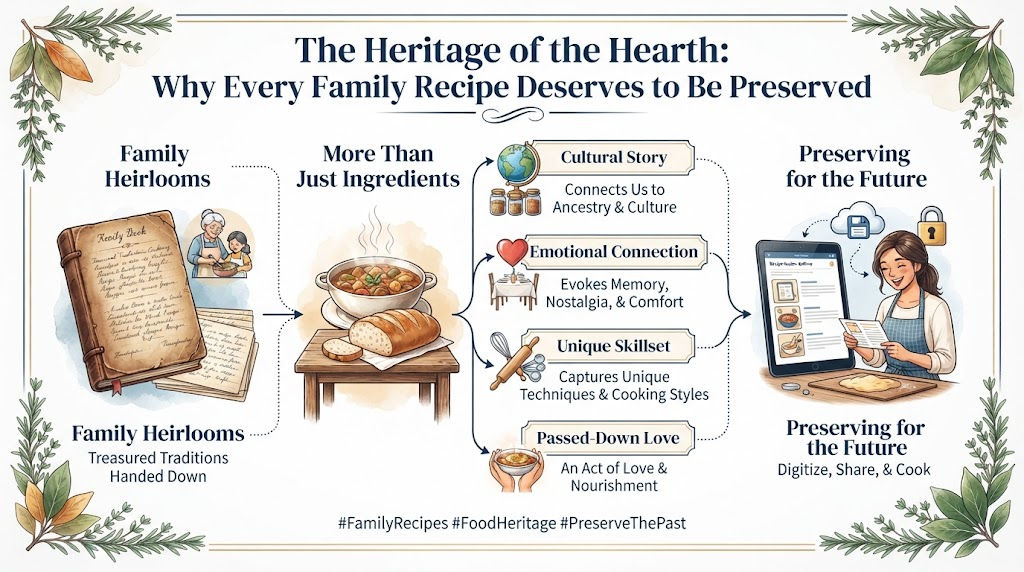
At first glance, a recipe appears entirely functional. It is a set of directions—a sequence of actions designed to turn raw ingredients into an edible meal. But a family recipe is rarely just about food. It is a silent repository of memories, human connections, geography, and personal experience. When your grandmother prepares her signature curry, or your father makes his special holiday bread, they are not merely following technical steps. They are channeling years of trial, error, adaptation, and love. A simple dish carries the imprint of the hands that shaped it. It reflects the local markets they shopped in, the kitchen tools they relied on, and the specific occasions that brought the household together. For future generations, preparing these traditional family recipes acts as a bridge across time. Even the most modest dish—a humble lentil soup, a festival sweet, a homemade pickle, or a Sunday roast—tells a story about the people who cooked it. It reveals their resourcefulness, their cultural background, and the flavors that brought them comfort during both joyful celebrations and difficult seasons.
Recipes Carry Family Memories Across Generations
Human memory is remarkably sensory-driven. While photographs can capture a visual likeness and written journals can record dates and milestones, food engages nearly every human sense simultaneously. Taste, smell, touch, and sound combine to create memories that linger long after a meal is finished. When you recreate a dish that your parents or grandparents used to make, the physical act of cooking triggers a cascade of recollections. The rhythmic sound of a knife chopping on a wooden board, the hiss of spices hitting hot fat, or the familiar texture of dough kneaded by hand can bring a rush of childhood emotions. Recording a recipe is an act of preservation that extends far beyond the kitchen. It ensures that these emotional anchors remain accessible even after the original cook is no longer able to prepare the meal. Intergenerational storytelling happens naturally around the dinner table, and documenting the instructions behind the food gives those stories a permanent home.
Why Grandmother Recipes Are Especially Valuable
Grandmother recipes hold a unique place in culinary culture because they often defy standard culinary formatting. If you look closely at an old handwritten card or listen to an elder explain how to make a classic dish, you will rarely find exact measurements like grams, milliliters, or precise cooking times. Instead, traditional wisdom relies on qualitative cues. Recipes feature measurements such as “a handful of fresh herbs,” “a pinch of salt,” “enough flour until the dough feels right,” or “cook until it smells ready.” Experienced home cooks depend on sensory feedback—watching the color of a sauce deepen, listening for the gentle crackle of seeds, or feeling the elasticity of a resting dough. These informal instructions are not missing details; they are an essential part of the recipe’s heritage. They teach us to cultivate an intuitive relationship with food, relying on observation, patience, and sensory awareness rather than rigid mechanical automation.
The Knowledge Hidden Inside a Family Recipe
A family recipe often serves as an unexpected archive of local history and environmental adaptation. When families settle in a particular region, their cooking practices naturally evolve to make the best possible use of local ingredients, seasonal changes, and available kitchen tools. Examining older recipes reveals fascinating details about how previous generations approached food preservation, resourcefulness, and daily nutrition. A recipe might show how families stretched expensive ingredients during lean seasons, utilized every part of a vegetable, or preserved summer harvests through pickling, drying, and fermentation to survive harsh winters. Furthermore, when families migrate, their recipes travel with them. Ingredients that are no longer available in a new country are substituted with local equivalents, creating entirely new culinary expressions that document the immigrant experience through flavor, adaptation, and resilience.
Family Recipes Can Preserve Cultural Identity
Food is one of the most expressive mediums of cultural identity. Long before children learn the formal history or geography of their ancestors, they often experience their cultural roots through the flavors, aromas, and ritual meals prepared in the family kitchen. Participating in the preparation of festival foods, holiday feasts, and everyday family meals fosters a deep sense of belonging. It connects younger generations to community traditions, regional heritage, and shared ancestral histories. At the same time, cultural traditions are rarely static. They breathe, grow, and adapt. Recognizing that food traditions evolve over time prevents us from locking cultures into rigid stereotypes. A recipe can change across generations while still maintaining an unbreakable emotional and cultural thread to the past.
What Happens When Family Recipes Are Never Written Down
Relying entirely on oral tradition and mental memory carries significant risks. When older family members pass away or experience memory loss without having shared their culinary knowledge, entire lifetimes of accumulated wisdom can vanish overnight. The subtle techniques—the precise wrist movement used to roll flatbread, the exact moment to pull a pastry from the oven, or the secret blend of toasted spices—are notoriously difficult to reconstruct from scratch. Without documentation, ingredient names shift, preparation steps blur, and beloved family dishes fade into distant memories. While written documentation is not the only valid way to honor a tradition, it acts as a crucial safety net. Recording recipes and their surrounding stories ensures that future generations can choose to revive those flavors whenever they wish.
Why the Story Behind a Recipe Matters
A list of ingredients and a set of instructions provides a functional guide, but adding the narrative context transforms a simple cooking guide into a treasured family heirloom. Documenting the story behind a dish adds depth, meaning, and emotional resonance.
Consider recording details such as:
- Who originally taught the recipe and where they learned it.
- The specific occasions, weddings, holidays, harvests, or ordinary Sunday dinners where the dish was served.
- Why the recipe holds special significance for the family.
- Any humorous kitchen disasters or improvisations that occurred along the way.
Everyday food stories are just as valuable as elaborate celebration dishes. Preserving these narratives turns a standard meal into a rich cultural record of family life.
Family Recipes Can Record Migration and Family History
Recipes act as silent cartographers of human movement. Throughout history, families have moved across towns, states, and oceans in search of better lives. Whenever they relocated, they carried their foodways with them in their memories and luggage. By tracking how a family recipe changed over two or three generations—such as swapping a native grain for an imported flour or adapting a spice blend to suit local grocery stores—you uncover a vivid timeline of migration. These culinary shifts provide tangible clues about where a family lived, how they integrated into new communities, and how they preserved their identity in unfamiliar surroundings.
Traditional Cooking Methods Deserve to Be Preserved Too
Preserving a family recipe requires more than listing ingredients; it also involves documenting the specific preparation techniques that give the dish its character. Methods such as stone grinding, slow simmering over wood fires, clay-pot roasting, natural fermentation, and hand-churning butter heavily influence texture, aroma, and flavor. Documenting these traditional methods keeps valuable mechanical skills alive. While modern kitchen appliances offer convenience, understanding traditional techniques connects us to the physical labor and craftsmanship of earlier generations.
Family Recipes Compared With Standard Recipe Collections
To understand the unique value of heritage dishes, it helps to compare them directly with commercial cookbooks and online recipe databases.
| Comparison Aspect | Family Recipe | Standard Recipe Collection |
| Personal history | Often connected to specific family memories | Usually focused on the dish itself |
| Cooking knowledge | May include informal family techniques | Usually provides structured instructions |
| Cultural context | Can reflect family and regional traditions | Context varies by source |
| Sensory guidance | May rely on sight, smell, touch, and experience | Often relies more on measurements and timing |
| Emotional value | Can be closely linked to people and memories | Usually focused on practical cooking |
| Adaptation | Often changes naturally across generations | Usually presented as a defined recipe |
Both family recipes and standard cookbooks serve important purposes. While commercial recipes offer reliable measurements for everyday baking and cooking, family recipes provide emotional depth, personal history, and a distinct sense of identity that no standard cookbook can replicate.
How to Preserve a Family Recipe Properly
Documenting a family recipe does not require professional publishing equipment. A thoughtful, systematic approach ensures that nothing important gets lost.
- Gather the basics: Write down the recipe name, ingredient list, and rough proportions.
- Capture sensory cues: Note down visual indicators, aroma milestones, and tactile sensations (e.g., “knead until the dough springs back softly”).
- Record the narrative: Ask older relatives about the origins of the dish and write down their personal stories.
- Use multimedia: Take photographs of each preparation stage or record a short video demonstration with the cook’s permission.
- Organize securely: Store your notes in a dedicated family recipe journal or a secure digital folder.
How to Preserve Recipes That Have No Exact Measurements
Traditional recipes often intimidate modern cooks because of vague quantities. When faced with instructions like “add flour until the batter feels silky,” the best approach is translation without erasure. Record the traditional phrasing exactly as it was spoken, and place your best approximation of modern measurements right beside it (e.g., “Add flour until smooth — approximately 2 cups”). This preserves the poetic authenticity of the original instruction while making the dish approachable for younger or less experienced cooks.
How Younger Generations Can Keep Family Food Traditions Alive
Preservation is most effective when it is active and collaborative. Younger family members play a vital role in keeping food traditions alive by stepping into the kitchen with their elders. Take the initiative to cook alongside your parents and grandparents. Ask questions about where they sourced ingredients, take clear photos of handwritten index cards, and record video interviews while preparing meals together. Embracing food heritage does not mean rejecting modern conveniences; it means blending contemporary cooking styles with ancestral wisdom.
Digital Archives Make Family Recipes Easier to Preserve
Modern digital tools make it easier than ever to protect family culinary history from loss, water damage, or misplaced paper notebooks. Cloud storage, dedicated family group chats, and digital archiving platforms allow relatives living in different cities or countries to access, contribute to, and enjoy shared recipe collections. Digital archives provide reliable backups and simple organization, ensuring that family culinary histories remain secure and searchable for generations to come.
How Blendz Helps Preserve Family Food Heritage
Platforms like Blendz operate as global food heritage archives dedicated to safeguarding traditional recipes, rare ingredients, grandmother cooking knowledge, festival foods, and forgotten food stories. By inviting home cooks and families to share their culinary histories, Blendz helps prevent oral food traditions from fading into obscurity. Centralizing these records allows food lovers around the world to discover diverse cooking traditions, connect over shared culinary roots, and appreciate the immense cultural value hidden inside everyday home cooking.
Every Recipe Does Not Need to Be Famous to Matter
It is easy to assume that food heritage only belongs to royal banquets, complex restaurant creations, or famous regional specialties. In truth, some of the most profound cultural history lives in ordinary, everyday meals. A simple pot of weeknight beans, a rustic loaf of soda bread, a family pickle recipe, or a basic vegetable stew carries just as much emotional weight as an elaborate holiday feast. These everyday dishes document the real, unvarnished lives of ordinary people who nourished their families with creativity, care, and resourcefulness.
A Simple Family Recipe Preservation Checklist
Use this quick checklist to guide your family recipe documentation project:
- The recipe name and common variations.
- Who taught the recipe and their relationship to you.
- Where the recipe originated or was most frequently cooked.
- When it is usually prepared (festivals, holidays, or ordinary days).
- Ingredients and approximate quantities.
- Traditional preparation method and steps.
- Cooking time, temperature, and heat levels.
- Visual, auditory, and olfactory sensory cues.
- Special cookware, utensils, or tools required.
- Family memories, anecdotes, or stories connected to the dish.
- Clear photographs or video recordings.
- Adaptations and changes made across generations.
- Permission and consent from the original cook for sharing.
Frequently Asked Questions
Why are family recipes important?
Family recipes are important because they do more than provide cooking instructions—they carry personal memories, cultural identity, traditional knowledge, and stories that connect multiple generations.
Why should old family recipes be preserved?
Old family recipes should be preserved before oral traditions and handwritten notes fade, ensuring that unique family flavors and histories are not lost over time.
How can I preserve my grandmother’s recipes?
You can preserve your grandmother’s recipes by cooking alongside her, asking detailed questions about her methods, recording ingredient proportions, taking photographs, and writing down her stories.
What should I record when documenting a family recipe?
Document the ingredient list, preparation steps, sensory cues, cooking tools, historical origins, and the personal family memories associated with the dish.
How can I preserve a recipe without exact measurements?
Record traditional phrases like “a handful” or “until golden” alongside your best estimate of modern measurements to maintain authenticity while keeping the recipe practical.
Why should the story behind a recipe be saved?
Saving the story behind a recipe adds emotional depth, turning a simple list of cooking steps into a meaningful family heirloom and cultural record.
Can family recipes help preserve cultural heritage?
Yes, family recipes connect families to their ancestral roots, traditional ingredients, and regional cooking customs, helping keep cultural heritage vibrant and alive.
How can younger generations help preserve food traditions?
Younger generations can help by interviewing older relatives, photographing old recipe cards, learning to cook traditional dishes, and storing recipes in digital or physical archives.
Can digital archives help preserve family recipes?
Digital archives offer secure cloud storage, easy organization, and simple sharing options, making it easier for dispersed family members to protect and access family recipes.
How does Blendz help preserve food heritage?
Blendz serves as a global food heritage archive, inviting people to submit family recipes, grandmother cooking knowledge, and food stories to protect culinary traditions from disappearing. Every family recipe holds something irreplaceable: a memory, a person, a place, a tradition, a cooking method, or a piece of personal history. Preserving these culinary treasures does not require professional writing or rigid measurements. Start with one meaningful family dish today, talk to the people who cook it, and document both the recipe and the story behind it to ensure your family’s culinary heritage lives on.
