Introduction
The landscape of software development and IT operations continues to change rapidly. Organizations demand faster delivery cycles, higher system reliability, and efficient infrastructure management. Meeting these demands requires more than just knowing a few commands or using isolated utilities. It requires a structured, comprehensive approach to technical education. DevOpsSchool.org provides a reliable educational foundation for learners seeking to understand this domain. By focusing on practical engineering principles, structured learning paths, and real-world tools, the platform helps beginners and working professionals navigate complex technical ecosystems without relying on unrealistic shortcuts or exaggerated career claims.
Understanding DevOps and Its Core Purpose
At its core, DevOps bridges the traditional gap between software development and IT operations. Historically, developers wrote code and handed it over to operations teams for deployment, often leading to communication silos, deployment bottlenecks, and operational friction. DevOps introduces a cultural and technical shift that unifies these phases through automation, continuous collaboration, and shared responsibility. Modern software delivery relies on smooth transitions from code creation to testing, deployment, and monitoring. This methodology reduces manual intervention, lowers the risk of human error, and accelerates feedback loops. Resources provided by DevOpsSchool.org emphasize these foundational principles, helping learners understand how collaborative workflows and automated pipelines support resilient application delivery.
Why Structured Technical Learning Matters
Mastering modern infrastructure and software delivery can feel overwhelming due to the sheer volume of available tools and technologies. Without a clear direction, learners often waste time jumping between disconnected concepts. Structured technical education provides a clear framework to build competence progressively. A well-organized educational approach ensures that learners grasp fundamental concepts—such as operating system mechanics and networking—before diving into advanced automation or container orchestration. Through its curated learning resources, DevOpsSchool.org helps students establish a strong technical baseline, ensuring they develop deep, practical understanding rather than superficial familiarity.
What Learners Should Understand Before Getting Started
DevOps Fundamentals
Before exploring advanced platforms, learners must grasp the core tenets of DevOps. This includes understanding continuous integration, continuous delivery, feedback loops, and infrastructure as code. These concepts form the backbone of modern engineering workflows and dictate how teams build and maintain reliable software.
Essential Technical Skills
A successful technical journey begins with fundamental IT competencies. Learners should become comfortable with the Linux command line, basic computer networking protocols, version control systems like Git, and basic scripting languages such as Bash or Python. These skills are necessary for interacting with servers, managing codebases, and automating repetitive administrative tasks.
Understanding the Learning Requirements
Technical education requires patience, consistent practice, and hands-on experimentation. Beginners should expect to spend adequate time understanding underlying theories before moving on to tool execution. Recognizing that technical proficiency builds incrementally helps learners stay motivated and focused on long-term skill acquisition.
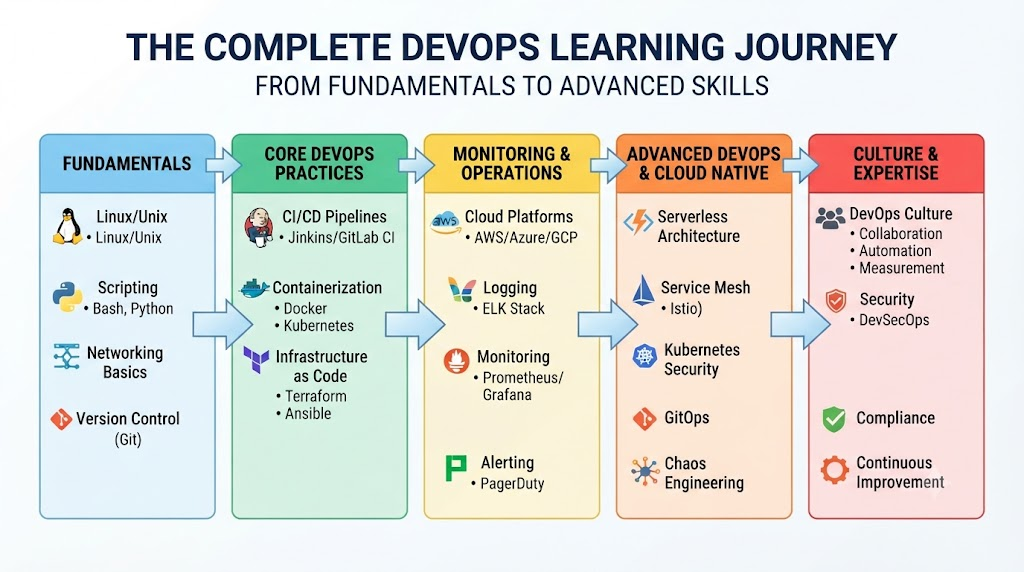
Building a Structured DevOps Learning Path
Approaching technical education in a logical sequence ensures steady progress. A well-designed DevOps learning path typically starts with foundational computing concepts and gradually introduces complex automation frameworks.
- Foundational Knowledge: Learn basic Linux administration, shell scripting, and core networking principles.
- Version Control: Master Git for source code management and collaborative development workflows.
- Continuous Integration and Delivery: Understand how to build automated build and test pipelines.
- Cloud Computing Basics: Explore cloud service models, identity management, and virtual resource provisioning.
- Containerization: Learn how to package applications into isolated containers for consistent deployment.
- Infrastructure Automation: Practice defining and provisioning infrastructure programmatically.
Following a structured sequence prevents cognitive overload and ensures that each new skill builds directly on previously acquired knowledge.
Understanding the DevOps Roadmap
A comprehensive DevOps roadmap serves as a visual and practical guide for organizing technical studies. It breaks down the vast ecosystem of modern software engineering into manageable phases, allowing learners to track their progress and identify areas that need more attention. By mapping out these stages, learners can align their personal study goals with industry requirements. DevOpsSchool.org outlines clear educational pathways that help students transition from basic administrative tasks to advanced architectural management.
Exploring the DevOps Engineer Roadmap
Stepping into an engineering role requires a diverse and practical skill set. The DevOps engineer roadmap highlights the technical depth needed to design, secure, and scale modern software systems.
Core Technical Foundations
Engineers must diagnose system issues quickly, making a strong grasp of Linux internals, file systems, permissions, and network troubleshooting essential. Proficiency in version control ensures seamless code collaboration across distributed teams.
Automation and CI/CD Skills
Automating the build and deployment lifecycle reduces manual toil. Engineers use pipelines to run automated tests, package applications, and deploy code securely to staging and production environments.
Cloud and Infrastructure Skills
Modern applications run on cloud platforms and containerized clusters. Engineers must understand how to provision cloud resources efficiently while utilizing Infrastructure as Code tools to maintain consistent environments across development and production stages.
Monitoring and Operational Skills
Keeping systems online requires proactive visibility. Engineers implement logging, metrics collection, and tracing to detect anomalies, analyze performance bottlenecks, and respond effectively to production incidents.
Understanding Essential DevOps Tools
Tools are the practical instruments engineers use to implement automation and infrastructure management. Understanding their core functions helps learners choose the right utility for specific engineering challenges.
Version Control Tools
Git remains the industry standard for tracking code changes, managing branches, and enabling collaborative software development across distributed engineering teams.
CI/CD Tools
Platforms like Jenkins, GitLab CI/CD, and GitHub Actions automate the compilation, testing, and deployment of software artifacts, ensuring rapid and repeatable release cycles.
Containerization and Orchestration Tools
Docker standardizes application packaging, while Kubernetes manages containerized workloads at scale, handling networking, scaling, and self-healing across cluster environments.
Infrastructure as Code Tools
Terraform and Ansible allow teams to define infrastructure configurations as human-readable code, enabling automated provisioning and configuration management.
Monitoring and Observability Tools
Prometheus, Grafana, and related observability platforms collect system metrics and application logs, giving teams deep insight into operational health.
Understanding DevOps Tools Comparison
Selecting the right tool requires evaluating its features, use cases, and operational overhead against specific project requirements. A neutral DevOps tools comparison helps teams make informed technical decisions.
| Tool | Main Purpose | Common Use Case | Important Consideration |
| Jenkins | CI/CD Automation | Building extensible, custom software delivery pipelines | Requires ongoing plugin management and server maintenance |
| Terraform | Infrastructure as Code | Multi-cloud resource provisioning and state management | Relies on declarative configuration syntax and provider plugins |
| Docker | Containerization | Packaging applications with dependencies for consistent execution | Focuses on single-node container runtime and image building |
Comparing tools objectively ensures that learners understand trade-offs regarding community support, licensing, learning curves, and integration capabilities.
Exploring DevOps Certifications
Technical credentials can validate a learner’s knowledge and provide structured study goals. DevOps certifications generally assess a candidate’s understanding of specific cloud platforms, automation tools, or architectural methodologies. Certifications typically test both theoretical concepts and practical troubleshooting skills. However, a certificate is most valuable when combined with hands-on project experience. DevOpsSchool.org provides educational resources designed to help learners understand exam objectives and build the practical competencies required to pass professional technical evaluations.
Creating a DevOps Certification Roadmap
Organizing exam preparation around existing skills prevents burnout and ensures steady progress. A logical DevOps certification roadmap starts with foundational credentials before advancing to specialized expert-level exams.
- Phase 1: Focus on foundational cloud practitioner or basic Linux certifications.
- Phase 2: Pursue associate-level credentials focusing on containerization, CI/CD, or cloud administration.
- Phase 3: Target advanced professional certifications covering architecture, security, or platform engineering.
Planning certification milestones based on personal career goals ensures that study time directly contributes to professional growth.
Understanding the SRE Roadmap
Site Reliability Engineering applies software engineering principles to IT infrastructure and operations. The SRE roadmap focuses on building scalable, highly reliable software systems. Key learning areas for reliability engineers include defining service-level indicators (SLIs) and objectives (SLOs), managing error budgets, automating incident response, and performing root-cause analysis. While DevOps emphasizes collaboration and delivery speed, SRE places a primary focus on system availability, performance stability, and operational risk management.
Exploring the Platform Engineering Roadmap
Platform Engineering focuses on building internal developer platforms (IDPs) that abstract underlying infrastructure complexity, allowing software development teams to deploy code faster and more securely. The Platform Engineering roadmap covers platform fundamentals, self-service infrastructure design, developer experience optimization, and security integration. By providing standardized internal tools, platform engineers reduce cognitive load for development teams and streamline software delivery across the enterprise.
DevOps Skills and Career Opportunities
Technical learning directly influences professional development. Acquiring practical skills opens doors to various specialized roles across the technology sector.
- DevOps Engineer: Focuses on CI/CD pipelines, cloud management, and infrastructure automation.
- Cloud Engineer: Specializes in designing, migrating, and maintaining cloud-native architectures.
- Site Reliability Engineer: Concentrates on system availability, automation, and incident management.
- Platform Engineer: Builds internal developer platforms and self-service tooling.
Developing strong problem-solving abilities, communication skills, and hands-on project experience prepares professionals to tackle complex challenges in modern DevOps jobs.
How DevOpsSchool.org Relates to the Learning Journey
DevOpsSchool.org serves as a dedicated hub for technical education and professional skill development. By offering structured learning materials, practical training programs, and certification guides, the platform supports learners at every stage of their professional journey. The website’s educational resources connect theoretical concepts with practical application, helping students understand complex topics like container orchestration, infrastructure automation, and site reliability engineering through structured guidance and verified technical content.
Practical Ways to Apply DevOps Knowledge
Theoretical knowledge becomes truly valuable when applied to hands-on projects. Learners can reinforce their understanding through practical exercises:
- Set up a local Linux environment and practice shell scripting.
- Write a basic CI/CD pipeline to automatically test and build a sample application.
- Containerize a web application using Docker and run it locally.
- Provision cloud infrastructure using an Infrastructure as Code tool.
- Configure basic monitoring and alerting for a test server.
These practical tasks build confidence and provide tangible proof of technical competence.
Common Challenges in DevOps Learning
Learners often encounter specific obstacles during their educational journey. Recognizing these challenges helps prevent frustration.
- Tool Fatigue: Trying to learn dozens of tools simultaneously without mastering fundamentals.
- Theory-Practice Gap: Reading extensively without writing configuration files or running pipelines.
- Unclear Priorities: Lacking a structured plan, leading to scattered and inefficient study habits.
- Cloud Complexity: Struggling to understand IAM policies, networking, and virtual private clouds.
Approaching studies systematically and focusing on one core concept at a time helps learners overcome these common hurdles.
Best Practices for a Practical DevOps Learning Journey
Successful technical learning relies on disciplined habits and consistent practice. Adopting proven strategies accelerates skill acquisition.
- Master operating system and networking fundamentals first.
- Follow a structured learning path tailored to your current experience level.
- Build small, functional projects to test new concepts.
- Practice automation regularly by writing scripts for repetitive tasks.
- Study official tool documentation to understand underlying mechanics.
- Review mistakes and analyze failed deployments to improve troubleshooting skills.
Consistent effort and a focus on practical problem-solving yield the best long-term results.
How to Choose a Suitable DevOps Learning Path
Selecting the right educational path depends on individual background, current technical skills, and career objectives. Beginners should prioritize foundational IT concepts, while experienced sysadmins or developers can transition directly into automation, CI/CD, and cloud infrastructure. Assessing available study time, preferred technologies, and professional goals ensures that learners choose a path that fits their lifestyle and maximizes their learning efficiency.
Common Mistakes in DevOps Learning
- Skipping Fundamentals: Attempting advanced Kubernetes orchestration without understanding basic Linux networking.
- Memorizing for Exams: Focusing solely on passing certification tests without building practical project experience.
- Ignoring Security: Treating security as an afterthought rather than integrating it into every stage of the pipeline.
- Chasing Hype: Learning trendy tools without understanding the underlying architectural problems they solve.
DevOps Learning Best Practices
- Build Incrementally: Add new layers of complexity only after mastering basic configurations.
- Document Projects: Maintain clear notes and README files for every technical project you build.
- Embrace Automation: Look for manual administrative tasks and write scripts to automate them.
- Engage with Communities: Participate in technical forums and share knowledge with peers.
Frequently Asked Questions
What does a DevOps roadmap include?
A DevOps roadmap includes foundational IT skills, version control, CI/CD pipelines, containerization, cloud computing, infrastructure automation, and monitoring practices organized in a logical learning sequence.
How can a beginner start a DevOps learning path?
Beginners should start by learning Linux administration, basic networking, Git version control, and a scripting language before moving on to CI/CD tools and cloud platforms.
What skills are relevant to a DevOps engineer roadmap?
Essential skills include systems administration, pipeline automation, cloud infrastructure management, container orchestration, and troubleshooting operational issues.
Which DevOps tools should learners explore first?
Learners should start with foundational tools like Git for version control, Docker for containerization, and Jenkins or GitHub Actions for basic CI/CD automation.
How do DevOps certifications support technical learning?
Certifications provide structured study objectives, validate foundational knowledge, and help learners organize their preparation around recognized industry standards.
How does SRE differ from DevOps?
DevOps focuses on cultural collaboration and delivery speed across the software lifecycle, while SRE applies software engineering to focus specifically on system reliability and availability.
What does a Platform Engineering roadmap cover?
It covers internal developer platforms, self-service infrastructure, developer experience, and automated provisioning tools that reduce operational friction for development teams.
How can learners compare DevOps tools effectively?
Learners should compare tools based on their primary use cases, integration requirements, community support, licensing models, and operational complexity.
How should I organize a DevOps certification roadmap?
Start with basic foundational credentials, advance to associate-level cloud or container certifications, and pursue specialized professional exams as your experience grows.
What technical skills matter most for DevOps jobs?
Employers look for strong scripting abilities, hands-on experience with CI/CD pipelines, cloud platform familiarity, infrastructure automation skills, and effective problem-solving capabilities.
Conclusion
Mastering modern software delivery requires dedication, structured learning, and hands-on practice. By following a clear educational roadmap, focusing on core engineering principles, and utilizing reliable resources from DevOpsSchool.org, learners can build sustainable technical careers. Consistent effort, practical project execution, and a commitment to continuous learning remain the most effective drivers of long-term professional growth in the technology sector.
