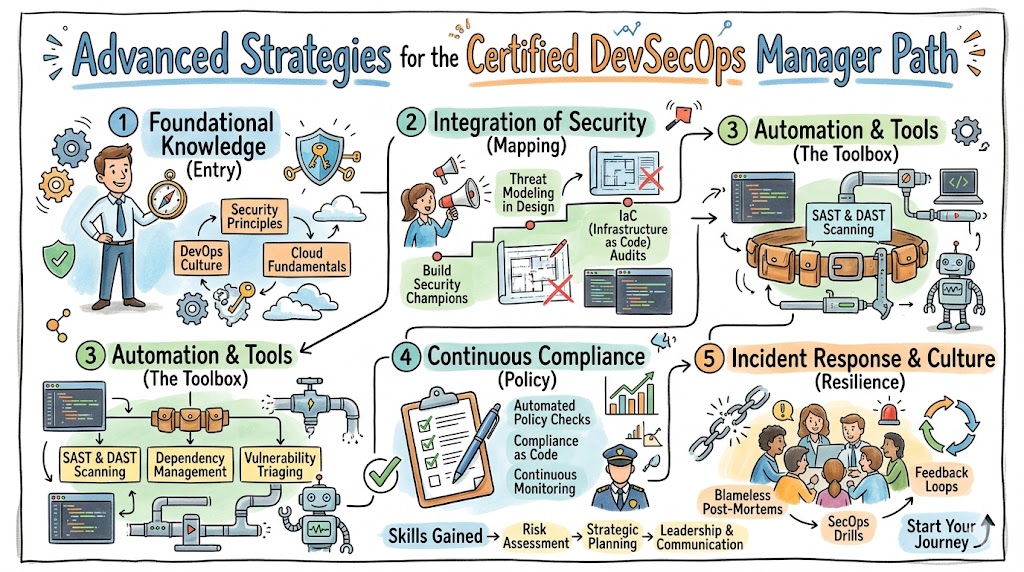
Introduction
In an era where security threats evolve as quickly as deployment cycles, the ability to manage security within a DevOps culture is no longer optional. The Certified DevSecOps Manager certification serves as a comprehensive framework for professionals aiming to lead security integration initiatives within enterprise engineering teams. This guide is tailored for those ready to move beyond basic tooling and master the strategic, process-oriented, and technical aspects of secure software delivery. Whether you are an SRE, a security practitioner, or an engineering leader, understanding this certification will help you align your skill set with industry demands, ensuring you remain competitive in an increasingly automated and security-conscious global market.
What is the Certified DevSecOps Manager?
The Certified DevSecOps Manager represents a high-level validation of an individual’s ability to orchestrate secure software development life cycles in high-velocity environments. It exists to formalize the expertise required to move security from a peripheral function to a core, automated component of the engineering workflow. Rather than focusing on theoretical concepts, it emphasizes production-grade implementation, risk management, and the cultural transformation necessary to sustain security practices. It aligns directly with modern enterprise needs, where manual security gates are replaced by policy-as-code and automated governance, ensuring that security scales effectively alongside the infrastructure and applications it protects.
Who Should Pursue Certified DevSecOps Manager?
This certification is designed for a broad spectrum of technical professionals who are responsible for the integrity and delivery of software products. DevOps Engineers, Site Reliability Engineers, and Cloud Architects who need to operationalize security automation will find this program essential for advancing their technical leadership capabilities. Security engineers and penetration testers aiming to transition into the development side of the pipeline will benefit from the deep integration techniques taught. Additionally, engineering managers and technical leads seeking to instill a culture of security throughout their organizations will gain the practical frameworks needed to guide their teams effectively toward secure delivery practices.
Why Certified DevSecOps Manager
As organizations shift toward highly distributed architectures, the demand for professionals who can simultaneously manage infrastructure speed and security posture will only increase. This certification provides a foundational expertise that transcends specific toolsets, focusing instead on core principles and architectural patterns that remain relevant regardless of technology shifts. It offers a significant return on investment by positioning individuals as leaders capable of reducing operational risk, accelerating delivery cycles, and navigating complex regulatory landscapes. By focusing on sustainable practices rather than temporary trends, professionals ensure their careers remain resilient and impactful in the face of ongoing technological evolution.
Certified DevSecOps Manager Certification Overview
The program is provided by the team at and is hosted on the devopsschool platform. The certification approach is grounded in real-world application, prioritizing hands-on competence over passive learning. Candidates are assessed on their ability to design, implement, and maintain secure CI/CD pipelines, manage vulnerabilities at scale, and foster security-first mindsets within engineering teams. The certification is structured to guide professionals from understanding foundational security concepts to executing advanced orchestration strategies, with assessments that mirror the challenges faced in contemporary production environments.
Certified DevSecOps Manager Certification Tracks & Levels
The certification structure is tiered to support career progression from foundational understanding to professional mastery and advanced strategic management. The foundation level focuses on core concepts, security automation basics, and the essential toolchain, providing the building blocks for secure engineering. The professional level builds on this, emphasizing complex pipeline integration, incident response, and compliance-as-code. The advanced level targets leaders and architects, focusing on organizational transformation, enterprise-wide governance, and the strategic alignment of security with business objectives. These tracks are designed to allow practitioners to progress at a pace that matches their current responsibilities and future career aspirations.
Complete Certified DevSecOps Manager Certification Table
| Track | Level | Who it’s for | Prerequisites | Skills Covered | Recommended Order |
| Core | Foundation | Engineers starting DevSecOps | Basic CLI, Linux, Git | Pipeline Security, Basic Scanners | 1 |
| Professional | Intermediate | Active DevOps/SRE | Foundation Level | Policy-as-Code, Vulnerability Management | 2 |
| Strategy | Advanced | Engineering Managers | Professional Level | Governance, Risk, Strategy | 3 |
Detailed Guide for Each Certified DevSecOps Manager Certification
Certified DevSecOps Manager – Foundation Level
What it is
This certification validates a candidate’s grasp of the fundamental principles required to secure a CI/CD pipeline and the basic tools used in automated security.
Who should take it
Software engineers, junior DevOps practitioners, and entry-level security analysts seeking to understand how to build security into modern delivery pipelines.
Skills you’ll gain
- Understanding shift-left security principles
- Identifying common vulnerabilities in CI/CD pipelines
- Basic configuration of automated security scanning tools
Real-world projects you should be able to do
- Implementing basic static code analysis in a CI/CD pipeline
- Securing secrets management for simple application deployments
- Setting up automated container image scanning
Preparation plan
- 7–14 days: Focus on core theory and understanding the basic DevSecOps vocabulary and methodology.
- 30 days: Practice hands-on configuration of popular open-source security tools in a lab environment.
- 60 days: Review case studies and attempt mock scenarios focused on pipeline integration.
Common mistakes
Focusing too much on specific tool versions rather than understanding the underlying security concepts and pipeline integration logic.
Best next certification after this
- Same-track option: Professional Level Certification
- Cross-track option: Cloud Security Foundation
- Leadership option: Project Management Basics
Choose Your Learning Path
DevOps Path
This path focuses on the automation of infrastructure and application delivery, ensuring that speed is not compromised by security requirements. It emphasizes the integration of security tools into existing CI/CD frameworks, enabling rapid yet secure releases.
DevSecOps Path
The dedicated path for professionals wanting to specialize in the intersection of security and engineering. It covers advanced vulnerability management, automated compliance, and the development of secure-by-design architectures in cloud environments.
SRE Path
This path bridges the gap between site reliability and security, ensuring that production systems are not only available and scalable but also resilient to threats. It focuses on observability, incident response, and automated remediation.
AIOps / MLOps Path
This path explores the integration of security in the machine learning life cycle, protecting data, models, and infrastructure. It addresses unique challenges like data poisoning, model theft, and automated monitoring of AI deployments.
DataOps Path
Focused on securing the data pipeline, from ingestion to analytics, ensuring compliance and privacy. It covers access control, data encryption, and automated governance for large-scale data platforms.
FinOps Path
This path integrates financial management with security, ensuring that security investments are cost-effective and optimized. It balances risk reduction with the budgetary constraints of modern cloud infrastructure.
Role → Recommended Certified DevSecOps Manager Certifications
| Role | Recommended Certifications |
| DevOps Engineer | Foundation, Professional |
| SRE | Foundation, Professional |
| Platform Engineer | Professional, Advanced |
| Cloud Engineer | Foundation, Professional |
| Security Engineer | Professional, Advanced |
| Data Engineer | Foundation |
| FinOps Practitioner | Foundation, Professional |
| Engineering Manager | Advanced |
Next Certifications to Take After Certified DevSecOps Manager
Same Track Progression
After achieving the manager-level certification, deepening your expertise in specific security domains such as Kubernetes security, cloud-native security, or identity and access management is the logical next step.
Cross-Track Expansion
Expand your skill set by pursuing certifications in adjacent fields like cloud architecture, platform engineering, or specialized security certifications that cover regulatory compliance and forensic analysis.
Leadership & Management Track
For those aiming for executive roles, certifications focusing on organizational leadership, enterprise risk management, and strategic technology planning are highly recommended to complement technical expertise.
Training & Certification Support Providers for Certified DevSecOps Manager
DevOpsSchool
As a primary provider, they offer comprehensive curriculum coverage that balances technical depth with practical implementation. Their programs are highly respected for preparing engineers for the realities of modern production environments.
Cotocus
Focuses on delivering high-quality, mentor-led training experiences. They excel in guiding professionals through the complexities of certification preparation, ensuring that learning is tied directly to actionable career outcomes.
Scmgalaxy
Specializes in delivering training that emphasizes the cultural and process-oriented aspects of DevOps. Their approach is ideal for those who need to understand how to implement changes across organizational teams effectively.
BestDevOps
Provides targeted training modules designed to bridge skill gaps for professionals at various stages of their careers. They focus on delivering high-impact knowledge that is immediately applicable to day-to-day engineering tasks.
devsecopsschool
This provider is dedicated specifically to the security aspect of the DevOps workflow. Their resources are essential for those looking for specialized expertise in building secure software delivery mechanisms and advanced threat mitigation.
sreschool
An excellent resource for professionals looking to combine security knowledge with high-reliability engineering practices. Their training is highly recommended for SREs and those working on large-scale distributed systems.
aiopsschool
Focuses on the unique security and reliability challenges inherent in artificial intelligence and machine learning operations. They are a go-to provider for those looking to expand into this emerging and critical technology domain.
dataopsschool
Provides deep insights into the security and management of data pipelines. They are ideal for professionals working in data-heavy environments who need to ensure integrity and compliance across their infrastructure.
finopsschool
Specializes in the financial management of cloud environments. Their training is crucial for those balancing security mandates with the necessity of maintaining cost-effective and efficient cloud operations.
Frequently Asked Questions (General)
- What is the overall difficulty level of this certification?The difficulty is calibrated to be challenging for experienced professionals, requiring a blend of theoretical knowledge and practical, hands-on application to succeed.
- How much time is typically required to prepare?Depending on your existing background, preparation can take anywhere from a few weeks to several months of consistent, hands-on study and practice.
- Are there any mandatory prerequisites?While some foundational knowledge of DevOps and security is expected, specific prerequisites are clearly outlined for each level to ensure success.
- Is this certification recognized globally?Yes, the skills validated are aligned with global industry standards, making the certification relevant and recognized across different markets, including India.
- How does this improve my ROI in terms of salary?Professionals who demonstrate high-level competency in secure delivery often see significant career advancement, as organizations actively seek leaders who can mitigate risk.
- Can I take this certification if I am a manager?Absolutely, the certification is designed to provide leaders with the necessary frameworks to guide technical teams effectively.
- Does the certification expire?Certifications typically require periodic updates or renewal to ensure your knowledge remains relevant as technology and security threats evolve.
- What kind of projects are included in the assessment?Assessments often include real-world simulation tasks, such as pipeline troubleshooting, policy implementation, and vulnerability remediation exercises.
- How should I sequence my certifications?It is recommended to start with foundational certifications to build confidence before moving into professional and advanced-level specializations.
- Is hands-on lab experience provided?Many approved training paths include access to labs, which is crucial for gaining the practical experience required for the certification exams.
- How does this help my career if I stay in my current role?Even in a current role, the certification provides you with the frameworks to improve the efficiency and security of your daily operations.
- Is it better to focus on tools or concepts?The most effective professionals focus on mastering core concepts, which allows them to adapt quickly as specific tools change over time.
FAQs on Certified DevSecOps Manager
- What is the core focus of the Certified DevSecOps Manager?It focuses on integrating security automation into the software delivery life cycle to maintain both agility and system integrity.
- How does this certification differ from general security certifications?It specifically bridges the gap between security and operational engineering, focusing on pipeline integration rather than just general security theory.
- Is this suitable for non-security professionals?Yes, it is highly recommended for DevOps and SRE professionals who need to manage security as part of their infrastructure and delivery responsibilities.
- How do I handle security at scale after getting certified?The certification teaches techniques like policy-as-code and automated governance, which are essential for managing security across distributed environments.
- Does it cover compliance requirements?Yes, it emphasizes automating compliance to ensure that regulatory standards are met consistently throughout the development process.
- What if my organization uses a specific cloud provider?The principles taught are platform-agnostic, allowing you to apply security best practices regardless of the specific cloud environment used.
- How does it address the human element of DevSecOps?A significant portion of the training focuses on organizational culture and team communication, which are vital for successful security implementation.
- Why is it important for managers to hold this?Managers gain the strategic insight needed to prioritize security investments and foster a culture of secure engineering across their departments.
Final Thoughts: Is Certified DevSecOps Manager Worth It?
Ultimately, this certification is a valuable investment for professionals who are serious about long-term career growth in the DevOps and security space. It is not a shortcut or a magic solution; rather, it is a structured pathway to mastering the complex demands of modern engineering. If you are looking to distinguish yourself, reduce operational risk, and gain a deep, practical understanding of secure delivery, this program provides the necessary foundation and credibility. Approach it with the intent to learn, apply, and lead, and you will find the experience transformative for your career trajectory.