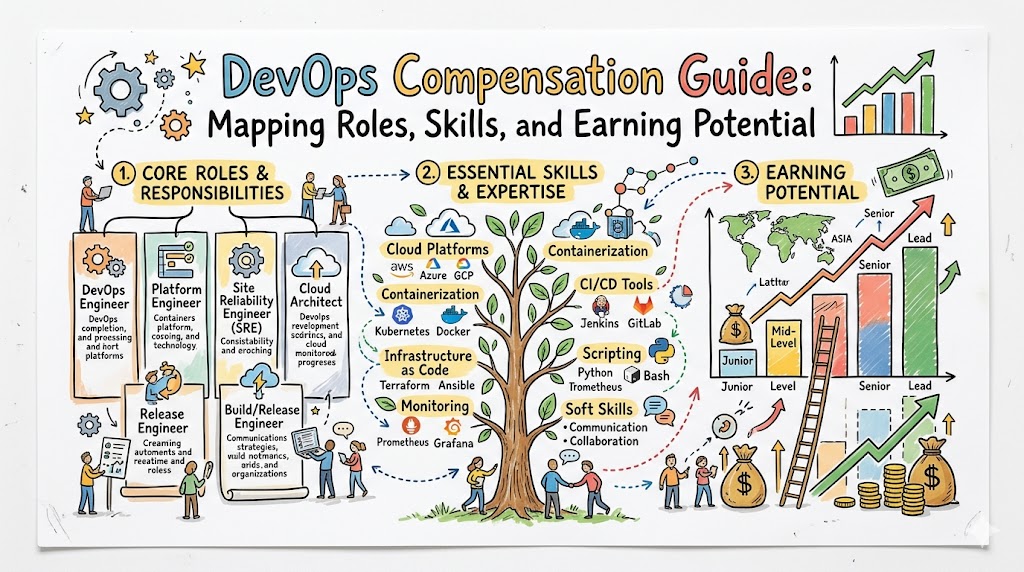
Introduction
The modern tech landscape is undergoing a massive shift. As cloud native infrastructure matures, organizations are no longer just asking how to build software faster—they are asking how to build it with absolute reliability, strict security, and cost-efficiency. This evolution has solidified DevOps as one of the highest-paying fields in the global IT sector.
DevOps salaries are increasing globally because the role has transitioned from a supporting IT function into a core pillar of business revenue. When infrastructure goes down, companies lose money, user trust, and market momentum. Consequently, organizations are willing to pay a premium for professionals who can bridge the gap between development agility and operational stability.
The rapid adoption of multi-cloud environments, containerized workflows, and automated workflows means that demand heavily outstrips the supply of qualified talent. However, the market is becoming highly performance-driven. In today’s hiring market, hands-on skills, system design capabilities, and operational outcome ownership matter far more than a collection of paper certifications.
Whether you are an aspiring IT professional or a seasoned engineer looking to optimize your career trajectory, this comprehensive guide will help you navigate the current compensation landscape. Below, we break down real-world salary data, high-paying specializations, critical skill sets, and practical career paths to maximize your earning potential.
Why DevOps Salaries Are High
The premium compensation associated with DevOps isn’t an accident; it is a direct reflection of structural shifts in how modern software is deployed and maintained:
- Pervasive Cloud Adoption: Organizations are migrating legacy systems to cloud environments, creating a massive need for engineers who understand infrastructure management at scale.
- The Push for End-to-End Automation: Manual deployments are a major bottleneck. Companies pay heavily for automation experts who can build self-healing pipelines and predictable release cycles.
- Kubernetes and Containerization Dominance: Container orchestration has become the standard for modern applications. Managing complex Kubernetes clusters requires specialized knowledge that commands a significant market premium.
- Pervasive CI/CD Implementation: Continuous Integration and Continuous Deployment (CI/CD) pipelines form the pulse of modern development. Minimizing deployment errors directly protects company revenue.
- The Rise of DevSecOps: Security can no longer be an afterthought. Integrating policy-as-code and automated compliance checks directly into pipelines prevents catastrophic data vulnerabilities.
- Complex Multi-Cloud Architectures: As businesses avoid vendor lock-in by balancing workloads across multiple cloud providers, the operational complexity rises exponentially.
- The Severe Talent Scarcity: While there is an abundance of professionals who know how to use a few specific tools, there is a distinct shortage of engineers who understand deep system design, reliability engineering, and cost optimization.
Who Should Read This Guide
This blueprint is designed specifically to provide actionable data for:
- Freshers trying to enter the tech space through a high-growth roadmap.
- Software Developers wanting to transition into architecture, automation, and infrastructure operations.
- Linux/Systems Administrators aiming to upgrade their traditional infrastructure skills to modern cloud-native systems.
- Cloud and Automation Engineers looking to specialize and hit higher salary brackets.
- SRE, Platform, and DevSecOps Engineers benchmarking their compensation against current global standards.
DevOps Salary Overview
The global DevOps compensation market is fragmenting into three distinct tiers: high-scale product organizations (which are highly equity-heavy), regulated enterprises (which lean toward bonus structures), and service or outsourcing firms (driven strictly by project rate cards).
As engineering organizations mature, generic “CI/CD tool operators” are seeing their compensation flatten. The market premium is shifting entirely toward professionals who can manage operational outcomes, optimize cloud spend, and design internal developer platforms.
DevOps Salary by Experience Level
Your title and years on paper matter less than your engineering scope and decision rights. The table below illustrates how your role and required skill sets evolve across different career tiers:
| Experience Level | Typical Roles | Skills Expected | Salary Growth Potential | Career Scope |
| Fresher / Junior | Junior DevOps Engineer, Cloud Associate | Linux basics, Git version control, basic shell scripting, foundational cloud usage. | Baseline entry-level market rates. | Executes well-defined tasks; focuses heavily on learning on-call basics and tools. |
| Mid-Level | DevOps Engineer, Automation Engineer | Independent CI/CD management, building infrastructure-as-code, basic container management. | Moderate to High (driven by tool mastery). | Ships infrastructure and pipeline changes independently without constant oversight. |
| Senior | Senior DevOps Engineer, SRE | Distributed systems design, advanced orchestration, incident response leadership, mentoring. | Very High (driven by system ownership). | Owns architecture design, leads complex system incidents, and shapes team engineering practices. |
| Lead / Architect | Lead Engineer, Platform Architect | Org-wide infrastructure standards, platform product thinking, multi-cloud strategy, cost engineering. | Peak Market Value (executive/staff tiers). | Directs long-term technical direction, defines platform roadmaps, and aligns tech infrastructure with business risk. |
Highest Paying DevOps Roles
Not all titles in the operations ecosystem are compensated equally. Specialization drastically alters your earning potential. The following table highlights standard market premiums relative to the baseline DevOps Engineer role:
| Role | Main Skills | Difficulty Level | Salary Potential | Career Demand |
| DevOps Engineer | CI/CD, Infra Automation, Basic Cloud | Medium | Baseline | Stable / Core Market |
| Site Reliability Engineer (SRE) | SLO/SLI engineering, Incident Response, Toil Reduction | High | +0% to +15% premium | Extremely High |
| Platform Engineer | Internal Developer Platforms (IDP), Paved Roads, Developer Tooling | High | +5% to +20% premium | Surging |
| DevSecOps Engineer | Policy-as-code, Pipeline Security, Automated Compliance | High | +10% to +30% premium | High Growth |
| Security Platform Engineer | Scalable Security Controls, IAM Governance, Developer Enablement | Very High | +15% to +35% premium | Scarce / Premium |
| Cloud Engineer | Cloud Landing Zones, Core Identity & Access Management | Medium | -5% to +10% vs baseline | Consistent |
| Release / CI/CD Engineer | Release Orchestration, Pipeline Delivery | Medium | -15% to 0% vs baseline | Flattening Market |
| FinOps / Cost Engineer | Capacity Economics, Cloud Bill Governance, Unit Cost Optimization | High | +5% to +25% premium | Emerging Niche |
DevOps Salary by Skills
Your skill set dictates your market value. The industry is rapidly moving past simple tool familiarity; you must understand the underlying engineering principles.
- The Baseline Requirements: Competency in Linux foundations, Git, Python/Go programming, and foundational CI/CD processes (Jenkins/GitHub Actions) is now viewed as a baseline expectation. Mastering these secures entry-level roles but will not command premium salary brackets.
- The High-Value Triggers: True compensation growth is unlocked when you master Infrastructure as Code (Terraform/OpenTofu) and Container Orchestration (Kubernetes). Knowing how to spin up a cluster is no longer enough—you need to know how to secure it, scale it, and troubleshoot its network overlays.
- The Premium Accelerators: The highest compensation brackets belong to those skilled in GitOps workflows (ArgoCD), Observability stacks (telemetry tracing, logging, and metrics), and DevSecOps frameworks. Connecting infrastructure engineering directly to business metrics—such as system uptime, MTTR (Mean Time To Resolution), and FinOps cost reductions—is the ultimate way to maximize your salary potential.
DevOps Salary by Certification
While real-world implementation always overrides a paper certificate, structured certifications from major cloud providers (AWS, Azure, Google Cloud) or cloud-native bodies can serve as an effective screening validator during resume reviews. They confirm that you possess a vetted baseline of knowledge, which helps secure initial interviews where you can demonstrate your practical expertise.
DevOps Salary by Country or Region
Compensation scales heavily based on geography and local market dynamics. The data below represents real-world base salary ranges extracted directly from the Best DevOps Salary Master Report, cross-referenced across key markets:
United States (USD Base Salary Bands)
- DevOps Engineer: $92,058 / $115,072 / $143,840
- Site Reliability Engineer (SRE): $99,422 / $124,278 / $155,347
- Platform Engineer: $103,105 / $128,881 / $161,101
- DevSecOps Engineer: $108,628 / $135,785 / $169,731
Canada (CAD Base Salary Bands)
- DevOps Engineer: $66,734 / $83,417 / $104,271 USD equivalent (Local Currency Median: 114,006 CAD)
- DevSecOps Engineer: $78,746 / $98,432 / $123,040 USD equivalent (Local Currency Median: 134,527 CAD)
Europe (EUR Base Salary Bands – Sample Markets)
- Netherlands (DevOps Engineer): $71,629 / $89,537 / $111,921 USD equivalent (Local Currency Median: 75,757 EUR)
- France (DevOps Engineer): $64,408 / $80,510 / $100,638 USD equivalent (Local Currency Median: 68,120 EUR)
- Spain (DevOps Engineer): $55,148 / $68,935 / $86,169 USD equivalent (Local Currency Median: 58,326 EUR)
Asia-Pacific & Middle East (Base Salary Bands)
- India (INR): $18,424 / $23,030 / $28,788 USD equivalent (Local Currency Median: 2,085,429 INR for baseline DevOps; SRE scales higher to a median of 2,252,263 INR)
- Singapore (SGD): $71,319 / $89,149 / $111,436 USD equivalent (Local Currency Median: 113,412 SGD)
- United Arab Emirates (AED): $63,247 / $79,059 / $98,824 USD equivalent (Local Currency Median: 290,345 AED)
Africa (Local Currency Snapshot)
- Kenya (KES): $12,223 / $15,279 / $19,099 USD equivalent (Local Currency Median: 1,965,270 KES)
- Nigeria (NGN): Note: Due to multi-rate currency regimes, conversions to USD are omitted to maintain strict data accuracy. The local currency median sits at 2,947,906 NGN for standard DevOps roles, scaling to 3,478,529 NGN for DevSecOps specializations.
DevOps Salary by Company Type
The structure of your employer heavily determines your day-to-day balance and financial upside:
- Startups: Offer accelerated learning opportunities and rapid title progression. You will touch every part of the stack (cloud, pipelines, on-call support). However, cash compensation is usually lower, offset by equity packages that carry high financial risk.
- Product-Based Companies / Top SaaS: These organizations offer premium base salaries and stable bonuses. They feature rigorous technical interviews and mature engineering hierarchies, forcing you to solve deep problems around performance and scale.
- MNCs & Service-Based Companies: Provide highly structured environments with clear, predictable career ladders. The focus is typically on project delivery and client rate cards, resulting in steadier, more moderate salary progression.
- Cloud-Native Enterprises: These businesses place the highest value on infrastructure engineering. Because their entire product relies on cloud delivery, their compensation structures for SRE and Platform roles closely match software engineering ladders.
Factors That Affect DevOps Salary
To put yourself in the top earning brackets, you must look beyond years of experience and optimize across these core vectors:
- Production System Impact: Your compensation directly tracks business risk. If you are responsible for revenue-generating uptime or major compliance boundaries, your financial leverage increases.
- Orchestration Maturity: Moving beyond basic deployments to managing container health, networking layers, and cluster security at scale.
- Automation Rigor: The ability to replace repetitive manual tasks (toil) with declarative, reusable code.
- FinOps Capability: Modern companies want engineers who can build highly scalable systems while actively monitoring and optimizing the underlying cloud spend.
- Architectural Vision & Communication: The highest-paying roles require you to present systems designs clearly to cross-functional teams, run blameless post-mortems, and mentor junior engineers.
Best Skills for High DevOps Salary
Building a highly lucrative career requires a structured approach to learning. Avoid trying to master every tool at once. Focus on building a solid foundation first:
[BEGINNER]                 [INTERMEDIATE]                 [ADVANCED]
Linux Foundations   ───>   Docker Containers      ───>    Kubernetes Architecture
Git Version Control ───>   Terraform (IaC)        ───>    GitOps (ArgoCD)
Shell Scripting     ───>   Jenkins / CI Pipelines ───>    Observability & DevSecOps
Real-World Career Scenarios
1. The Fresher Starting Out
A graduate entering the market can secure stable entry-level compensation by focusing on Linux fundamentals, basic scripting, and cloud configurations. The primary goal here should be learning how live production environments handle on-call shifts.
2. The Developer Transitioning to DevOps
Software developers already understand code structures. By mastering infrastructure-as-code (Terraform) and continuous delivery systems, they can quickly bridge the gap to high-paying hybrid developer roles like SRE or Platform Engineering.
3. The SysAdmin Migrating to the Cloud
Traditional systems administrators bring deep, invaluable knowledge of Linux, storage systems, and networking. By layering modern container skills (Docker) and cloud API orchestration on top of that base, they can quickly pivot away from legacy data center constraints into premium cloud roles.
Common Mistakes That Reduce Salary Growth
If your compensation has plateaued, check if you are falling into these common career traps:
- Collecting Paper Certifications: Memorizing exam answers without being able to debug a broken, real-world deployment live during an interview.
- Neglecting Systems Foundations: Attempting to manage Kubernetes clusters without understanding basic Linux networking, file systems, or permissions.
- Becoming a “Click-Ops” Engineer: Relying on manual cloud console configurations instead of writing declarative infrastructure code.
- Ignoring a Public Portfolio: Failing to maintain documented, public examples of your pipelines and architecture designs on GitHub.
- Neglecting Communication Skills: Being unable to explain root-cause analyses or write clear, collaborative technical documentation for other teams.
Hands-On Projects to Increase Salary Opportunities
To stand out in competitive hiring pools, build and document real projects that mirror production challenges:
- Multi-Stage Secure CI/CD Pipeline: Build a pipeline that automatically runs linting, code quality checks, container vulnerability scans, and records audit trails before deploying.
- Declarative Infrastructure Deployment: Use Terraform to stand up a modular, multi-region cloud landing zone complete with isolated networks and strict IAM boundary controls.
- Production-Grade Kubernetes Clustering: Deploy an application cluster featuring automated scaling rules, ingress management, secret isolation, and central log forwarding.
- End-to-End GitOps and Observability Workflow: Set up an environment where changes automatically sync via git repositories, backed by centralized tracking dashboards that alert on real SLO violations.
FAQs
Is DevOps a high-paying career?
Yes. Because infrastructure reliability directly impacts business revenue, qualified engineers command some of the highest compensation packages across the global IT sector.
Which DevOps skill gives the highest salary?
Advanced system design, multi-region Kubernetes management, cloud cost engineering (FinOps), and automated compliance architecture (DevSecOps) yield the highest market premiums.
Is Kubernetes good for salary growth?
Absolutely. Production-grade container orchestration is a standard expectation for modern web architecture. Mastering cluster networking and security is a major salary driver.
Does certification increase salary?
Certifications validate your foundational knowledge and help pass initial automated resume screens. However, your actual compensation is determined by your hands-on engineering experience and system design capability.
How long does it take to become a DevOps engineer?
For a professional with a solid background in development or systems administration, mastering the core automation, container, and cloud workflows typically takes 6 to 12 months of dedicated practice.
Final Recommendation
To maximize your long-term value in the DevOps ecosystem, prioritize deep operational engineering over chasing fleeting tool trends. Avoid the trap of collecting superficial certificates. Instead, invest your time into building verifiable portfolios, running live projects, and learning how to tie your infrastructure decisions directly to business outcomes like reliability, velocity, and cost management. Continuous, hands-on learning remains your single greatest asset.
For a deeper look into regional data breakdowns, leveling systems, and detailed negotiation strategies, consult the full Best Deps Salary Master Report.