Introduction
When searching for legal help online or reading through legal documents, you will often encounter terms like lawyer, advocate, and attorney. In everyday conversation, people tend to use these words as if they mean the exact same thing. Someone might say they need to call a lawyer for a property dispute, look up an attorney for business contracts, or hire an advocate to resolve a family matter. However, these professional titles are not always universal or interchangeable. Their exact meanings, professional scope, and regulatory requirements depend heavily on the country and the specific legal system in question. Understanding the differences between these terms helps remove confusion, especially when you are trying to find the right professional for your needs. Legal systems across the globe organize their legal professions differently based on historical traditions, educational pathways, and court admission rules.
What Does Lawyer Mean?
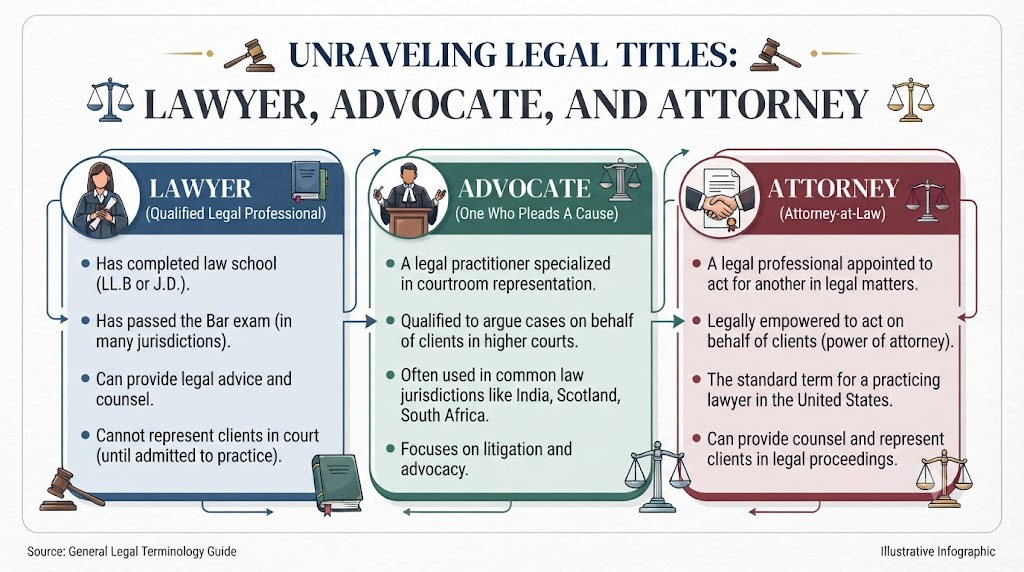
The term “lawyer” is the broadest and most commonly recognized title in the legal world. In general terms, a lawyer is a person who has completed legal training and earned a law degree. This means they have studied the principles of jurisprudence, contracts, property law, criminal law, and civil procedure. However, completing a law degree and earning an academic title does not automatically grant someone the right to practice law independently or represent clients in court. In most jurisdictions, a distinction exists between holding an educational qualification and holding a formal professional license. To practice actively, provide formal legal advice, or represent clients before judicial bodies, a lawyer must typically fulfill additional regulatory requirements. These often include completing practical training, passing bar examinations, registering with a governing legal body, or satisfying character and fitness evaluations. Therefore, while every licensed practitioner is generally rooted in legal training, the title alone can sometimes refer broadly to anyone educated in the law rather than someone actively authorized to handle active court cases.
What Does Advocate Mean?
The term “advocate” carries a specific professional meaning in several legal systems around the world, particularly within common law countries influenced by British legal traditions. An advocate is traditionally understood as a professional who pleads the cause of another, specifically representing clients in courtrooms and formal judicial proceedings. To use India as an important example, the title “advocate” has a strict statutory definition under the governing legal framework. In India, an individual must hold a recognized law degree and be formally enrolled with a State Bar Council under the Advocates Act. Only after fulfilling these enrollment requirements does the person gain the statutory right to practice law and argue cases before courts. In these contexts, an advocate is not merely someone who has studied law academically, but an officer of the court who has been officially admitted to practice advocacy.
What Does Attorney Mean?
The word “attorney” is most commonly associated with legal professionals in the United States. Formally known as an “attorney-at-law,” this term generally refers to a lawyer who has been admitted to practice law and is legally authorized to act on behalf of clients in legal matters. The historical root of the word implies someone appointed to act in the transaction of business for another. In modern legal practice, an attorney performs tasks such as drafting legal documents, negotiating settlements, providing counsel, and representing clients in court. In the United States, authorization to act as an attorney is granted at the state level through admission to a state bar. A person might be an attorney in one state but lack the authorization to practice in another unless they are admitted to that specific jurisdiction’s bar or obtain pro hac vice permission for a particular case.
Lawyer vs Advocate vs Attorney at a Glance
To help clarify how these terms compare, the following simplified educational table outlines their general meanings, common usages, and jurisdictional traits.
| Term | General Meaning | Common Usage | Court Representation | Jurisdiction Notes |
| Lawyer | A person trained in the law and holding a law degree. | Used broadly as a general term for legal professionals. | Depends on licensing and local court admission rules. | Used globally as an umbrella term for anyone with legal education. |
| Advocate | A legal professional authorized to plead cases in court. | Common in countries like India and international tribunals. | Typically holds formal rights of audience in court. | Specific statutory meaning varies heavily by country. |
| Attorney | A licensed practitioner authorized to act for clients. | Widely used in the United States. | Authorized within the specific states or courts where admitted. | Strongly tied to U.S. state bar admissions and agency concepts. |
Note: This table is a simplified educational comparison and does not imply that every jurisdiction uses these terms interchangeably or with identical legal powers.
Why Legal Terminology Changes by Country
Legal terminology varies across borders because legal systems evolve from different historical traditions, cultural frameworks, and legislative structures. While countries like the United States, India, and the United Kingdom share common law roots, their contemporary legal professions are organized under distinct regulatory frameworks. Differences in legal education systems, professional licensing procedures, bar admission standards, and court system designs mean that a title valid in one country may carry a different administrative meaning elsewhere. For instance, a professional qualified as a solicitor or barrister in the United Kingdom operates under a historically divided profession, whereas an attorney in the United States typically handles both advisory and courtroom duties under a unified licensing model. Because of these structural variations, anyone seeking legal help must examine the local rules of the specific jurisdiction where their matter is taking place.
Lawyer, Advocate, and Attorney in India
In India, the legal profession is strictly regulated by statute, primarily under the Advocates Act enacted by Parliament. The term “advocate” is the official designation for a person who is authorized to practice law and represent clients before courts and tribunals. To practice in India, a candidate must graduate from a law school recognized by the Bar Council of India and enroll with a State Bar Council. Following enrollment, candidates are typically required to clear the All India Bar Examination to maintain their full practice rights. The Bar Council system plays an oversight role, maintaining professional standards, regulating professional conduct, and handling disciplinary matters. Consequently, in the Indian context, not every person holding an academic law degree is automatically classified as an advocate; active practice requires formal enrollment and adherence to statutory regulations.
Lawyer, Advocate, and Attorney in the United States
In the United States, the terms “lawyer” and “attorney” are frequently used interchangeably in everyday speech. However, a technical distinction exists: while a lawyer is someone who has completed law school (often earning a Juris Doctor degree), an attorney is someone who has successfully passed a bar exam, received a license to practice, and been admitted to the bar of a specific state. U.S. legal practice is governed on a state-by-state basis rather than through a single national body. Each state maintains its own bar association, sets its own admission requirements, and enforces its own rules of professional conduct. Because of this decentralized structure, an attorney licensed in New York cannot automatically practice law in California without meeting that state’s admission criteria. This regional licensing system ensures that legal professionals possess specific knowledge of local state laws and court procedures.
Lawyer, Advocate, and Attorney in the United Kingdom
The legal profession in the United Kingdom—focusing particularly on England and Wales—historically maintains a structural division between two primary types of lawyers: solicitors and barristers. A solicitor generally handles direct client interactions, provides ongoing legal advice, negotiates contracts, drafts legal paperwork, and prepares cases for court. A barrister specializes in courtroom advocacy, presenting arguments before judges and juries. While the overarching term “lawyer” is used by the public to describe anyone in the profession, the formal division between solicitors and barristers remains central to how legal work is distributed in the UK court system. Furthermore, Scotland and Northern Ireland maintain their own distinct legal jurisdictions with separate professional bodies and terminology.
Can a Lawyer Represent You in Court?
Whether a lawyer can represent you in court depends entirely on their professional licensing, jurisdiction, and active standing. Completing a legal education grants academic knowledge, but it does not automatically confer the right of audience in judicial forums. In many legal systems, a lawyer must be admitted to the bar of a specific court or jurisdiction to present arguments before a judge. For example, a corporate lawyer who specializes exclusively in drafting internal compliance documents may not routinely handle courtroom litigation, even if they hold a valid law license. Always verify whether a legal professional holds active court authorization for your specific geographic and legal venue.
Can an Advocate Give Legal Advice?
Advocates are professionally authorized to provide legal advice and represent clients within the scope of their licensing and jurisdiction. Because their training covers substantive law and procedural rules, they are qualified to interpret legal statutes, evaluate risks, and guide clients through administrative or judicial processes. However, the exact scope of permissible advice depends on the governing laws of the country or region where they practice. Clients should ensure that the advocate they consult has relevant experience in the specific practice area—such as family law, criminal defense, or property disputes—matching their unique situation.
Can an Attorney Represent Someone in Court?
In the United States, an attorney-at-law who maintains an active license and good standing with their state bar generally possesses the authority to represent clients in court. Nevertheless, court representation rules can still vary by specific court level. Federal courts, appellate courts, and specialized tribunals often require separate bar admissions or specific credentials. An attorney licensed for general civil practice in a state trial court may need special permission to argue a case before a federal district court or a state supreme court.
Lawyer vs Advocate vs Attorney for Legal Consultation
When individuals look for an initial legal consultation, they often encounter these terms across various directories and digital platforms. The most important factor during this search is not fixating on a specific title, but confirming that the professional is properly qualified and authorized to handle the relevant legal matter within the applicable jurisdiction.
When evaluating potential legal help, consider factors such as:
- Practice Area Expertise: Does the professional focus on the specific area of law relevant to your case, such as family law, real estate, or business contracts?
- Jurisdictional Licensing: Are they licensed or enrolled to practice in the exact city, state, or country where your legal matter is centered?
- Professional Experience: How many similar cases or consultations have they handled?
- Communication Style: Are they clear, responsive, and transparent about their fees and process?
Legal Qualification Is Not the Same as Legal Authorization
A critical distinction for consumers to grasp is that legal qualification is not the same as legal authorization. Earning a law degree or completing academic examinations represents an educational milestone. However, legal authorization—such as state bar admission, statutory enrollment, or the issuance of a practicing certificate—is the regulatory mechanism that grants someone the legal right to practice professionally. Depending on the country, practicing law without proper authorization can be a violation of statutory regulations. Consumers must therefore look beyond academic credentials to verify that a practitioner holds active licensing and good standing with the appropriate governing authority.
Why Jurisdiction Matters
Jurisdiction is the legal authority of a court or official body to govern a particular case or geographic area. In simple words, jurisdiction dictates which laws apply and which legal professionals are permitted to act. A lawyer authorized in one country or state cannot automatically provide binding legal representation in another. For example, an advocate enrolled in India cannot practice U.S. federal law unless admitted to the relevant U.S. jurisdiction. Similarly, family laws, property regulations, and contract statutes differ significantly across regions. Always ensure that the professional you consult understands the local laws governing your specific geographic area.
How to Choose the Right Legal Professional
Selecting the right legal professional involves a structured evaluation of your specific needs rather than relying on generic titles. Use this practical framework when beginning your search:
- Identify the Core Legal Problem: Clearly define whether your issue involves real estate, business compliance, family matters, or civil litigation.
- Determine the Relevant Jurisdiction: Pinpoint the exact city, state, or country where the legal action or dispute is taking place.
- Check Professional Authorization: Confirm that the practitioner holds active licensing, bar admission, or statutory enrollment.
- Evaluate Experience and Fit: Review their background in handling similar cases and assess how effectively they communicate during initial discussions.
Questions to Ask Before Hiring a Legal Professional
Before entering into a formal engagement with a legal professional, asking targeted questions can help ensure a clear and productive working relationship:
- What is your formal professional qualification and licensing status in this jurisdiction?
- How many years of experience do you have handling cases similar to mine?
- Are you personally authorized to represent clients in the specific court or forum handling this matter?
- What is your fee structure, and what costs should I anticipate?
- How will we communicate, and what is your expected timeline for updates?
- What documents or evidence should I gather to support my case?
- What are the potential outcomes and risks associated with my situation?
- What are the immediate next steps we need to take?
- Can you provide an estimated timeline for the resolution process?
- What is your preferred format for follow-up consultations?
Common Mistakes People Make When Searching for Legal Help
Navigating the legal landscape can be intimidating, leading everyday people to make avoidable errors during their search for guidance:
- Choosing Solely Based on a Title: Assuming that any title guarantees expertise across all legal domains without checking specific practice areas.
- Ignoring Jurisdiction: Hiring a professional located in a different state or country who lacks familiarity with local laws.
- Chasing Low Fees: Prioritizing the lowest cost over professional qualifications, relevant experience, and proper licensing.
- Failing to Verify Credentials: Assuming that holding an academic law degree automatically grants active court authorization.
- Relying Solely on General Internet Content: Treating broad educational articles as a substitute for tailored professional advice regarding a specific legal dispute.
Lawyer, Advocate, and Attorney Are Not Always Interchangeable
While terms like lawyer, advocate, and attorney overlap frequently in everyday conversation, treating them as universally identical can lead to misunderstandings about professional responsibilities and court rights. Different legal traditions and regulatory bodies assign distinct meanings to these roles. Recognizing that professional qualifications and rights vary by jurisdiction ensures you can make informed decisions when seeking legal assistance.
Understanding Legal Titles Before an Online Consultation
Understanding legal terminology helps you communicate more effectively when using online legal consultation platforms. When you connect with a professional remotely, being familiar with terms like lawyer, advocate, and attorney enables you to describe your situation clearly and ask direct questions about their licensing status. Organizing your documents, summarizing your key facts, and verifying jurisdictional authorization beforehand ensures you maximize the value of your initial discussion.
How BestLawyerNow Can Help With Legal Professional Discovery
Finding the right guidance for a legal concern requires reliable resources and structured pathways. BestLawyerNow provides a digital platform designed to help users connect with legal professionals online and explore educational guidance across various practice areas.
Whether you are navigating a property disagreement, a family transition, or general business questions, the platform assists in identifying appropriate legal categories and preparing for remote consultations. By emphasizing the importance of verifying professional licensing, checking relevant jurisdictional experience, and organizing essential documents ahead of time, BestLawyerNow helps bridge the gap between everyday individuals and qualified legal support.
Frequently Asked Questions
- What does the term “lawyer” generally mean?
A lawyer is a person who has completed legal education and earned a law degree, though active practice rights depend on local licensing and bar admission. - What is the specific definition of an “advocate”?
An advocate is a legal professional who pleads cases in court, holding a specific statutory role in legal systems like India under the Advocates Act. - How is an “attorney” typically defined?
An attorney, or attorney-at-law, is a licensed legal practitioner authorized to represent clients and practice law, most commonly within the United States. - Are a lawyer and an advocate always the same thing?
No, while all advocates have legal training, not all lawyers are automatically advocates with active court representation rights. - What distinguishes a lawyer from an attorney?
A lawyer holds legal education credentials, whereas an attorney has successfully passed bar examinations and received active licensing to practice law. - Can an advocate represent clients in court?
Yes, advocates are specifically authorized to plead and argue cases in courtrooms within their governing jurisdictions. - Do attorneys have the authority to represent clients in judicial proceedings?
Yes, licensed attorneys in good standing generally possess the authority to represent clients in court, subject to local court rules. - Why do legal terms differ so much between countries?
Legal terminology varies because different countries develop unique legal traditions, educational pathways, court structures, and regulatory frameworks. - What should readers check before hiring a legal professional?
Readers should verify the professional’s licensing, jurisdictional authorization, relevant practice area experience, and fee structure. - How can an online legal consultation help with legal discovery?
An online consultation provides convenient initial guidance, helping users understand their options, organize documents, and connect with verified professionals remotely.
Conclusion
Understanding the distinctions between a lawyer, an advocate, and an attorney clarifies how legal systems operate across different parts of the world. Because these titles carry distinct statutory and professional meanings depending on the jurisdiction, relying on a title alone is not enough. Readers should prioritize professional authorization, relevant legal experience, practice area expertise, and jurisdictional licensing when seeking assistance. Exploring resources on BestLawyerNow can help you prepare carefully, ask the right questions, and connect with qualified professionals suited to your specific legal needs.
