Introduction
Food is never just something we put on a plate to get through the day. Every single meal carries a silent story. When you smell a particular spice simmering on the stove, or taste a warm bowl of soup prepared just the way your grandmother used to make it, you are not simply eating—you are traveling through time. Recipes, cooking methods, local ingredients, and family meals act as living books. They hold the memories of where we come from, how our ancestors lived, and the places they once called home.
Yet, over time, these quiet traditions can easily be lost. Older generations pass on, modern life moves at a fast pace, and convenience foods often replace slow-cooked family recipes. When a kitchen secret is forgotten, a small piece of our shared history disappears with it. That is why preserving food stories matters so deeply. It is about keeping our roots alive. Out of this very need to protect, celebrate, and share the culinary tales of the world, the Blendz Global Food Heritage Archive was born.
What Is Food Heritage?
To understand the archive, we first need to explore what food heritage truly means. In simple terms, food heritage is the collection of traditional recipes, cooking techniques, local ingredients, and food habits passed down through generations. It is the culinary identity of a community or a family.
Food heritage is made up of many everyday elements:
- Traditional recipes handed down from parents to children, often without written measurements.
- Cooking methods like clay-oven baking, slow-simmering, open-fire roasting, or ancient fermentation techniques.
- Local ingredients sourced from nearby farms, forests, rivers, or coastal waters.
- Family food habits and Sunday dinner rituals that anchor us to our roots.
- Festivals and food prepared exclusively during seasonal shifts, harvest celebrations, or religious holidays.
- Community meals shared during weddings, gatherings, or times of mourning.
- Food memories that evoke immediate feelings of comfort, warmth, and belonging.
Food heritage differs wonderfully from place to place. What a family eats in a mountain village is shaped by cold winters and hearty root vegetables, while a coastal community relies on the bounty of the sea and sun-loving spices. Every dish tells a story about geography, climate, and creativity.
Why Food Is Part of Our Heritage
Food is one of the most honest reflections of human culture. It shows us where people come from and how they adapted to their surroundings. When we look closely at what people eat, we learn about their daily lives, local traditions, and seasonal rhythms.
For instance, agricultural practices dictate which grains become staples. Religious and community celebrations bring people together around large communal tables, reinforcing social bonds. Seasonal habits remind us to respect the natural cycle of the earth, eating what is fresh and available rather than demanding everything year-round. These practices form the bedrock of our cultural identity. Preserving them is a way of honoring the wisdom of those who came before us.
The Story Behind the Blendz Global Food Heritage Archive
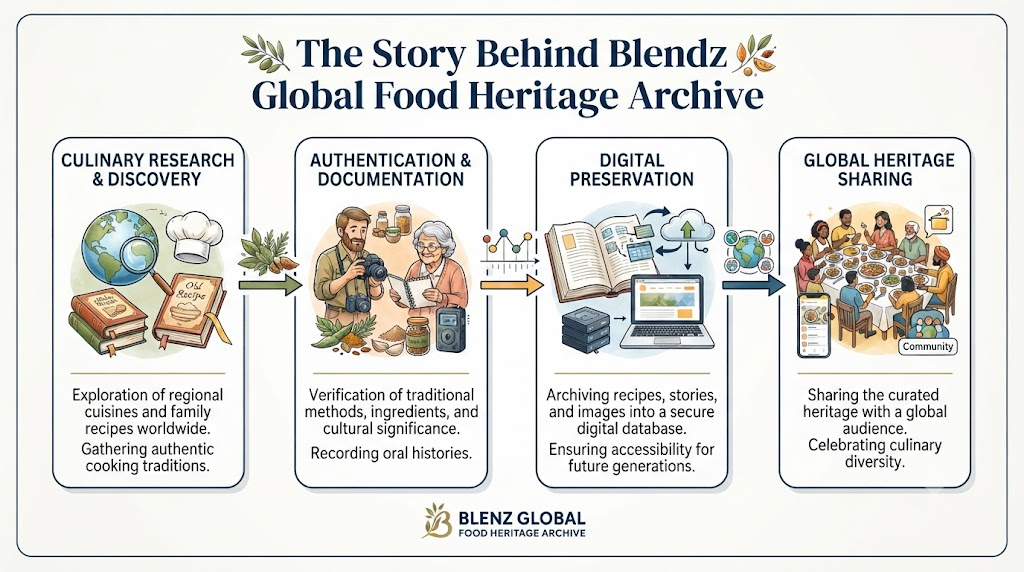
The Blendz Global Food Heritage Archive was created out of a deep appreciation for these kitchen traditions. The core idea behind the platform is simple: food stories are worth saving, traditional recipes matter, and local food knowledge should never be forgotten.
In a world where culinary traditions are changing rapidly, bringing food stories together in one accessible place can help people learn about different communities with empathy and curiosity. The archive serves as a gathering space where traditional recipes, family cooking methods, and regional food stories can be kept safe for anyone who wants to learn, cook, or explore. It respects the fact that every culture has its own unique culinary voice, and listening to those voices brings us closer together as human beings.
Why Preserving Food Traditions Matters
Preserving food traditions is not about living in the past; it is about keeping our human connections strong. Here are a few reasons why protecting these traditions is so valuable:
- Passing recipes to younger generations ensures that kids and teenagers grow up knowing how to make the dishes that sustained their ancestors.
- Keeping family memories alive through food helps us feel close to relatives who may no longer be with us.
- Protecting local food knowledge ensures that ancient skills—like cheese-making, bread-baking, or spice-blending—do not vanish.
- Understanding different cultures becomes much easier when you share a meal or learn about the history behind a foreign dish.
- Recording traditional cooking methods helps us appreciate the ingenuity of human cooking long before modern kitchen appliances existed.
- Remembering ingredients that may become less common protects agricultural biodiversity and encourages sustainable eating.
When we write down a recipe or record a food story, we are building a bridge between yesterday and tomorrow.
How Food Stories Connect Generations
In most families, food knowledge is passed down informally. Older family members teach younger ones not through textbooks, but through shared moments in the kitchen.
Think about how children learn to cook. They stand on a small stool by the counter, watching flour dust the air, smelling roasting spices, and tasting sauces straight from a wooden spoon. They learn by watching, helping, and listening to stories told over simmering pots.
During family meals, elders often share tales of their own childhoods—stories of what they ate during hard times, how they celebrated good harvests, or what special treats were reserved for festivals. These shared moments create powerful emotional bonds. A simple dish becomes a vessel for family history, teaching children patience, appreciation, and a sense of belonging.
How Migration Changes Food Traditions
Human history is a history of movement. When people move from one region to another—whether across a country or across oceans—they rarely leave their food behind. They pack their favorite recipes in their memories and adapt them to new surroundings.
Migration has always been one of the greatest drivers of culinary evolution. When families settle in a new place, they face a puzzle: how to recreate the tastes of home using ingredients available in local markets. This leads to wonderful culinary innovations:
- Family recipes cross borders and take on new dimensions.
- New local ingredients are integrated into traditional dishes.
- Traditional cooking styles blend with techniques borrowed from neighbors.
- Food traditions evolve organically over time to reflect a new life chapter.
This cultural exchange proves that food traditions are alive and flexible. They do not stay frozen in time; they grow, adapt, and tell the story of human resilience and creativity.
How Travel Helps People Discover Food Heritage
Travel is another wonderful way to encounter food heritage. When we visit a new city or country, stepping into a local market or sitting down at a family-run eatery teaches us more about the local culture than any guidebook ever could.
Travelers can experience food heritage through:
- Bustling local markets filled with unfamiliar fruits, vegetables, and spices.
- Family-run food spots where recipes have remained unchanged for decades.
- Regional festivals celebrating local harvests, cheeses, wines, or street foods.
- Conversations with local cooks who take pride in sharing the stories behind their dishes.
Good travel involves respect. When we explore foreign food traditions, we must approach them with openness, honoring local people, farmers, and cooks rather than treating food merely as a tourist attraction.
Traditional Recipes as Cultural Stories
A recipe is much more than a list of ingredients and step-by-step instructions. It is a snapshot of history. If you read between the lines of an old recipe book, you can learn a great deal about a region:
- Local ingredients reveal what grows naturally in the soil or thrives in the local climate.
- Farming practices are reflected in seasonal dishes that rely on fresh harvests.
- History and migration explain why certain spices or cooking tools appear in unexpected places.
- Celebrations show what communities value most, whether it is a bountiful harvest, a religious milestone, or a wedding.
Every traditional dish has a reason for existing. Understanding that reason helps us respect the culture that created it.
What a Global Food Heritage Archive Can Preserve
A well-maintained food heritage archive acts as a treasure chest for culinary knowledge. It gathers diverse elements of human food culture so they remain accessible to everyone. Such an archive typically preserves:
- Traditional recipes complete with regional variations and notes on how they evolved.
- Food stories and personal memoirs shared by home cooks and elders.
- Traditional cooking methods explained in clear, easy-to-follow steps.
- Ingredient guides detailing local produce, heirloom seeds, and regional spices.
- Family memories that highlight the emotional connection between people and their meals.
- Cultural notes explaining the context behind festival foods and ritual dishes.
- Archival photographs and visual records of traditional kitchens, utensils, and prepared dishes.
By bringing these elements together, an archive ensures that the culinary wisdom of ordinary people is honored and remembered.
Related Food Stories You May Find Helpful
Before we explore how families and communities can actively protect their food traditions, here are a few related resources and articles from Blendz that you might enjoy exploring:
| No. | Suggested Sentence | Anchor Text | Target Page/URL | Why This Link Is Useful |
| 1. | If you want to dive deeper into how traditional ingredients travel across borders, check out our guide on global spice routes. | global spice routes | https://blendz.com/global-spice-routes | Explains how historical trade routes shaped modern kitchen ingredients. |
| 2. | Discover how home cooks are keeping old cooking techniques alive in our feature on traditional cooking methods. | traditional cooking methods | https://blendz.com/traditional-cooking-methods | Offers practical insights into ancient culinary techniques still used today. |
| 3. | For inspiration on capturing your own family meals, read our tips on recording family recipes. | recording family recipes | https://blendz.com/recording-family-recipes | Gives simple ideas for writing down and saving your family’s culinary history. |
How Food Heritage Changes Over Time
It is completely normal for food traditions to change. As new kitchen tools are invented, as trade brings new ingredients to our shores, and as families move to different cities, our cooking habits naturally shift.
Change does not mean that a tradition is lost. Often, food heritage grows stronger by absorbing new ideas while holding onto its core values. A traditional curry might incorporate a new vegetable found in a local market, or a classic holiday bread might be baked in an electric oven instead of a wood-fired brick oven. The heart of the tradition remains intact even as the outward details adapt to modern life.
The Role of Families in Food Heritage
Families are the primary guardians of food heritage. Without active participation at home, ancient recipes can easily slip away. Fortunately, anyone can play a part in preserving their family’s culinary history. Here are a few practical things you can do:
- Write down family recipes in a dedicated notebook before memory fades.
- Record stories from older relatives about what they ate during their childhoods and how certain dishes were made.
- Take photos of traditional dishes and family cooking sessions to create a visual record.
- Teach recipes to younger family members by inviting them into the kitchen to help chop, stir, and taste.
- Save special cooking tools passed down from grandparents, such as heavy iron skillets, wooden rolling pins, or clay pots.
Preserving food heritage does not require special equipment—just a little time, curiosity, and care.
The Role of Communities in Food Heritage
Beyond individual families, local communities have a powerful role to play in keeping food traditions alive. Neighborhood associations, local markets, cultural clubs, and community centers can host events that celebrate regional cuisine.
Community cooking workshops, local food festivals, and neighborhood recipe-sharing circles give people a chance to showcase dishes that might otherwise remain hidden in private homes. When neighbors gather to share food, stories, and laughter, cultural understanding deepens, and local pride grows stronger.
How Digital Archives Help Preserve Food Stories
In the modern era, digital tools offer incredible opportunities to save and share food stories. In the past, recipes were often written on scraps of paper that could easily get lost, stained, or thrown away.
Today, digital archives make it possible to store recipes, photographs, audio interviews, and written memories in secure, searchable online collections. This means someone living halfway across the world can learn about a remote village’s harvest soup, or a young person can search for their great-grandmother’s holiday biscuit recipe with a single click. Digital platforms help bridge geographic distances, ensuring that local food knowledge reaches a wider global audience.
What Readers Can Add to Food Heritage
You do not need to be a professional historian or a famous chef to contribute to food heritage. Every single person has a unique culinary story to tell.
Think about the meals that defined your childhood. Think about the unique way your family prepares a holiday feast, or the secret ingredient your uncle adds to his famous stew. By writing these details down, interviewing your elders, and sharing your family recipes with platforms like the Blendz archive, you become an active part of preserving global food culture. Your kitchen history matters.
How Blendz Fits into the Global Food Heritage Story
The Blendz Global Food Heritage Archive serves as a welcoming space for anyone curious about the intersection of food, culture, and history. By bringing together stories, recipes, and cultural notes from various communities, Blendz helps readers explore the rich tapestry of world food traditions without feeling overwhelmed by academic jargon.
Whether you are looking to understand the history behind a daily staple or hoping to find inspiration for a family dinner rooted in tradition, Blendz provides a warm, accessible window into the culinary lives of people around the world. It reminds us that no matter how different our backgrounds may be, we all share a common bond around the dinner table.
Frequently Asked Questions
What is food heritage?
Food heritage refers to the traditional recipes, cooking methods, local ingredients, and food habits that are passed down from one generation to the next within a family or community.
Why is food heritage important?
It helps us understand our cultural roots, connects us with family memories, preserves ancient cooking knowledge, and fosters mutual respect for different cultures around the world.
What is a global food heritage archive?
It is a collection of food stories, traditional recipes, and cultural notes gathered from various communities across the globe to preserve culinary history for future generations.
Why should traditional recipes be preserved?
Traditional recipes carry the history, climate, and resourcefulness of past generations, ensuring that valuable culinary skills and flavors are not lost to time.
How can food tell stories about a culture?
Food reflects local geography, farming practices, religious traditions, and migration patterns, showing how communities adapted to their environments over centuries.
How do family recipes connect generations?
When older family members pass down recipes and share stories while cooking together, it creates emotional bonds and keeps family history alive for younger members.
How does migration affect food traditions?
Migration introduces new ingredients and cooking styles to traditional recipes, leading to delicious culinary evolution as families adapt to new homes.
How can digital archives help preserve food stories?
Digital archives store recipes, photos, and stories securely online, making them easily searchable and accessible to anyone interested in learning about global food culture.
How can people preserve their own family food traditions?
You can write down family recipes, record stories from older relatives, take photos of traditional dishes, and teach cooking methods to younger family members.
What is the Blendz Global Food Heritage Archive?
It is an initiative designed to help people explore, share, and appreciate global food heritage, traditional recipes, and cultural stories in a simple and engaging way.
Conclusion
Food is the thread that weaves human history together. From the simple warmth of a family breakfast to the elaborate dishes prepared during ancient seasonal festivals, our culinary traditions tell the story of who we are, where we come from, and how we care for one another.
While time moves forward and the world changes rapidly, we have the power to protect these valuable memories. By writing down our family recipes, listening to the stories of older generations, and supporting platforms dedicated to cultural preservation, we ensure that our culinary roots remain strong.
We invite you to explore the Blendz Global Food Heritage Archive today, discover new stories from around the world, and perhaps even share a piece of your own kitchen history with the community.
