Introduction
The Certified FinOps Engineer credential stands as a crucial professional landmark for engineering specialists navigating modern multi-cloud ecosystems. With enterprises expanding their footprints across public platforms and hybrid architectures, computing spend has transitioned from an indirect accounting line item into an immediate reflection of technical design decisions. This guide is developed for system developers, site reliability engineers, cloud platform architects, data engineers, and technical leadership who must evolve from simple infrastructure provisioning to active fiscal stewardship. By integrating financial accountability into early software lifecycles, this program equips technical talent with the framework required to curb expanding infrastructure costs without limiting operational velocity, service stability, or system agility. Exploring this roadmap allows engineers and decision-makers to evaluate certification paths, review essential technical competencies, and make informed choices for career growth.
What is the Certified FinOps Engineer?
The Certified FinOps Engineer represents a shift from reactive cloud cost-cutting toward continuous, programmatic fiscal optimization. Historically, financial auditing occurred post-facto through finance personnel who lacked architectural context, while system builders deployed resources with little visibility into operational billing impacts. The Certified FinOps Engineer bridges this operational gap by integrating cost transparency directly into active engineering routines, delivery pipelines, and Infrastructure as Code configurations. Beyond passive theoretical ideas, the credential prioritizes practical, production-focused skills like unit cost analysis, dynamic workload rightsizing, billing anomaly tracking, and automated tagging compliance. It provides an operational standard that unifies engineering teams with business leaders, transforming variable computing charges into a predictable engine for business growth.
Who Should Pursue Certified FinOps Engineer?
This certification targets technical specialists and managers who manage cloud infrastructure and engineering budgets. DevOps specialists, Site Reliability Engineers, and Platform Engineers building deployment pipelines gain the capability to design cost-aware software release models. System Architects, Security Specialists, and Data Engineers learn strategies to engineer efficient systems, eliminate orphaned resources, and manage variable processing costs. Furthermore, Engineering Managers, Tech Leads, and FinOps Practitioners benefit from mastering unit metrics that convert operational cloud activity into executive business insights. The credential holds global career value and is relevant across tech ecosystems, including India and global enterprise markets, where organizations scale infrastructure while optimizing operational budgets.
Why Certified FinOps Engineer
The shift toward cloud-native microservices, serverless components, and containerized deployments has made cloud financial control an urgent business requirement. In highly dynamic environments, unmanaged workloads can scale costs rapidly, creating financial risks for growing organizations. Earning the Certified FinOps Engineer credential establishes an engineer as a key contributor who can drive operational efficiency inside technical teams. Unlike tool-specific certifications that lose value as vendor features change, this program emphasizes durable architectural principles, automated policy mechanisms, and cross-functional team workflows. Investing time into this certification offers lasting career returns by preparing professionals for high-impact roles, technical leadership positions, and specialized cloud governance careers.
Certified FinOps Engineer Certification Overview
The Certified FinOps Engineer program is delivered via the official curriculum hosted on finopsschool.com. Moving past simple multiple-choice evaluations, the program relies on practical, scenario-based assessments that measure a candidate’s ability to evaluate cloud billing telemetry, enforce corporate compliance rules, and design efficient technical architectures. Curated by active industry practitioners, the learning materials address modern multi-cloud management challenges. The learning path guides candidates from core financial concepts to hands-on execution, ensuring graduates gain both strategic perspective and technical delivery capabilities.
Certified FinOps Engineer Certification Tracks & Levels
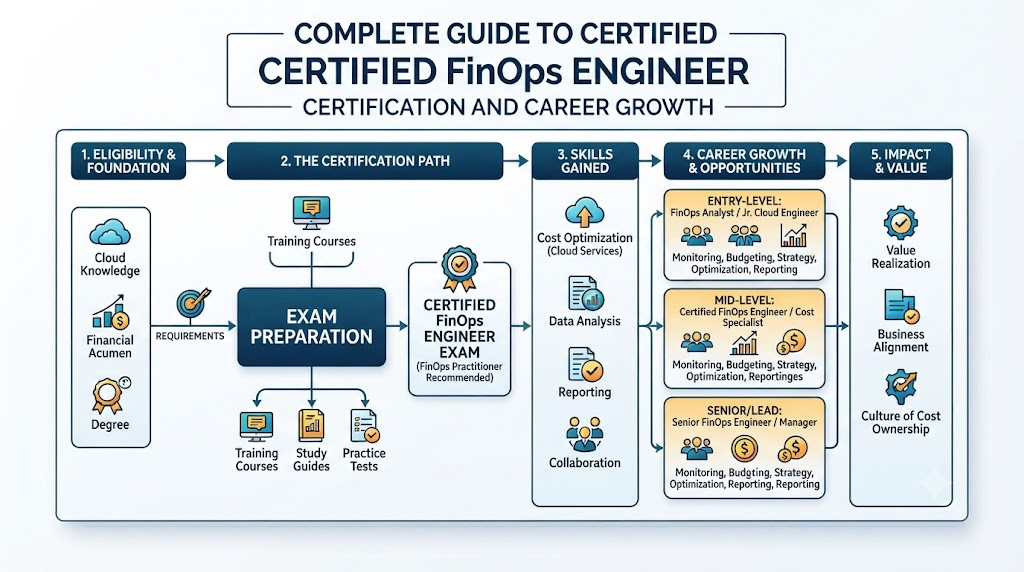
The certification framework is organized across three progressive tiers: Foundation, Professional, and Advanced. The Foundation tier establishes baseline literacy in cloud cost structures, allocation mechanisms, and core financial management workflows. The Professional tier emphasizes practical execution, focusing on automation, IaC controls, cost-aware CI/CD integration, and active resource optimization. The Advanced tier is tailored for senior architects and technology directors, concentrating on multi-cloud governance, predictive capacity modeling, unit economics, and establishing an enterprise FinOps Center of Excellence. This structure allows engineers to enter at their current experience level and advance toward their long-term career targets.
Complete Certified FinOps Engineer Certification Table
| Track | Level | Who it’s for | Prerequisites | Skills Covered | Recommended Order |
| Core FinOps | Foundation | Entry-Level Engineers, Analysts, Finance Partners | Fundamental Cloud Concepts | Cloud Cost Models, FinOps Concepts, Inform/Optimize/Operate Lifecycle | Step 1 |
| Engineering FinOps | Professional | DevOps, SRE, Platform Engineers, Cloud Specialists | 1-2 Years Cloud Operations | Automated Rightsizing, Tagging Policy Enforcement, Cost-Aware Pipelines | Step 2 |
| Enterprise FinOps | Advanced | Principal Architects, Tech Leads, Engineering Directors | Professional Certification | Unit Economics, Predictive Forecasting, Multi-Cloud Governance, FinOps CoE | Step 3 |
Detailed Guide for Each Certified FinOps Engineer Certification
Certified FinOps Engineer – Foundation
What it is
The Foundation certification validates basic operational understanding of cloud cost management concepts, billing mechanisms, and variable spend models. It proves an engineer understands cloud expenditure mechanics and can collaborate across technology and finance departments.
Who should take it
This credential fits junior system admins, entry-level cloud engineers, finance analysts working alongside technical departments, and technology professionals transitioning into cloud cost management roles.
Skills you’ll gain
- Understanding cloud variable expenditure models compared to capital expenditure models.
- Mastery of FinOps concepts, vocabulary, and operational persona mapping.
- Capability to execute core lifecycle phases: Inform, Optimize, and Operate.
- Understanding resource tagging standards and fundamental cost allocation mechanics.
Real-world projects you should be able to do
- Audit cloud billing reports to identify major cost drivers across core infrastructure services.
- Map unallocated cloud infrastructure resources to team-specific operational tags.
Preparation plan
- 7–14 Days: Review cloud financial glossaries, core framework guides, and provider billing structures.
- 30 Days: Complete practice tests, examine cloud provider cost dashboards, and study allocation mechanisms.
- 60 Days: Work through practical exercises, study real billing data samples, and analyze multi-account account setups.
Common mistakes
- Treating cloud operational variable spend like traditional static IT capital budgets.
- Overlooking the cultural alignment needed between engineering and financial teams.
- Focusing exclusively on immediate cost reductions instead of business value creation.
Best next certification after this
- Same-track option: Certified FinOps Engineer – Professional
- Cross-track option: Certified DevOps Engineer
- Leadership option: Certified Engineering Manager
Certified FinOps Engineer – Professional
What it is
The Professional certification validates practical proficiency in executing technical cost optimizations, automated policy enforcement, and infrastructure governance. It verifies an engineer’s capability to set up monitoring, automate resource lifecycles, and integrate cost checks into delivery pipelines.
Who should take it
Designed for experienced DevOps specialists, SREs, Systems Engineers, and Platform Architects running active production workloads in public or hybrid cloud environments.
Skills you’ll gain
- Workload rightsizing techniques across compute, container, storage, and database instances.
- Implementing automated policy scripts for non-production resource schedules and unattached storage cleanup.
- Programmatic deployment and management of commitment-based discount instruments.
- Building cost-aware delivery pipelines and developer-facing feedback loops.
Real-world projects you should be able to do
- Construct automated cleanup routines to identify and purge unattached storage volumes and idle load balancers.
- Deploy automated tag enforcement frameworks using Policy-as-Code tooling inside deployment pipelines.
Preparation plan
- 7–14 Days: Study cloud cost management APIs, native billing CLI utilities, and pricing endpoints.
- 30 Days: Build automated cleanup routines in non-production environments using Terraform and serverless functions.
- 60 Days: Deploy end-to-end cost visibility dashboards, test commitment management strategies, and optimize container cluster spend.
Common mistakes
- Relying on manual cost reviews rather than building automated policy enforcement scripts.
- Over-specifying infrastructure capacity during initial design without analyzing usage patterns.
- Failing to provide continuous cost visibility back to software delivery teams.
Best next certification after this
- Same-track option: Certified FinOps Engineer – Advanced
- Cross-track option: Certified Site Reliability Engineer (SRE)
- Leadership option: Certified Platform Director
Certified FinOps Engineer – Advanced
What it is
The Advanced certification validates expert capability in executive financial management, multi-cloud cost governance, enterprise unit economics, and organizational change leadership. It confirms an engineer can lead enterprise cost management programs and build reporting architectures across complex environments.
Who should take it
Built for Principal Engineers, Enterprise Cloud Architects, Engineering Directors, and FinOps Leads overseeing infrastructure budgets and cross-departmental operations.
Skills you’ll gain
- Developing unit economic frameworks connecting infrastructure expenses to business outcomes.
- Architecting multi-cloud and hybrid financial telemetry reporting structures.
- Building and leading an enterprise-wide FinOps Center of Excellence.
- Applying machine learning models for workload forecasting and automated capacity planning.
Real-world projects you should be able to do
- Construct an enterprise unit economic framework calculating cost per transaction or active user across clouds.
- Design an organizational governance framework integrating cost metrics into executive performance goals.
Preparation plan
- 7–14 Days: Review executive reporting methodologies, corporate financial structures, and governance practices.
- 30 Days: Evaluate multi-cloud billing datasets, build anomaly detection algorithms, and design chargeback frameworks.
- 60 Days: Execute a simulated enterprise FinOps transformation, covering unit economics, executive reporting, and policy enforcement.
Common mistakes
- Focusing only on technical scripting while ignoring cross-departmental culture shifts.
- Setting broad cost-cutting mandates without assessing feature delivery or growth impacts.
- Underestimating the complexity of reconciling data across multi-cloud providers.
Best next certification after this
- Same-track option: Advanced FinOps Fellow
- Cross-track option: Certified AIOps Architect
- Leadership option: Chief Technology Officer (CTO) Executive Track
Choose Your Learning Path
DevOps Path
The DevOps path focuses on placing financial feedback mechanisms directly into continuous integration and delivery routines. Engineers learn to calculate infrastructure cost changes before code reaches production by using Infrastructure as Code analysis tools. This path concentrates on policy automation, dynamic resource scaling, and real-time developer notifications. Mastering these capabilities ensures software release velocity continues without cost management blind spots.
DevSecOps Path
The DevSecOps path blends cost optimization routines with security compliance and risk controls. Technical professionals analyze how security posture checks, compliance scans, and identity boundaries affect resource usage and monthly billing. They learn to discover untracked shadow IT assets, secure financial management telemetry access, and enforce automated compliance rules that eliminate security risks and unnecessary spend.
SRE Path
The Site Reliability Engineering path links system uptime targets, performance standards, and error budgets to financial costs. SREs learn to balance redundancy requirements against the expense of over-provisioned infrastructure. This focus area covers cost-conscious autoscaling, disaster recovery budgeting, and setting service level objectives that maximize performance per dollar spent.
AIOps Path
The AIOps path focuses on using machine learning techniques and automated analysis to catch spending spikes and manage dynamic cloud setups. Engineers learn to run algorithms that analyze historical usage trends, forecast capacity needs, and adjust resources automatically. This path helps technical teams move from static rule alerts to predictive cost controls.
MLOps Path
The MLOps path targets the computing costs tied to AI model training, hardware accelerators, and large-scale data workflows. Technical specialists study GPU efficiency techniques, automated training job teardowns, storage tiering for training datasets, and inference scaling. By bringing financial structure to machine learning pipelines, MLOps engineers ensure AI initiatives stay within budget targets.
DataOps Path
The DataOps path applies financial optimization methods to big data pipelines, analytical databases, and distributed storage systems. Data engineers learn techniques for query cost management, automated data lifecycle moves, partition tuning, and serverless data warehouse management. This path offers strategies to maintain analytical speed while controlling processing costs across high-volume data setups.
FinOps Path
The specialized FinOps path is designed for engineers concentrating entirely on cloud cost allocation, governance, and business value optimization. Learners advance through foundational ideas, technical policy scripting, and executive organizational governance. This structured path prepares specialists to build dedicated FinOps practices, handle cloud vendor agreements, and align engineering work with business targets.
Role → Recommended Certified FinOps Engineer Certifications
| Role | Recommended Certifications |
| DevOps Engineer | Certified FinOps Engineer – Professional, Certified DevOps Engineer |
| SRE | Certified FinOps Engineer – Professional, Certified SRE |
| Platform Engineer | Certified FinOps Engineer – Professional, Certified Platform Architect |
| Cloud Engineer | Certified FinOps Engineer – Foundation, Certified Cloud Specialist |
| Security Engineer | Certified FinOps Engineer – Foundation, Certified DevSecOps Engineer |
| Data Engineer | Certified FinOps Engineer – Professional, Certified DataOps Engineer |
| FinOps Practitioner | Certified FinOps Engineer – Advanced, FinOps Practice Specialist |
| Engineering Manager | Certified FinOps Engineer – Advanced, Certified Engineering Manager |
Next Certifications to Take After Certified FinOps Engineer
Same Track Progression
Moving forward within the FinOps domain involves shifting from individual resource optimization to multi-cloud financial governance. After mastering engineering controls at the Professional tier, candidates should move to the Advanced certification to gain expertise in enterprise unit economics, cross-cloud data standardization, and automated compliance. This progression prepares specialists to oversee major cloud commitments, lead vendor contract evaluations, and construct financial management models for global systems.
Cross-Track Expansion
Expanding technical capabilities across complementary operational fields increases an engineer’s overall strategic value. Combining FinOps certifications with credentials in SRE, Platform Engineering, or AIOps allows specialists to build systems that are resilient, scalable, and cost-efficient. Cross-domain expertise helps prevent isolated engineering choices, ensuring financial efficiency is integrated into system design, release pipelines, and monitoring routines from the start.
Leadership & Management Track
For specialists aiming for management roles, leadership credentials provide the governance, communication, and strategic planning skills needed for senior positions. Transitioning into management requires moving from hands-on configuration tasks to organizational strategy, team alignment, and executive reporting. Combining technical FinOps mastery with leadership certifications prepares managers to build a FinOps Center of Excellence, bridge gaps between engineering and finance, and align technology investments with business objectives.
Training & Certification Support Providers for Certified FinOps Engineer
The Core Platform Authority
The Core Platform Authority for FinOpsSchool serves as the primary governing platform and educational authority dedicated to establishing global cloud financial management standards. As cloud environments grow in complexity, FinOpsSchool acts as an industry benchmark for hands-on, practical engineering skills. The platform delivers structured, production-aligned curricula developed by enterprise practitioners who manage large-scale cloud environments. By offering clear learning paths across Foundation, Professional, and Advanced levels, the authority ensures engineers gain real-world execution skills rather than abstract concepts. Through practical scenario evaluations, automated playbooks, and updated learning paths, FinOpsSchool maintains alignment with cloud technology shifts, helping technical professionals drive financial efficiency and architectural improvements across their organizations.
DevOpsSchool
DevOpsSchool is a global educational provider, offering professional training programs across DevOps, Cloud Computing, SRE, FinOps, and platform engineering disciplines. Featuring interactive instructor-led classes and practical learning formats, DevOpsSchool has guided thousands of technical professionals toward mastering modern deployment methods and cloud governance practices. The curriculum is designed by senior industry experts to prioritize production execution skills, scenario resolution, and toolchain integration. Learners gain lifetime access to course repositories, hands-on lab environments, career preparation assets, and mentorship channels. DevOpsSchool functions as a practical resource connecting technical concepts with enterprise execution, helping engineers globally advance their careers.
Cotocus
Cotocus offers specialized IT consulting services and technology training programs designed to drive digital maturity and operational alignment for enterprise teams. Their training courses focus on hands-on application, cloud financial governance, and infrastructure automation for corporate engineering groups and individual learners. Cotocus pairs expert-led instruction with practical case scenarios, enabling candidates to apply learned skills directly inside live production environments.
Scmgalaxy
Scmgalaxy operates as an educational platform and community knowledge base focused on configuration management, build automation, continuous integration, and cloud administration frameworks. Well-known for its technical guides, open-source resources, and training courses, Scmgalaxy supplies technical talent with practical learning assets. Their instructional materials assist engineers in embedding cost monitoring, automated testing, and governance rules into delivery workflows.
BestDevOps
BestDevOps focuses on delivering structured educational content and skill development courses built for software engineering and cloud operations roles. The platform emphasizes industry practices, automation frameworks, and cloud financial management tactics. Through focused learning tracks and practical lab exercises, BestDevOps enables engineers to upgrade their skills efficiently to keep pace with industry shifts.
devsecopsschool.com
devsecopsschool.com delivers specialized education focused on embedding security policies and compliance frameworks into fast-moving release pipelines. Their courses teach candidates to move security practices earlier in the development lifecycle while maintaining resource efficiency and budget controls. Learners master running automated security scans alongside financial governance rules to protect systems while managing costs.
sreschool.com
sreschool.com offers focused training programs built around Site Reliability Engineering concepts, system resilience, and operational observability. Their curriculum shows how to maintain system stability alongside cost efficiency, teaching engineers to manage error budgets, dynamic scaling policies, and infrastructure expense drivers without lowering performance standards or user experiences.
aiopsschool.com
aiopsschool.com addresses the intersection of artificial intelligence, machine learning, and automated IT operations. The platform trains engineers to apply predictive models for monitoring system health, automating operational tasks, and catching billing anomalies early. Their educational tracks prepare candidates to manage modern enterprise platforms using intelligent automation frameworks.
dataopsschool.com
dataopsschool.com provides training focused on designing, scaling, and maintaining efficient data pipelines and analytics systems. Their courses cover database performance optimization, serverless data warehouse management, and analytical query cost controls. Engineers acquire the skills to run large-scale data workflows while managing underlying processing expenses.
finopsschool.com
finopsschool.com serves as an educational portal dedicated to cloud financial management, offering structured certification tracks for engineers, system architects, and tech leaders. The platform supplies comprehensive learning paths, hands-on lab projects, and actual billing datasets, helping engineers build skills in cost visibility, resource rightsizing, and automated policy governance.
Frequently Asked Questions (General)
- What is the Certified FinOps Engineer credential?
It is a specialized technical certification that validates an engineer’s capability to apply financial management principles, automated policy governance, and resource optimization to cloud environments.
- How long does it take to prepare for the Certified FinOps Engineer exam?
Preparation timelines vary by background, but candidates generally need 2 to 4 weeks for Foundation, 4 to 6 weeks for Professional, and 8 to 12 weeks for Advanced levels.
- Are there any strict prerequisites for taking the exam?
The Foundation tier has no strict prerequisites beyond basic cloud knowledge, whereas the Professional tier recommends 1 to 2 years of cloud hands-on experience, and the Advanced tier requires prior Professional certification or equivalent experience.
- How does FinOps differ from traditional cloud cost management?
Traditional cloud cost management relies on reactive financial reviews conducted after bills arrive, while FinOps integrates real-time cost visibility and automated governance into active engineering workflows and delivery pipelines.
- Is this certification recognized globally?
Yes, the certification is recognized internationally across enterprises, cloud consultancies, and technology companies that build and manage cloud infrastructure setups.
- How does the exam evaluate candidates?
The examination combines theoretical questions with scenario-based practical problems that evaluate a candidate’s ability to analyze real billing data, configure policy scripts, and resolve optimization challenges.
- Can non-engineering professionals take this certification?
Yes, finance partners, procurement managers, and business leaders can complete the Foundation level to understand cloud billing mechanics and improve cross-departmental collaboration.
- What cloud platforms are covered in the curriculum?
The curriculum emphasizes vendor-neutral principles applicable across Amazon Web Services, Microsoft Azure, Google Cloud Platform, and hybrid infrastructure setups.
- How does this credential impact salary and career progression?
Holding specialized FinOps credentials often supports career progression, expanded system responsibilities, and higher earning potential, as companies actively hire specialists who can manage cloud budgets efficiently.
- Is hands-on coding required for the exam?
The Professional and Advanced tiers require an understanding of scripting, Infrastructure as Code, and policy setups, whereas the Foundation tier focuses on fundamental operational concepts and frameworks.
- How often does the certification need to be renewed?
Certifications generally require renewal or ongoing education credits every two to three years to ensure candidates remain current with multi-cloud pricing updates and new governance tools.
- What is the recommended sequence for earning multiple certifications?
Candidates should begin with the Foundation level, advance to the Professional level after gaining practical cloud experience, and pursue the Advanced level when moving into senior architect or management roles.
FAQs on Certified FinOps Engineer
- Why is the Certified FinOps Engineer credential essential for modern cloud teams?
As enterprise cloud environments expand, unmanaged variable costs can lead to budget overruns. The Certified FinOps Engineer credential provides teams with the methods and tools needed to make cost optimization a routine engineering practice, ensuring release speed does not compromise financial discipline.
- What specific technical skills are assessed in the Certified FinOps Engineer exam?
The exam tests knowledge in cloud pricing structures, tagging policy enforcement, resource rightsizing, programmatic commitment management, cost-aware CI/CD integration, and setting up automated anomaly detection routines.
- How does earning a Certified FinOps Engineer credential help DevOps and SRE professionals?
It broadens their technical capability by bringing cost metrics into daily infrastructure management. SREs and DevOps specialists learn to treat cost as an operational metric alongside uptime and performance, enabling them to build efficient systems.
- What role does automation play in the Certified FinOps Engineer curriculum?
Automation is central to the training. Instead of manual reviews, candidates learn to write policy scripts, implement Policy-as-Code rules, and set up self-healing cost governance tasks that automatically resolve unused resources.
- How does the Certified FinOps Engineer program address multi-cloud environments?
The curriculum teaches vendor-neutral methods and unified data practices, allowing engineers to combine, analyze, and manage cost data across different cloud providers using consistent reporting metrics.
- How does the certification help bridge the gap between engineering and finance teams?
It builds a shared vocabulary and transparent operational metrics, such as unit economics and showback models, helping engineers and finance partners make joint decisions that align with organizational objectives.
- What type of real-world projects are included in the certification preparation?
Learners complete practical projects like creating automated storage cleanup scripts, configuring mandatory tagging rules in deployment pipelines, building live cost dashboards, and calculating unit costs for microservice apps.
- Is the Certified FinOps Engineer credential suitable for technology professionals in India?
Yes, India houses major global capability centers and growing tech sectors where cloud efficiency is a priority. Technical professionals in India holding this credential gain a distinct advantage in the job market.
Final Thoughts: Is Certified FinOps Engineer Worth It?
Building a career in cloud engineering requires balancing quick deployment capabilities with operational efficiency. As organizations advance their cloud maturity, the ability to build scalable architectures while controlling infrastructure costs has become an essential engineering skill. Earning the Certified FinOps Engineer credential shows that a specialist understands both system design and unit business economics.
For engineers, platform leads, and technical managers, this certification offers a practical path toward strategic career growth. It moves your value beyond routine tasks, positioning you as an engineer capable of aligning technical decisions with business financial goals. If you aim to expand your technical impact and advance your career in cloud platform management, earning this credential is a valuable investment.
