Introduction
In the current digital landscape, the complexity of IT operations has exploded. With the shift toward cloud-native architectures, Kubernetes-orchestrated microservices, and massive distributed systems, traditional monitoring tools are failing to keep pace. An enterprise team today might receive thousands of alerts every single day, most of which are noise, making it nearly impossible to identify the actual root cause of a system outage during a critical incident.
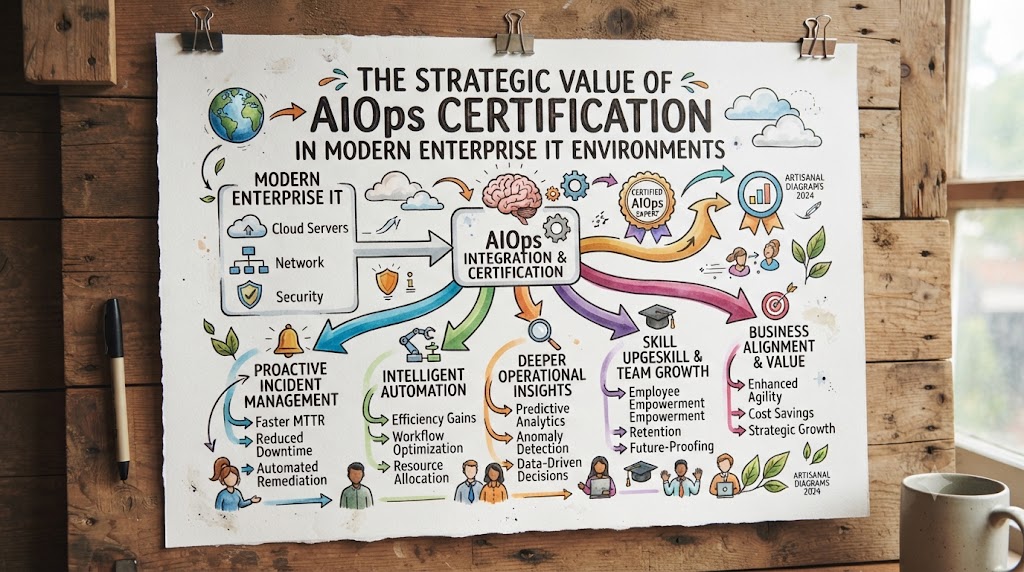
This “alert fatigue” is not just a nuisance; it is a direct threat to business stability and customer satisfaction. To solve this, organizations are turning to Artificial Intelligence for IT Operations. For those looking to stay ahead, mastering these skills is no longer optional—it is a requirement for professional growth. Whether you are an SRE, a DevOps engineer, or a technical leader, AIOpsSchool provides the specialized training and certification needed to bridge the gap between reactive monitoring and proactive, intelligent operations.
Featured Snippet
What Is AIOps?
AIOps (Artificial Intelligence for IT Operations) is the application of machine learning, data analytics, and automation to IT operations data. It automates the collection, analysis, and correlation of logs, metrics, and traces to detect anomalies, identify root causes, and resolve incidents faster than humanly possible.
Understanding AIOps
What Is Artificial Intelligence for IT Operations?
AIOps acts as the “brain” for your IT infrastructure. It ingests vast amounts of telemetry data to provide actionable insights, effectively cutting through the noise that plagues modern monitoring systems.
Why Traditional IT Operations Are No Longer Enough
Traditional tools rely on static thresholds. If CPU usage hits 90%, you get an alert. However, in a microservices environment, high CPU might be normal behavior. Traditional tools miss the context, leading to either constant false alarms or missed critical failures.
How AI and Machine Learning Improve Operations
By utilizing algorithms, AIOps learns “normal” behavior (baselining). When something deviates—even in ways that don’t trigger a hard threshold—the system identifies the anomaly. It then correlates related events across different services to pinpoint the true source of a problem.
Evolution from Monitoring to Intelligent Operations
| Traditional Operations | AIOps-Driven Operations |
| Reactive, manual troubleshooting | Proactive, automated resolution |
| Static thresholds and rules | Dynamic baselining and pattern matching |
| Data silos (logs/metrics/traces) | Unified observability and intelligence |
| High alert fatigue | High signal-to-noise ratio |
Why AIOps Skills Are Becoming Essential
In Simple Terms
Imagine trying to fix a leaking pipe in a house where 100 other pipes are all making noise. AIOps is the tool that highlights the one pipe that is actually broken, ignoring all the harmless background noise.
Real-World Example
A global e-commerce site experiences a checkout failure. Without AIOps, engineers manually check logs across five different clusters. With AIOps, the system correlates the spike in database latency with a specific deployment from ten minutes ago and automatically flags the culprit.
Why It Matters
For businesses, downtime costs millions. For engineers, AIOps represents the transition from “firefighting” to “system engineering,” reducing stress and allowing for more innovative work.
Key Takeaways
- AIOps eliminates noise by prioritizing relevant alerts.
- It enables faster mean time to resolution (MTTR).
- It transforms IT teams into data-driven decision-makers.
AIOps Certification Explained
What Is an AIOps Certification?
A professional certification validates that an individual possesses the theoretical knowledge and practical proficiency to design, implement, and manage AIOps solutions.
Benefits of Professional Certification
- Industry Recognition: Demonstrates expertise to employers.
- Skill Standardization: Ensures you follow industry best practices.
- Career Advancement: Positions you for senior SRE or Architect roles.
Who Should Pursue AIOps Certification?
- DevOps/SRE Engineers: To automate incident response.
- Cloud/Platform Engineers: To manage complex cloud architectures.
- IT Managers: To lead digital transformation initiatives.
AIOps Training and Courses
Learners at AIOpsSchool typically dive deep into:
- Event Correlation: Linking alerts to specific incidents.
- Predictive Analytics: Forecasting capacity needs.
- Observability: Utilizing OpenTelemetry to gain full-stack visibility.
AIOps Engineer Certification Path
| Level | Skills | Outcome |
| Beginner | Observability basics, Monitoring tools | Foundations of data collection |
| Intermediate | ML models for IT, Event correlation | Building automated alerting flows |
| Advanced | AI Strategy, Predictive Ops, Architecture | Enterprise-scale AIOps adoption |
AIOps Engineer Career Roadmap
Learning Sequence
- Master core Linux and Networking.
- Become proficient in Cloud (AWS/Azure/GCP) and Kubernetes.
- Deep dive into Monitoring and Observability (Prometheus, Grafana).
- Learn Automation (Python/Go) and CI/CD pipelines.
- Specialize in AIOps platforms and ML techniques.
AI Observability Training
What Is AI Observability?
It is the ability to understand the internal state of a system based on its external outputs (logs, metrics, traces), enhanced by AI to explain why things are failing.
Monitoring vs. Observability
| Feature | Monitoring | Observability |
| Focus | “Is the system healthy?” | “Why is it behaving this way?” |
| Scope | Known unknowns (dashboards) | Unknown unknowns (exploratory) |
AIOps for SRE and DevOps Engineers
AIOps integrates seamlessly into SRE practices by automating the “Toil.” Instead of manually analyzing logs during an incident, SREs use AIOps to automatically group related events and present the root cause in the incident ticket. This drastically reduces the cognitive load during high-pressure outages.
Enterprise AIOps Consulting
Organizations often struggle with the “how” rather than the “what.” Consulting helps by assessing operational maturity, ensuring you have the right data quality, and helping with vendor selection. Implementing AIOps isn’t just about software; it’s about changing how teams operate.
AIOps Implementation Services
Implementation Lifecycle
- Assessment: Analyze current data streams.
- Design: Create the architecture.
- Integration: Connect tools via OpenTelemetry.
- Optimization: Tune ML models for accuracy.
Real-World Enterprise Use Cases
- Banking: Detecting fraudulent transaction patterns via infrastructure anomalies.
- SaaS: Self-healing auto-scaling groups that resolve memory leaks without manual intervention.
Common Challenges & Solutions
- Data Quality: “Garbage in, garbage out.” Solution: Invest in standardizing logs and metrics early.
- Resistance: Teams fearing job loss. Solution: Frame AIOps as a tool for career growth, not replacement.
Why Learn with AIOpsSchool
AIOpsSchool combines deep technical training with real-world consulting expertise. Our programs ensure that students aren’t just learning tools, but understanding the architectural principles behind successful AI-driven IT operations.
FAQ SECTION
1. What is AIOps Certification?
A formal validation of your professional skills, confirming you can design, implement, and manage AI-driven systems to optimize IT operations.
2. Who should learn AIOps?
Any IT professional involved in system reliability, DevOps, SRE, or platform engineering who wants to move from manual monitoring to intelligent automation.
3. What skills are required for AIOps Engineers?
You need a solid foundation in Linux, networking, cloud infrastructure, Kubernetes, and basic programming (Python), plus a deep understanding of monitoring tools.
4. How does AIOps help DevOps teams?
It reduces “toil” by automating root cause analysis, filtering out noise, and allowing teams to focus on shipping code rather than managing incidents.
5. What is AI Observability?
It is the advanced practice of using AI to interpret telemetry data (logs, metrics, traces), providing deeper context into why system failures occur.
6. What is OpenTelemetry?
It is an open-source framework that provides a standardized way to collect and export telemetry data, making it the backbone of modern observability.
7. How long does it take to learn AIOps?
With a structured approach and hands-on labs, you can build proficiency in a few months, though mastery comes with continuous practice.
8. What are AIOps Implementation Services?
These are expert-led services that help organizations assess their current maturity and deploy AIOps tools to ensure a smooth, effective transition.
9. Is AIOps a good career choice?
Yes. As companies scale, they desperately need engineers who can manage complex systems intelligently, making AIOps skills highly valuable.
10. What is the future of AIOps?
The future is moving toward fully autonomous, “self-healing” infrastructure that can predict and fix issues before they impact the end user.
FINAL SUMMARY
The adoption of AIOps is inevitable as infrastructure complexity continues to rise. By mastering these skills through structured training and certification, you position yourself at the forefront of the IT industry. Whether you are an individual looking to pivot your career or an organization looking to implement these technologies, AIOpsSchool offers the expertise and frameworks to guide you toward a more resilient, efficient, and intelligent future.
