Introduction
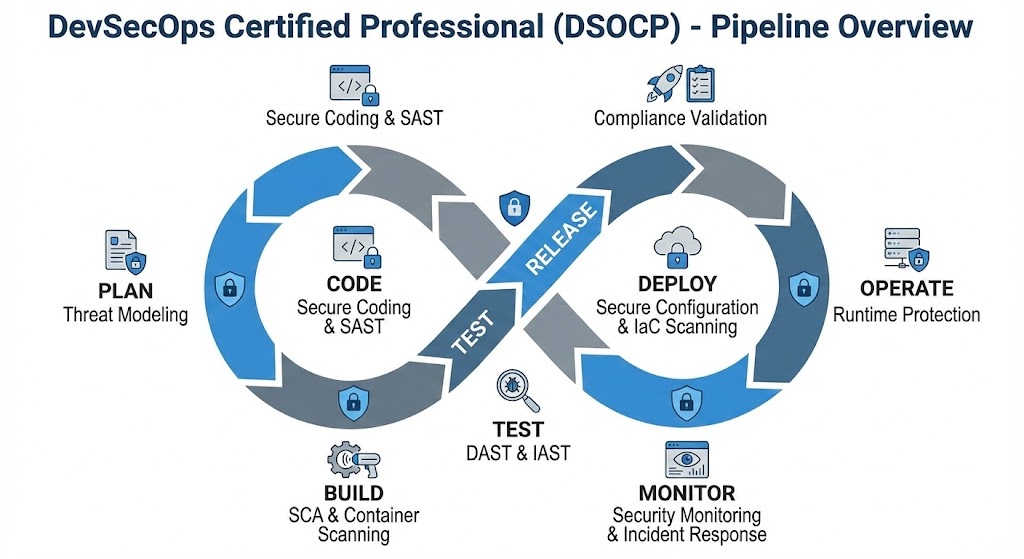
In the current era of rapid software delivery, security often becomes a bottleneck if teams treat it as an afterthought. Consequently, the industry has shifted toward a model where security integrates directly into the DevOps pipeline. This comprehensive guide focuses on the DevSecOps Certified Professional (DSOCP) program, which equips engineers with the skills to automate security across the entire software development lifecycle. Specifically, this guide serves professionals who aim to bridge the gap between development, operations, and security. By following this roadmap, engineers and managers can make informed career decisions and master the art of building “security as code.” Ultimately, this certification provides a structured path to becoming a high-demand specialist in the global tech market.
What is the DevSecOps Certified Professional (DSOCP)?
The DevSecOps Certified Professional (DSOCP) represents a rigorous validation of an engineer’s ability to implement security protocols within automated environments. Rather than focusing purely on theoretical concepts, this program emphasizes real-world, production-focused learning. It exists to address the critical need for security automation in modern engineering workflows. Furthermore, the certification aligns with enterprise practices where speed and safety must coexist. Professionals who earn this credential demonstrate that they can manage vulnerabilities, secure containers, and maintain compliance without slowing down the release cycle. Therefore, it serves as a benchmark for excellence in the cloud-native ecosystem.
Who Should Pursue DevSecOps Certified Professional (DSOCP)?
Software engineers and system administrators who want to transition into specialized security roles find immense value in this program. Additionally, Site Reliability Engineers (SREs) and Platform Engineers benefit because they must ensure the infrastructure they build remains resilient against attacks. Cloud professionals and data engineers also pursue this certification to protect sensitive information in distributed systems. Beginners with a foundational understanding of DevOps can use this track to niche down early in their careers. Meanwhile, engineering managers and technical leaders gain the oversight necessary to guide their teams toward secure delivery. Both the Indian market and the global tech industry currently show a massive demand for these specific skills.
Why DevSecOps Certified Professional (DSOCP) is Valuable for the Future
The demand for DevSecOps professionals continues to grow as enterprises migrate more workloads to the cloud. Specifically, organizations now prioritize candidates who can prevent breaches before they occur in production. This certification ensures longevity in a professional’s career because it teaches principles that remain relevant despite frequent tool changes. Furthermore, the return on time investment is significant, as certified individuals often command higher salaries and more senior roles. Since enterprise adoption of automated security is no longer optional, this credential proves that an engineer can handle complex compliance requirements. Consequently, staying relevant in the modern landscape requires this deep technical expertise.
DevSecOps Certified Professional (DSOCP) Certification Overview
The DevSecOps Certified Professional (DSOCP) program is delivered via the official DevSecOps Certified Professional (DSOCP) course page and hosted on DevOpsSchool. This program uses a practical assessment approach that evaluates a candidate’s hands-on capabilities rather than just their memory. The ownership of the certification rests with industry experts who ensure the curriculum stays updated with current threats and technologies. Generally, the structure includes a mix of interactive modules, lab exercises, and a final evaluation. Professionals appreciate this structure because it provides immediate feedback on their technical proficiency. Clearly, the program prioritizes competence over mere participation.
DevSecOps Certified Professional (DSOCP) Certification Tracks & Levels
The certification path follows a logical progression from foundational knowledge to advanced mastery. First, the foundation level introduces core concepts such as the CI/CD pipeline and basic security scanning. Subsequently, the professional level—where DSOCP resides—dives deep into automation, container security, and compliance as code. Finally, the advanced levels focus on architecture, threat modeling, and executive-level security strategy. These specialization tracks allow professionals to align their learning with their specific career goals, whether they focus on SRE, FinOps, or pure Security Engineering. By progressing through these levels, an engineer builds a robust portfolio of skills that matches modern enterprise needs.
Complete DevSecOps Certified Professional (DSOCP) Certification Table
| Track | Level | Who it’s for | Prerequisites | Skills Covered | Recommended Order |
| DevSecOps Core | Foundation | Aspiring Engineers | Basic Linux & Git | DevOps Basics, Intro to Security | 1st |
| DSOCP | Professional | DevOps/Security Engineers | 1-2 years experience | SAST, DAST, Container Security, Vault | 2nd |
| Expert Track | Advanced | Senior Architects | DSOCP Certification | Threat Modeling, Governance, Policy | 3rd |
| Cloud Security | Professional | Cloud Engineers | AWS/Azure Basics | IAM, VPC Security, CloudTrail | Concurrent |
| Compliance Track | Professional | Audit & Lead Roles | DSOCP Basics | PCI-DSS, GDPR Automation, SOC2 | Optional |
Detailed Guide for Each DevSecOps Certified Professional (DSOCP) Certification
DevSecOps Certified Professional (DSOCP) – Foundation
What it is This certification validates a professional’s understanding of the basic synergy between development and security teams. It ensures that the candidate understands the terminology and the cultural shift required for DevSecOps.
Who should take it Entry-level engineers, students, or traditional QA professionals should take this exam. It serves those who have little experience with security automation but understand the software lifecycle.
Skills you’ll gain
- Understanding the DevOps lifecycle
- Basic Git and version control security
- Introduction to automated testing
- Awareness of common vulnerabilities (OWASP Top 10)
Real-world projects you should be able to do
- Setting up a basic Jenkins pipeline
- Running a simple SonarQube scan
- Identifying insecure dependencies in a project
Preparation plan
- 7 Days: Review all core DevOps definitions and the DSOCP syllabus.
- 30 Days: Complete foundational labs on Linux and basic scripting.
- 60 Days: Build three different pipelines with integrated security checks.
Common mistakes
- Ignoring the cultural aspect of DevOps.
- Focusing only on tools instead of the underlying process.
- Skipping the prerequisites of basic Linux commands.
Best next certification after this
- Same-track option: DSOCP Professional
- Cross-track option: Cloud Practitioner
- Leadership option: DevOps Foundation
DevSecOps Certified Professional (DSOCP) – Professional
What it is This level confirms that an engineer can actively implement security tools into a live CI/CD environment. It validates expertise in Static Application Security Testing (SAST) and Dynamic Application Security Testing (DAST).
Who should take it Active DevOps engineers and security analysts with at least one year of experience should pursue this. It fits those who are responsible for maintaining production infrastructure and code quality.
Skills you’ll gain
- Implementing SAST/DAST tools like Snyk and ZAP
- Managing secrets using HashiCorp Vault
- Securing Docker containers and Kubernetes clusters
- Automating infrastructure security with Terraform
Real-world projects you should be able to do
- Create a zero-trust architecture for a microservices app.
- Automate secret rotation across multiple environments.
- Build a pipeline that fails builds based on high-severity security findings.
Preparation plan
- 7 Days: Focus on tool integration syntax and API usage.
- 30 Days: Set up complex labs involving Vault and Kubernetes.
- 60 Days: Perform a full end-to-end security audit on a sample application.
Common mistakes
- Hardcoding secrets during lab exercises.
- Failing to understand how to interpret tool reports.
- Over-automating without setting proper alert thresholds.
Best next certification after this
- Same-track option: DevSecOps Expert
- Cross-track option: Certified Kubernetes Security Specialist (CKS)
- Leadership option: Engineering Manager Track
Choose Your Learning Path
DevOps Path
Engineers on this path focus primarily on the speed of delivery and the reliability of the system. Specifically, they learn how to integrate security tools so that they do not impede the developer’s experience. This path emphasizes CI/CD mastery and infrastructure as code. Consequently, these professionals become the bridge between the product and the platform.
DevSecOps Path
This path prioritizes the security-first mindset throughout the entire automation process. Instead of just running scripts, these engineers design the guardrails that protect the whole organization. They focus heavily on vulnerability management and compliance automation. Ultimately, they ensure that every piece of code is verified before it reaches a customer.
SRE Path
Site Reliability Engineers focus on the availability and performance of applications under stress. In this path, security is viewed as a component of reliability, as a breach is essentially a major reliability failure. These professionals learn to monitor for security anomalies in real-time. Therefore, they combine observability with security forensics to maintain system health.
AIOps / MLOps Path
As artificial intelligence becomes standard, securing the data pipeline and the models themselves is crucial. This path teaches how to protect machine learning training data and prevent model poisoning. Furthermore, it covers the automation of operational tasks using AI-driven security insights. Professionals here work at the cutting edge of automated defense.
DataOps Path
Data security and privacy are the primary goals for this learning trajectory. Specifically, engineers learn how to secure data at rest and in transit across large-scale distributed databases. They implement automated masking and encryption within the data pipeline. This path is essential for organizations dealing with highly sensitive user information.
FinOps Path
While FinOps focuses on cost optimization, security plays a role in preventing unauthorized resource consumption. This path covers how to identify “rogue” resources that might indicate a security breach or a cryptojacking attempt. Additionally, it explores how to automate governance to keep cloud spending and security in check. Clearly, it provides a unique blend of financial and technical oversight.
Role → Recommended (Topic name) Certifications
| Role | Recommended Certifications |
| DevOps Engineer | DSOCP Professional, Docker/K8s Certified |
| SRE | DSOCP Professional, Prometheus/Grafana Certified |
| Platform Engineer | DSOCP Expert, Terraform Associate |
| Cloud Engineer | DSOCP Professional, AWS/Azure Security Specialty |
| Security Engineer | DSOCP Expert, CKS, CISSP |
| Data Engineer | DSOCP Foundation, Big Data Security |
| FinOps Practitioner | DSOCP Foundation, FinOps Certified Practitioner |
| Engineering Manager | DSOCP Foundation, DevOps Leader |
Next Certifications to Take After DevSecOps Certified Professional (DSOCP)
Same Track Progression
After completing the DSOCP, professionals should aim for the Expert level to master architectural security. This involves learning how to design entire systems that are “secure by design” from the ground up. Specifically, this track focuses on advanced threat modeling and incident response automation. Achieving this level marks an individual as a top-tier technical authority in the field.
Cross-Track Expansion
Broadening your skills into related areas like Kubernetes security or Cloud architecture is highly beneficial. For instance, obtaining a CKS (Certified Kubernetes Security Specialist) complements the DSOCP perfectly. Additionally, learning about cloud-specific security services on AWS or Azure provides a well-rounded profile. This expansion ensures that an engineer can handle any environment, regardless of the provider.
Leadership & Management Track
If you intend to move into leadership, focus on certifications that emphasize governance and team strategy. Roles like Head of DevSecOps require a mix of technical knowledge and people management skills. Consequently, you should look into certifications that cover the business impact of security and risk management. This transition allows you to influence security culture at the highest organizational levels.
Training & Certification Support Providers for DevSecOps Certified Professional (DSOCP)
DevOpsSchool This provider offers extensive hands-on training and lab-based learning for DSOCP aspirants. They provide expert-led sessions that cover the entire toolchain in great detail. Furthermore, their curriculum stays updated with the latest industry trends.
Cotocus Cotocus focuses on providing corporate training solutions tailored for large engineering teams. They emphasize practical implementation and real-world scenarios in their DevSecOps modules. Additionally, their mentors come with deep industrial experience.
Scmgalaxy As a community-driven platform, Scmgalaxy offers a wealth of resources, tutorials, and documentation for DevSecOps. They help professionals understand the nuances of source code management and security integration. Their forums are excellent for troubleshooting complex technical issues.
BestDevOps BestDevOps provides curated learning paths for engineers looking to specialize in automation. They offer specialized workshops that focus on specific tools like Vault or Jenkins. Consequently, they are a great choice for targeted skill development.
devsecopsschool.com This is a dedicated platform for all things related to security in the DevOps world. They offer niche certifications and deep-dive courses into specific security domains. Clearly, it serves as a central hub for DevSecOps professionals globally.
sreschool.com SREschool focuses on the reliability and stability aspect of the modern infrastructure. They provide training that bridges the gap between traditional operations and modern site reliability. Their courses often include security as a pillar of reliability.
aiopsschool.com This provider specializes in the intersection of artificial intelligence and IT operations. They teach how to use machine learning to automate security monitoring and incident response. This is ideal for engineers looking toward the future of automation.
dataopsschool.com DataOpsschool offers training specifically for securing data pipelines and managing data at scale. They focus on the unique challenges of data privacy and compliance in the cloud. Their modules are essential for modern data engineers.
finopsschool.com This platform teaches the art of cloud financial management combined with technical governance. They help professionals understand how to keep cloud environments both secure and cost-effective. It is the go-to resource for FinOps practitioners.
Frequently Asked Questions (General)
- How difficult is the DSOCP exam? The difficulty level is moderate to high because it requires hands-on proficiency rather than just theoretical knowledge. You must demonstrate the ability to configure tools and fix security vulnerabilities in a simulated environment. Consequently, candidates who rely only on reading often find the practical labs challenging. Proper hands-on practice is essential for success.
- How much time does it take to prepare for DSOCP? Preparation time varies based on your background, but most professionals spend 30 to 60 days. If you are already familiar with CI/CD, you might only need a few weeks to learn the security tools. However, beginners should dedicate at least two months to master the underlying technologies. Consistency in lab practice is the key to reducing this time.
- What are the prerequisites for this certification? A basic understanding of Linux, Git, and the DevOps lifecycle is highly recommended. While there are no strict mandatory prerequisites, having some experience with scripting significantly helps. Furthermore, familiarity with at least one cloud provider like AWS or Azure makes the learning process smoother. These basics form the foundation for all advanced security concepts.
- Is the DSOCP certification worth the investment? Yes, the certification offers a high return on investment given the current demand for security-aware engineers. Companies are willing to pay a premium for professionals who can protect their infrastructure. Additionally, the skills you gain are applicable across many different industries and technology stacks. It essentially future-proofs your career against shifting market demands.
- Should I learn DevOps before DevSecOps? It is highly beneficial to understand the core principles of DevOps before diving into security. You need to know how a pipeline works before you can effectively secure it. Transitioning from DevOps to DevSecOps is a natural progression for most engineers. Therefore, having a solid grasp of automation basics will make your DevSecOps journey much easier.
- How does DSOCP compare to other security certifications? Unlike traditional certifications like CISSP which are more theoretical, DSOCP is deeply technical and automation-focused. It specifically targets the modern cloud-native ecosystem and CI/CD workflows. While other certifications might focus on policy, DSOCP focuses on “Security as Code.” This makes it more relevant for engineers working in active development environments.
- What tools are covered in the DSOCP program? The program covers a wide range of industry-standard tools including Jenkins, SonarQube, Snyk, and Docker. It also includes deep dives into HashiCorp Vault for secret management and various DAST tools. Specifically, you learn how to integrate these tools into a unified pipeline. This toolset represents the core of a modern DevSecOps architecture.
- Can I take the DSOCP exam online? Yes, the certification process is designed to be accessible globally through online platforms. You can complete the training and the assessments from the comfort of your home or office. This flexibility allows working professionals to balance their learning with their job responsibilities. Generally, the online environment provides all the necessary lab resources.
- How long is the DSOCP certification valid? Typically, the certification remains valid for two to three years, reflecting the fast-paced nature of the industry. Professionals are encouraged to stay updated by participating in continuing education or taking higher-level exams. This ensures that your skills remain sharp and relevant to the latest threats. Renewal processes often involve simplified assessments or project submissions.
- Does DSOCP help in getting a job in India? The Indian tech market is currently seeing a massive surge in demand for DevSecOps specialists in major hubs like Bangalore and Pune. Many large enterprises and startups specifically look for this credential during their hiring process. Consequently, having this certification on your resume can significantly increase your chances of landing a high-paying role. It serves as a strong differentiator.
- What is the typical salary for a DSOCP certified professional? Salaries vary by region and experience, but certified professionals often earn 20-30% more than their standard DevOps counterparts. In the global market, DevSecOps roles are among the highest-paid positions in the engineering field. Specifically, senior roles can command very high compensation packages. The investment in the certification usually pays for itself within the first year.
- Is there any lab support provided during the course? Most training providers like DevOpsSchool offer dedicated lab environments for hands-on practice. These labs simulate real-world production scenarios where you can practice without any risk. Furthermore, mentors are usually available to help you troubleshoot when you get stuck. This practical support is a crucial part of the learning experience.
FAQs on DevSecOps Certified Professional (DSOCP)
- What is the primary focus of the DSOCP curriculum? The curriculum focuses on the practical automation of security checks within the CI/CD pipeline. Specifically, it teaches engineers how to implement SAST, DAST, and container security. Professionals learn to treat security as an integral part of the development process rather than a separate phase.
- Does DSOCP cover cloud-specific security tools? Yes, the program includes security practices that are applicable to major cloud providers. It covers how to secure infrastructure as code and manage identities in cloud environments. Consequently, you gain the skills to protect applications regardless of where they are hosted.
- How does the assessment work for DSOCP? The assessment involves practical tasks where you must secure a given application or pipeline. You are evaluated on your ability to identify and fix real-world vulnerabilities. This ensures that every certified professional has the actual technical capability to perform the job.
- Is programming knowledge required for DSOCP? A basic understanding of scripting languages like Bash or Python is very helpful. Since DevSecOps involves automation, you will need to write and modify scripts to integrate tools. However, you do not need to be an expert software developer to succeed.
- Does the course cover container security and Kubernetes? Yes, securing containers and orchestrators is a major component of the DSOCP program. Specifically, you learn how to scan images for vulnerabilities and secure the Kubernetes runtime. This is essential for modern microservices architectures used by most enterprises today.
- Can a project manager benefit from DSOCP? Technical project managers find this certification useful for understanding the complexities of secure delivery. It helps them set realistic timelines and understand the security requirements of their products. Consequently, they can better facilitate communication between developers and security teams.
- Are there any group discounts for corporate training? Many providers like Cotocus offer specialized pricing for teams and corporate groups. This allows organizations to upskill their entire engineering department simultaneously. It is an effective way to drive a cultural shift toward DevSecOps across the whole company.
- What kind of certificate do I receive upon completion? You receive a digital certificate that is verifiable and can be shared on professional networks. This credential proves your expertise to potential employers and peers worldwide. Many professionals find that adding this to their LinkedIn profile leads to increased recruiter interest.
Final Thoughts: Is DevSecOps Certified Professional (DSOCP) Worth It?
From the perspective of a mentor with decades of experience, the shift toward integrated security is the most significant trend in modern engineering. Specifically, the DSOCP certification provides the structured path needed to master this complex domain. While the exam requires effort and hands-on practice, the career benefits are undeniable and long-lasting. You will gain the ability to build systems that are not just fast, but inherently safe. Therefore, if you aim to be a leader in the DevOps or Security space, this certification is a highly practical and rewarding choice. Avoid the hype and focus on the skills; this program provides exactly what the industry needs right now.