Introduction
Production environments require more than just deployment scripts; they demand absolute resilience, automated recovery, and structured scalability. This comprehensive guide details the Certified Site Reliability Engineer framework, designed explicitly for modern software engineers, platform specialists, and engineering leaders navigating complex cloud architectures. For professionals aiming to transition into high-scale environments or scale enterprise systems efficiently, understanding this learning path clarifies how to build systems that remain reliable under intense operational strain. Organizations globally rely on these methodologies to minimize downtime, and mastering these principles ensures long-term career relevance across DevOps, cloud architecture, and platform engineering domains. To explore the foundational learning tracks, engineers often utilize structured training from providers like aiopsschool to bridge the gap between traditional operations and automated platform infrastructure.
What is the Certified Site Reliability Engineer?
The Certified Site Reliability Engineer designation represents a practical blueprint for managing large-scale production environments through code and automation. It exists because theoretical knowledge fails when distributed systems experience cascading failures or network partitions under peak loads. This framework emphasizes hands-on mastery over infrastructure as code, continuous observability, chaos engineering, and rapid incident response protocols.
Unlike traditional administration pathways that rely on manual interventions, this curriculum aligns directly with real-world, production-focused engineering workflows. It trains professionals to treat operational problems as software engineering challenges, integrating closely with enterprise continuous delivery pipelines. By focusing on metrics that matter to the business, it transforms how teams manage availability, latency, efficiency, and capacity.
Who Should Pursue Certified Site Reliability Engineer?
This certification serves software engineers who want to specialize in system reliability, alongside active DevOps and cloud professionals looking to formalize their infrastructure expertise. Systems administrators aiming to transition away from manual scripting into full-scale automation will find immediate value in these tracks. Security engineers and data infrastructure professionals also benefit by learning how to build resilient data pipelines and secure runtime environments.
For beginners, it establishes the core mental models needed to understand distributed systems without getting lost in tool specificities. Experienced engineers gain advanced strategies for chaos engineering, root-cause analysis, and large-scale architectural design. Technical leaders and engineering managers in India and global tech hubs use this structure to standardize operational terminology, set realistic service level objectives, and build high-performing engineering cultures.
Why Certified Site Reliability Engineer
The modern technology stack evolves rapidly, but the architectural fundamentals of reliability remain remarkably consistent over time. Enterprise adoption of microservices and multi-cloud architectures has driven an unprecedented demand for engineers who understand system boundaries, failure domains, and automated remediation. This curriculum helps professionals stay relevant because it teaches underlying patterns and principles rather than focusing on a single vendor toolset.
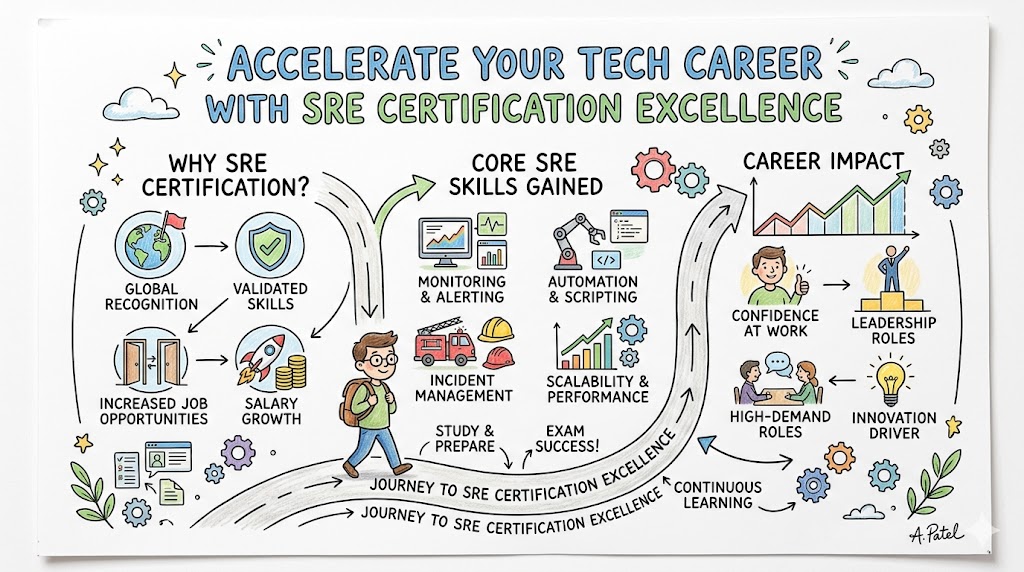
Investing time into this certification yields a substantial return by positioning engineers for senior infrastructure and platform design roles. It moves practitioners away from firefighting daily production fires toward designing self-healing systems that lower operational overhead. Ultimately, this expertise protects business revenue by ensuring system uptime, making certified individuals highly valuable assets to enterprise leadership teams.
Certified Site Reliability Engineer Certification Overview
The structured program is delivered via the official training portal and hosted on sreschool. The entire certification ecosystem uses practical, scenario-based assessments rather than simple multiple-choice questions to validate a candidate’s actual engineering capabilities. Ownership of the curriculum rests with industry practitioners who update the material to reflect contemporary production challenges.
The structure is broken down into distinct, sequential phases that prevent learners from skipping critical architectural fundamentals. Each level demands a mix of theoretical comprehension and hands-on laboratory completion to ensure concepts translate into real-world competence. By maintaining a strict evaluation standard, the program ensures that certified professionals possess true operational readiness.
Certified Site Reliability Engineer Certification Tracks & Levels
The curriculum organizes itself into foundation, professional, and advanced tiers to mirror the natural progression of an engineering career. The foundation level builds baseline competency in core metrics, basic automation, and Linux internals necessary for any modern cloud role. The professional tier shifts focus toward advanced system design, deep observability, and complex deployment strategies used in enterprise environments.
Specialization tracks allow professionals to align their studies with specific organizational needs, including deep dives into platform automation, architectural resilience, or financial optimization. Advanced levels challenge candidates with full-scale architectural failure scenarios and system design defenses. This multi-tiered approach provides a clear path for continuous skill acquisition over several years of professional development.
Complete Certified Site Reliability Engineer Certification Table
| Track | Level | Who it’s for | Prerequisites | Skills Covered | Recommended Order |
| Core SRE | Foundation | Associate Engineers & Systems Administrators | Basic Linux & Networking | SLOs, SLIs, Basic Git, Incident Response | 1 |
| Platform Automation | Professional | DevOps & Cloud Engineers | Foundation Level Core | Infrastructure as Code, CI/CD, Containerization | 2 |
| Resilience Engineering | Advanced | Senior SREs & Infrastructure Architects | Professional Level Automation | Chaos Engineering, Post-mortems, System Design | 3 |
| Operational Efficiency | Professional | Financial & Operations Managers | Basic Cloud Knowledge | Cost Optimization, Resource Allocation, Metrics | 4 |
Detailed Guide for Each Certified Site Reliability Engineer Certification
Certified Site Reliability Engineer – Foundation
What it is
This certification validates a candidate’s fundamental understanding of reliability engineering principles, core metrics, and basic system troubleshooting methodologies. It ensures the professional speaks the language of modern operations and understands the balance between feature velocity and system stability.
Who should take it
Junior software developers, system administrators transitioning to cloud roles, and technical project managers who need to interface regularly with infrastructure teams.
Skills you’ll gain
- Defining accurate Service Level Indicators (SLIs) and Service Level Objectives (SLOs).
- Calculating and managing error budgets to balance deployment speed and risk.
- Navigating Linux environments and diagnosing basic network connectivity issues.
- Participating effectively in on-call rotations and basic incident mitigation.
Real-world projects you should be able to do
- Configure a basic monitoring dashboard that tracks application error rates and latency.
- Write an incident retrospective document detailing a simulated production outage.
Preparation plan
- 7–14 Days: Focus heavily on the core vocabulary, studying the differences between availability metrics and reading case studies on error budget usage.
- 30 Days: Complete all foundational hands-on labs, practice setting up basic alerts, and review standard Linux command-line diagnostic tools.
- 60 Days: Take multiple practice evaluations, refine your understanding of incident workflows, and review foundational networking concepts thoroughly.
Common mistakes
- Spending too much time memorizing specific software command flags instead of learning core concepts.
- Overcomplicating SLI definitions by tracking too many non-essential metrics simultaneously.
Best next certification after this
- Same-track option: Certified Site Reliability Engineer – Professional
- Cross-track option: Platform Automation Specialist
- Leadership option: Engineering Management Foundation
Certified Site Reliability Engineer – Professional
What it is
This certification confirms an engineer’s capability to architect, automate, and observe complex distributed systems under variable traffic patterns. It proves mastery over automated deployment patterns, infrastructure code, and deep telemetry collection across microservices.
Who should take it
Mid-level DevOps engineers, active SREs with a few years of experience, and cloud architects looking to validate their operational execution skills.
Skills you’ll gain
- Implementing infrastructure as code blueprints for multi-tier applications.
- Building advanced distributed tracing systems to isolate microservice latencies.
- Designing automated canary deployments and automated rollback triggers.
- Managing stateful workloads inside container orchestration platforms efficiently.
Real-world projects you should be able to do
- Build a fully automated continuous deployment pipeline that rolls back automatically when error budgets are breached.
- Deploy a distributed tracing mesh across five distinct microservices to identify N+1 query problems.
Preparation plan
- 7–14 Days: Review advanced container networking models and deep-dive into the architectural mechanics of infrastructure-as-code state management.
- 30 Days: Build complete deployment pipelines from scratch in test environments, incorporating automated testing and telemetry verification stages.
- 60 Days: Focus on complex troubleshooting labs, practice reading distributed traces under simulated load, and take comprehensive practice exams.
Common mistakes
- Ignoring the data layer when planning automated rollbacks, leading to database state corruption during practice labs.
- Relying too much on manual configuration fixes during practical assessments instead of correcting the underlying automation code.
Best next certification after this
- Same-track option: Certified Site Reliability Engineer – Advanced
- Cross-track option: DevSecOps Automation Expert
- Leadership option: Technical Program Lead
Choose Your Learning Path
DevOps Path
This pathway bridges the traditional gap between application development and production deployments by emphasizing automated delivery pipelines. Engineers learn to integrate automated testing, linting, and structural validation directly into source control events. The primary focus centers on increasing deployment velocity without compromising the underlying system stability. Practitioners completing this track excel at creating repeatable environments that behave identically from local workstations all the way to production clusters.
DevSecOps Path
Security cannot exist as an afterthought or a final manual gate before a software release. This path embeds security scanning, vulnerability assessment, and compliance verification directly into the automated delivery pipeline. Engineers learn to audit container images, scan infrastructure code for misconfigurations, and manage secrets securely at scale. By treating security policy as code, professionals ensure that every deployment satisfies strict regulatory compliance standards automatically.
SRE Path
The core SRE track concentrates directly on system availability, latency optimization, capacity planning, and emergency response management. Practitioners master the art of monitoring production systems, writing automated self-healing scripts, and conducting blameless post-mortems. This path changes how engineers view failures, shifting the focus from blaming human error to fixing systemic architectural flaws. It is ideal for individuals who want to maintain large-scale, highly available internet properties.
AIOps Path
Modern production systems generate far too much telemetry data for human operators to analyze manually in real time. This specialization teaches engineers how to apply machine learning models to log streams, metric data, and trace information to detect anomalies early. Professionals learn to automate root-cause analysis and filter out alert fatigue by clustering related events together. This path prepares engineers to manage ultra-complex environments where traditional threshold-based alerting falls short.
MLOps Path
Deploying machine learning models requires a unique blend of traditional software engineering, data management, and infrastructure automation. This track focuses on building reliable pipelines for model training, versioning, deployment, and continuous drift monitoring. Engineers learn to manage GPU resources efficiently, scale inference endpoints dynamically, and ensure data lineage remains traceable. It bridges the gap between data science experimentation and hardened production reliability.
DataOps Path
Data pipelines require the same level of operational rigor, validation, and automated testing as traditional software codebases. This pathway teaches engineers how to build resilient data ingestion, transformation, and storage systems that handle fluctuating data volumes gracefully. Participants focus on monitoring data quality, automating database schema migrations, and ensuring high availability for data warehouses. It minimizes data corruption incidents and pipeline failures across the enterprise.
FinOps Path
Cloud scalability can lead to unpredictable operational costs if resource allocation runs unmonitored. This track educates professionals on how to align cloud spending with business value through detailed tagging, structural optimization, and architectural adjustments. Engineers learn to identify idle resources, configure precise auto-scaling thresholds, and design cost-efficient architectures without sacrificing performance. It ensures that infrastructure scaling remains financially sustainable over long-term growth.
Role → Recommended Certified Site Reliability Engineer Certifications
| Role | Recommended Certifications |
| DevOps Engineer | Foundation Core + Platform Automation Professional |
| SRE | Foundation Core + Professional Core + Advanced Resilience |
| Platform Engineer | Platform Automation Professional + Advanced Resilience |
| Cloud Engineer | Foundation Core + Operational Efficiency Professional |
| Security Engineer | Foundation Core + DevSecOps Automation Track |
| Data Engineer | Foundation Core + DataOps Specialization |
| FinOps Practitioner | Operational Efficiency Professional + FinOps Specialization |
| Engineering Manager | Foundation Core + Operational Efficiency Professional |
Next Certifications to Take After Certified Site Reliability Engineer
Same Track Progression
Once the core foundational and professional tiers are secure, deep specialization requires moving into advanced system architecture and chaos engineering frameworks. This involves studying how complex systems fail in unpredictable ways and designing validation suites that actively inject faults into production safely. Practitioners focus on absolute infrastructure resilience, disaster recovery patterns across multiple cloud vendors, and building self-healing platforms.
Cross-Track Expansion
Broadening your engineering impact means taking reliability principles and applying them to adjacent domains like security or data infrastructure. An experienced reliability engineer might expand into advanced compliance automation or machine learning pipeline design to diversify their skill set. This cross-pollination of skills creates versatile engineers capable of solving complex architectural bottlenecks that span multiple departments.
Leadership & Management Track
Transitioning away from individual technical delivery toward engineering leadership requires mastering cost structures, organizational design, and team operational dynamics. This path teaches how to translate technical error budgets into business risk assessments that executives understand. Leaders learn to build cultures that embrace blameless post-mortems, reduce operational toil, and balance feature delivery with long-term platform health.
Training & Certification Support Providers for Certified Site Reliability Engineer
DevOpsSchool provides comprehensive instructor-led training formats focused heavily on practical execution and live lab environments for enterprise teams.
Cotocus specializes in deep-dive technical bootcamps designed to help experienced systems engineers transition rapidly into modern platform automation roles.
Scmgalaxy offers an extensive repository of technical tutorials, community forums, and step-by-step guides covering core configuration management tooling.
BestDevOps focuses on delivering structured curriculum tracks tailored around contemporary continuous integration patterns and real-world deployment pipelines.
devsecopsschool centers its entire training catalog around security integration, vulnerability management automation, and compliant infrastructure-as-code implementations.
sreschool delivers the dedicated structural learning blueprints, specialized laboratory assessments, and core framework tracks for reliability engineering.
aiopsschool provides advanced training programs focusing on data anomaly detection, automated log analysis, and machine learning operations for enterprise infrastructure.
dataopsschool designs specialized training paths targeting data pipeline reliability, automated data validation, and distributed data warehouse operational strategies.
finopsschool concentrates exclusively on cloud financial management, resource optimization techniques, and aligning infrastructure expenditures with corporate business goals.
Frequently Asked Questions (General)
- What is the primary focus of this certification framework?The framework focuses entirely on converting manual operational tasks into automated software engineering solutions to ensure system reliability at scale.
- Are there strict prerequisites for the entry-level certification?No strict technical certifications are required, but a basic understanding of computer networking and standard operating system command lines is highly recommended.
- How long does it typically take to prepare for the professional exam?Most professionals with prior cloud experience spend between thirty to sixty days reviewing materials and completing practical laboratory assignments.
- Does the examination involve writing actual code or scripts?Yes, the higher-tier assessments require candidates to solve real infrastructure problems by writing automation scripts and configuration manifests.
- How does this program handle vendor-specific cloud technologies?The core curriculum teaches vendor-agnostic patterns and principles, ensuring the skills apply whether you run infrastructure on AWS, Azure, Google Cloud, or on-premises.
- What is the validity period of the issued certifications?Certifications remain valid for three years, after which professionals must complete recertification modules or clear a higher-level examination tier.
- How do error budgets protect engineering teams from burnout?Error budgets establish clear quantitative thresholds that dictate when a team must stop pushing new features and focus exclusively on stabilizing the platform.
- Can an engineering manager benefit from taking these technical courses?Yes, it provides managers with the framework necessary to define realistic service objectives and structure their teams for operational success.
- What is the difference between DevOps and SRE within this framework?DevOps focuses primarily on the velocity of delivery pipelines, while SRE focuses directly on the reliability and operational life cycle of the running software.
- How are the practical laboratory exams graded by the platform?Exams are evaluated based on the final operational state of the environment and whether the automated system meets the defined availability criteria.
- Are these certifications recognized by global enterprise organizations?Yes, the skills verified mirror the operational standards practiced by major technology companies and large-scale enterprise environments globally.
- Can I skip the foundational level if I have years of experience?Experienced practitioners can review the syllabus and choose to attempt the professional-level evaluations directly if they possess equivalent industry exposure.
FAQs on Certified Site Reliability Engineer
- How does the Certified Site Reliability Engineer program directly address modern alert fatigue?The curriculum teaches engineers to move away from simple threshold alerts on CPU utilization toward symptom-based alerting centered on customer impact. Students learn to configure alerts only when user-facing metrics like latency or error rates violate the agreed-upon Service Level Objectives.
- Does this training program include specific material covering container orchestration systems?Yes, container environments represent a major component of modern production infrastructure within the curriculum. The professional track covers managing stateful workloads, troubleshooting service mesh communication, and ensuring network isolation inside complex cluster configurations.
- What specific automation languages are utilized during the practical assessments?The practical challenges accept standard industry languages including Python, Go, and shell scripting for automation tasks. For infrastructure declaration, candidates utilize standard declarative formatting languages commonly found in modern infrastructure-as-code tools.
- How does the curriculum teach engineers to handle post-incident investigations cleanly?The framework provides a structured methodology for conducting blameless post-mortems that isolate systemic flaws rather than human errors. It focuses on timeline reconstruction, root-cause analysis isolation, and creating actionable engineering tickets to prevent failure recurrence.
- Is chaos engineering covered within the standard reliability learning paths?Chaos engineering principles are introduced at the professional level and explored thoroughly during the advanced resilience certification tracks. Engineers learn how to safely plan, execute, and monitor controlled failure injections within production environments to uncover hidden architectural weaknesses.
- How do Indian enterprise environments benefit from adopting this standardized framework?Enterprises dealing with high transaction volumes across digital payments, e-commerce, and logistics use this framework to minimize costly transactional downtime. It helps local engineering teams build systems that scale dynamically during massive localized traffic spikes.
- What strategy does the course recommend for managing legacy non-automated applications?The training details specific encapsulation methods, allowing legacy systems to interface with modern observability tools without requiring complete code rewrites. It guides teams on refactoring high-toil operations gradually through structured wrapper scripts and external monitoring probes.
- How does the program validate that a candidate understands capacity planning?Candidates must complete lab scenarios that simulate organic business growth alongside unexpected traffic surges. The evaluations test whether an engineer can accurately analyze historical resource usage trends to forecast necessary compute, storage, and network resource requirements.
Final Thoughts: Is Certified Site Reliability Engineer Worth It?
Navigating an engineering career in infrastructure requires making deliberate choices about where to invest your learning time. The Certified Site Reliability Engineer framework offers an authentic, structured path away from tactical, reactive firefighting toward strategic, automated platform engineering. It challenges practitioners to develop a deep, structural understanding of how software behaves when deployed at global scale across distributed nodes.
For professionals committed to mastering system resilience, this curriculum provides the necessary technical depth without leaning on marketing hype or passing tool trends. The value shows clearly in the real-world outcomes: steadier production environments, shorter incident resolution windows, and clear alignment between engineering velocity and business metrics. If your goal is to build and manage systems that withstand true production stress, formalizing your expertise through this path is a sound, practical investment.