Introduction
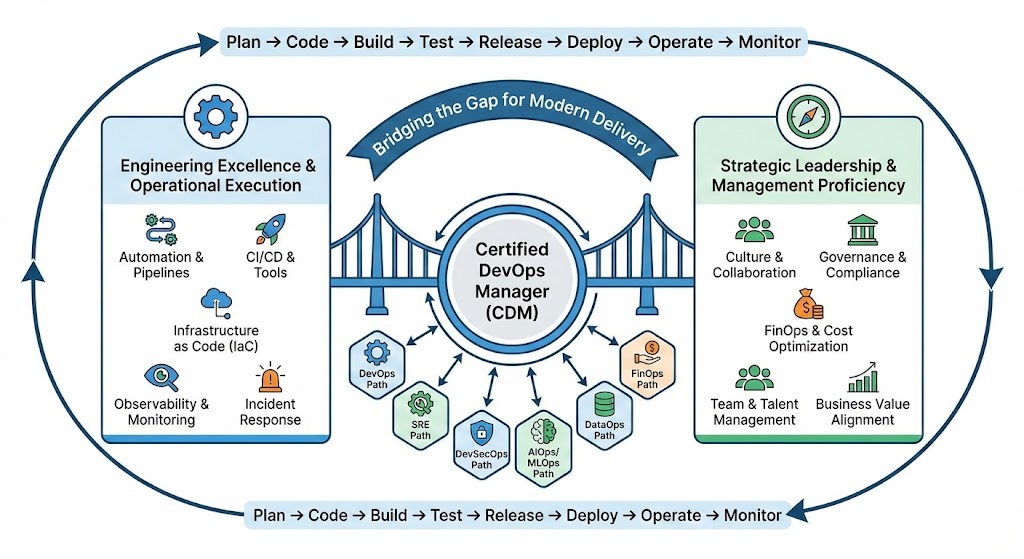
Navigating a career in the cloud-native era requires more than just knowing a few tools. Professionals often find themselves at a crossroads between technical execution and strategic leadership. This guide explores the Certified DevOps Manager (CDM) program, which bridges the gap between engineering excellence and management proficiency. It serves as a comprehensive roadmap for those looking to lead high-performing teams in a DevOps environment. Furthermore, this article clarifies how the program helps professionals make better career decisions while staying relevant in a competitive market.
What is the Certified DevOps Manager (CDM)?
The Certified DevOps Manager (CDM) represents a standard of excellence for individuals who lead modern software delivery teams. It exists because organizations need leaders who understand both the cultural shifts and the technical complexities of continuous integration and delivery. Instead of focusing solely on abstract management theories, this program emphasizes real-world, production-focused learning. Consequently, participants learn how to align engineering workflows with enterprise goals to ensure stability and speed. It provides a structured approach to mastering the orchestration of people, processes, and technology within a modern infrastructure.
Who Should Pursue Certified DevOps Manager (CDM)?
Engineering managers, technical leads, and aspiring directors benefit most from this certification. Experienced Site Reliability Engineers (SREs) and senior DevOps practitioners who want to move into leadership roles will find the curriculum particularly relevant. Moreover, cloud architects and security professionals who oversee large-scale deployments can use this knowledge to better integrate their domains. It is equally valuable for professionals in India and across the globe who manage diverse, distributed teams. Both beginners in leadership and seasoned veterans find that it validates their expertise and provides a common language for enterprise-level operations.
Why Certified DevOps Manager (CDM) is Valuable in 2026 and Beyond
The demand for skilled managers who can navigate the complexities of platform engineering and cloud-native ecosystems continues to grow. As organizations move away from legacy systems, they require leaders who can maintain operational excellence during major digital transformations. Longevity in a technical career depends on the ability to adapt to tool changes without losing sight of business value. This certification ensures that a professional stays relevant by focusing on core principles like automation, observability, and security. Ultimately, it offers a significant return on time by positioning the individual as a strategic asset to any engineering organization.
Certified DevOps Manager (CDM) Certification Overview
The program is delivered via DevOpsSchool and is hosted on devopsschool.com. It features a robust assessment approach that moves beyond simple multiple-choice questions to evaluate practical decision-making skills. The certification ownership resides with industry experts who have designed the structure to reflect current enterprise needs. It offers different levels of depth to accommodate various career stages, from foundational understanding to advanced strategic planning. By following this structured path, candidates gain a clear understanding of how to manage the lifecycle of modern software applications effectively.
Certified DevOps Manager (CDM) Certification Tracks & Levels
The certification structure includes foundation, professional, and advanced levels to support continuous professional development. The foundation level introduces core concepts of management within a DevOps culture, while the professional level dives into operational strategies and metric tracking. Furthermore, advanced levels focus on governance, financial management, and large-scale architectural oversight. These specialization tracks allow professionals to align their learning with specific roles like SRE lead or DevSecOps manager. As a result, the levels provide a logical progression that mirrors a typical career path from team lead to executive leadership.
Complete Certified DevOps Manager (CDM) Certification Table
| Track | Level | Who it’s for | Prerequisites | Skills Covered | Recommended Order | Official Link |
| Management | Foundation | Aspiring Leads | Basic DevOps knowledge | Culture, CI/CD Basics | First | devopsschool.com |
| Management | Professional | Current Managers | 3+ years experience | Metrics, KPIs, Tooling | Second | devopsschool.com |
| Management | Advanced | Directors/CTOs | 7+ years experience | Governance, Scaling | Third | devopsschool.com |
| SRE Lead | Professional | SRE Managers | SRE Fundamentals | Reliability, Error Budgets | Optional | devopsschool.com |
| Security | Professional | DevSecOps Leads | Security Basics | Compliance, Auditing | Optional | devopsschool.com |
Detailed Guide for Each Certified DevOps Manager (CDM) Certification
Certified DevOps Manager (CDM) – Foundation
What it is This certification validates a candidate’s understanding of the fundamental principles of DevOps management and cultural transformation. It ensures that the professional can articulate the value of automation and collaboration to stakeholders.
Who should take it Aspiring team leads and junior managers should take this to build a solid base in DevOps methodology. It is also suitable for project managers moving into the technical space.
Skills you’ll gain
- Understanding the DevOps mindset and cultural barriers.
- Knowledge of basic continuous integration and delivery pipelines.
- Ability to facilitate communication between siloed departments.
- Understanding of the software development life cycle (SDLC).
Real-world projects you should be able to do
- Designing a basic communication plan for a cross-functional team.
- Mapping out a value stream for a single application pipeline.
- Implementing a feedback loop between developers and operations.
Preparation plan
- 7–14 days: Review the core glossary and watch introductory videos on cultural shifts.
- 30 days: Complete a foundational course and participate in community forum discussions.
- 60 days: Deep dive into case studies of successful DevOps transitions and take mock exams.
Common mistakes
- Focusing too much on specific tools rather than cultural principles.
- Ignoring the importance of the human element in digital transformation.
Best next certification after this
- Same-track option: CDM Professional.
- Cross-track option: Certified SRE Practitioner.
- Leadership option: Project Management Professional (PMP).
Certified DevOps Manager (CDM) – Professional
What it is The professional level confirms that a manager can effectively measure, scale, and optimize DevOps practices across multiple teams. It focuses on data-driven decision-making and performance optimization.
Who should take it Current engineering managers and senior leads who oversee multiple pods or departments should pursue this. It is ideal for those responsible for the delivery speed and quality of software.
Skills you’ll gain
- Mastery of DORA metrics and engineering productivity tracking.
- Ability to select and manage a complex DevOps toolchain.
- Implementation of incident management and post-mortem cultures.
- Budgeting for cloud resources and automation tools.
Real-world projects you should be able to do
- Building a dashboard to track lead time and deployment frequency.
- Leading a root cause analysis (RCA) session for a production outage.
- Optimizing a CI/CD pipeline to reduce build times by 30%.
Preparation plan
- 7–14 days: Study the DORA metrics and performance measurement frameworks.
- 30 days: Analyze real-world incident reports and practice capacity planning.
- 60 days: Conduct a full audit of a hypothetical enterprise DevOps environment.
Common mistakes
- Over-complicating the toolstack without solving process bottlenecks.
- Failing to align engineering metrics with business outcomes.
Best next certification after this
- Same-track option: CDM Advanced.
- Cross-track option: DevSecOps Professional.
- Leadership option: MBA in Technology Management.
Certified DevOps Manager (CDM) – Advanced
What it is This certification proves that a leader can manage the governance, compliance, and financial aspects of large-scale DevOps organizations. It emphasizes strategic alignment and long-term sustainability.
Who should take it Senior directors, CTOs, and principal consultants who design organizational structures should take this level. It is meant for those who influence the technical direction of an entire enterprise.
Skills you’ll gain
- Strategic planning for enterprise-wide digital transformation.
- Advanced knowledge of FinOps and cloud cost optimization.
- Expertise in regulatory compliance within automated environments.
- Leadership strategies for managing high-performance technical cultures.
Real-world projects you should be able to do
- Creating a three-year roadmap for an enterprise cloud migration.
- Developing a governance framework for automated security checks.
- Managing a multi-million dollar budget for infrastructure and tools.
Preparation plan
- 7–14 days: Focus on financial modeling and governance frameworks.
- 30 days: Review legal and compliance requirements for various industries.
- 60 days: Draft a comprehensive organizational transformation strategy.
Common mistakes
- Losing touch with technical realities while focusing on high-level strategy.
- Underestimating the resistance to change in large legacy organizations.
Best next certification after this
- Same-track option: Executive Leadership Certification.
- Cross-track option: Certified FinOps Professional.
- Leadership option: Board Member Certification.
Choose Your Learning Path
DevOps Path
The DevOps path focuses on the seamless integration of development and operations. It guides managers through the process of building automated pipelines and fostering a culture of shared responsibility. Professionals on this path learn to eliminate silos and accelerate delivery cycles. Consequently, they become experts in workflow optimization and continuous improvement. This path is ideal for those who want to master the core tenets of modern software delivery.
DevSecOps Path
The DevSecOps path emphasizes the “shift left” mentality by integrating security into every stage of the lifecycle. Managers learn how to automate compliance checks and manage security vulnerabilities without slowing down production. Additionally, it covers the implementation of secure coding practices and automated auditing. This path is crucial for leaders working in highly regulated industries like finance or healthcare. It ensures that security is a shared responsibility rather than an afterthought.
SRE Path
The SRE path focuses on the reliability and scalability of production systems. Managers learn to balance the need for new features with the requirement for system stability using error budgets. Furthermore, it covers incident response, observability, and capacity planning. This path is perfect for leaders who manage infrastructure and platform teams. It provides the framework for maintaining high availability in complex, distributed environments.
AIOps / MLOps Path
The AIOps and MLOps path addresses the unique challenges of managing artificial intelligence and machine learning workflows. Managers learn how to apply DevOps principles to data science models and automated intelligence tools. This involves managing data pipelines, model versioning, and automated retraining. As a result, they can lead teams that deliver intelligent applications at scale. This path is becoming increasingly relevant as more companies integrate AI into their core products.
DataOps Path
The DataOps path applies the DevOps philosophy to data management and engineering. It focuses on improving the quality and reducing the cycle time of data analytics. Managers learn to orchestrate data pipelines and ensure data privacy across the organization. Moreover, it emphasizes the collaboration between data engineers, scientists, and business analysts. This path is essential for organizations that rely on real-time data for decision-making.
FinOps Path
The FinOps path teaches managers how to handle the financial complexities of cloud computing. It focuses on cost transparency, optimization, and accountability within engineering teams. Leaders learn to bridge the gap between finance, procurement, and engineering. Specifically, they discover how to maximize the value of cloud spend while maintaining performance. This path is vital for any organization looking to scale their cloud infrastructure sustainably.
Role → Recommended Certified DevOps Manager (CDM) Certifications
| Role | Recommended Certifications |
| DevOps Engineer | CDM Foundation, Jenkins Certified, Kubernetes Admin |
| SRE | CDM Professional, SRE Practitioner, Prometheus Expert |
| Platform Engineer | CDM Professional, Terraform Specialist, Cloud Architect |
| Cloud Engineer | CDM Foundation, AWS/Azure/GCP Architect |
| Security Engineer | CDM Professional, DevSecOps Specialist, CISSP |
| Data Engineer | DataOps Certification, CDM Foundation, BigData Expert |
| FinOps Practitioner | FinOps Certified, CDM Professional |
| Engineering Manager | CDM Advanced, PMP, Agile Leadership |
Next Certifications to Take After Certified DevOps Manager (CDM)
Same Track Progression
Deep specialization within the management track involves pursuing higher levels of the CDM program. After completing the foundation, a professional should aim for the professional level to master operational metrics. Following that, the advanced level prepares the individual for executive-level responsibilities. This progression ensures a deep understanding of the entire management spectrum. It solidifies your position as a subject matter expert in DevOps leadership.
Cross-Track Expansion
Broadening your skills across different tracks can make you a more versatile leader. For example, a manager with a CDM background might pursue a DevSecOps certification to better handle security concerns. Alternatively, learning about SRE practices can help a manager improve system reliability. This expansion allows you to speak the language of different specialized teams. Consequently, you can manage more diverse departments with higher efficiency.
Leadership & Management Track
Transitioning into broader executive leadership requires skills beyond technical management. After CDM, consider pursuing certifications like the PMP for project governance or an MBA for business strategy. These credentials help you understand the financial and organizational impacts of technical decisions. Furthermore, they prepare you for roles like VP of Engineering or Chief Technology Officer. This path is ideal for those who want to shape the future of their entire company.
Training & Certification Support Providers for Certified DevOps Manager (CDM)
DevOpsSchool
DevOpsSchool offers comprehensive training programs specifically tailored for the CDM certification. They provide expert-led sessions that focus on practical, hands-on experience and real-world scenarios. Their curriculum is regularly updated to reflect the latest industry trends and toolsets. Furthermore, they offer mentorship that helps professionals navigate their specific career challenges.
Cotocus
Cotocus provides specialized consulting and training services that focus on high-end DevOps and SRE practices. They help candidates prepare for the CDM exam by providing deep technical insights and architectural guidance. Their instructors are industry veterans who bring years of production experience to the classroom. Additionally, they offer customized corporate training for teams looking to upskill together.
Scmgalaxy
Scmgalaxy is a well-known community and training portal that provides a wealth of resources for DevOps managers. They offer practice exams, study guides, and community support for those pursuing the CDM certification. Their focus on supply chain management and automation makes them a great resource for operational excellence. Consequently, many professionals use their platform as a primary study hub.
BestDevOps
BestDevOps focuses on delivering high-quality, practical training for modern engineering roles. They offer CDM preparation courses that emphasize the use of industry-standard tools and frameworks. Their training modules are designed to be concise yet thorough, making them ideal for busy professionals. Moreover, they provide continuous support through alumni networks and specialized workshops.
devsecopsschool.com
This provider focuses specifically on the intersection of security and DevOps. They offer training that helps CDM candidates understand how to lead secure engineering organizations. Their curriculum covers everything from automated threat modeling to compliance as code. This makes them an essential partner for managers in high-security environments.
sreschool.com
Sreschool.com provides dedicated training for Site Reliability Engineering and system stability. They help managers understand the technical requirements for maintaining high-availability systems. Their courses are a perfect complement to the CDM program for those focused on production operations. Specifically, they focus on observability, incident management, and error budget implementation.
aiopsschool.com
Aiopsschool.com is a leading provider of training for artificial intelligence in operations. They help managers understand how to integrate machine learning into their DevOps workflows. Their CDM-related modules focus on the management of automated intelligence systems and data science models. This ensures that leaders are prepared for the next wave of technological innovation.
dataopsschool.com
Dataopsschool.com offers specialized training in the management of data pipelines and analytics. They help CDM candidates understand the unique challenges of applying DevOps to data engineering. Their courses emphasize collaboration, data quality, and automated testing for data systems. As a result, managers can lead data-driven organizations more effectively.
finopsschool.com
Finopsschool.com focuses on the financial management of cloud environments. They provide CDM candidates with the tools and knowledge needed to optimize cloud spending and improve ROI. Their training covers cost allocation, forecasting, and the cultural shift required for financial accountability. This is a critical skill for any modern engineering leader.
Frequently Asked Questions (General)
- How difficult is the Certified DevOps Manager (CDM) exam? The exam is moderately challenging because it requires a mix of technical knowledge and management intuition. It does not just test your ability to memorize facts but evaluates how you apply DevOps principles to solve organizational problems. Candidates with a background in engineering or team leadership usually find the concepts relatable. However, those without any exposure to CI/CD or Agile might struggle with the foundational concepts. Preparation is key, and taking a structured course significantly improves the pass rate. Transitioning from a purely technical role to a management mindset is often the hardest part.
- How much time is required to prepare for the CDM certification? The time required varies based on your experience level and the specific track you choose. For a foundational level, most professionals need about 30 days of consistent study to feel confident. For the professional and advanced levels, a more rigorous 60-day plan is recommended to cover complex topics like governance and FinOps. You should dedicate at least 5-10 hours per week to reading, watching videos, and taking practice exams. Consistency is more important than cramming, as the concepts need time to sink in. Structured training programs can often accelerate this timeline.
- What are the prerequisites for the Certified DevOps Manager (CDM)? The prerequisites depend on the level you are targeting within the CDM framework. For the foundation level, a basic understanding of software development and IT operations is sufficient. For the professional level, having 3 to 5 years of experience in an engineering or lead role is highly recommended. The advanced level typically requires at least 7 years of industry experience and a history of managing teams or large projects. Familiarity with Agile methodologies and basic cloud concepts is also expected across all levels. These prerequisites ensure that candidates can actually apply what they learn in a professional setting.
- Is the CDM certification worth the investment in India? Yes, it is highly valuable in India due to the massive growth of the technology sector and the shift toward cloud-native architectures. Indian GCCs (Global Capability Centers) and service providers are constantly looking for leaders who can manage DevOps transformations. Having a CDM certification sets you apart from candidates who only have technical skills. It demonstrates to employers that you understand the business and cultural side of technology. Consequently, many professionals see a significant salary hike or a move into a senior leadership role after getting certified. It is a solid investment for long-term career growth.
- Should I take the CDM certification before or after an SRE certification? This depends on your career goals and current role. If you are already in a management position or want to move into one quickly, taking the CDM first is beneficial. It provides the broad leadership framework you need to oversee various technical functions. However, if you are currently a deep-dive technical contributor, taking an SRE certification first might be better. The SRE training provides the technical foundation for reliability which the CDM then builds upon from a management perspective. Often, the two certifications complement each other well, and many people eventually complete both for a well-rounded profile.
- What is the typical salary impact of the Certified DevOps Manager (CDM)? While salary depends on many factors like location and experience, the CDM certification generally leads to a positive impact. Certified managers often command salaries that are 20% to 30% higher than their non-certified peers in similar roles. This is because the certification validates a specialized skill set that is in high demand and short supply. In global markets, this can translate to significant annual increases. Furthermore, it opens doors to high-paying director and executive-level positions. Companies are willing to pay a premium for leaders who can effectively reduce delivery times and improve system reliability.
- How does CDM compare to a traditional PMP certification? The CDM and PMP serve different purposes within an organization. The PMP is a general project management certification that focuses on timelines, budgets, and traditional governance. In contrast, the CDM is specifically tailored for the DevOps and software engineering environment. It covers technical topics like CI/CD, automation, and site reliability that the PMP does not address. While a PMP is great for generalists, the CDM is superior for those leading modern engineering teams. Ideally, a senior leader might hold both to demonstrate a comprehensive understanding of both general and technical management.
- Can I pass the CDM exam without formal training? It is possible to pass the exam through self-study if you have extensive real-world experience in DevOps management. However, formal training is highly recommended for most candidates. Training programs provide a structured curriculum, expert insights, and practice materials that are hard to find on your own. They also help you focus on the specific areas that the exam covers, saving you time. Moreover, the mentorship provided in formal courses can help you understand complex cultural and strategic concepts. For most people, the investment in a training program pays off by ensuring a first-time pass.
- Does the CDM certification expire? Most professional certifications require some form of renewal or continuing education to stay active, and the CDM is no different. This ensures that certified professionals remain up to date with the latest industry trends and technological shifts. Usually, you need to renew every two to three years by participating in professional development activities or passing a shorter renewal exam. This process encourages lifelong learning and maintains the value of the credential in the eyes of employers. Always check the official website for the most current renewal policies and requirements to ensure your certification remains in good standing.
- How do I choose the right provider for CDM training? Choosing the right provider involves looking at their track record, instructor expertise, and course curriculum. Look for providers like DevOpsSchool that have a long history of training DevOps professionals. Read reviews and testimonials from past students to gauge the quality of the instruction. Ensure that the course offers hands-on labs and real-world case studies rather than just theory. Additionally, consider the level of post-training support and community access they provide. A good provider should offer more than just a certificate; they should offer a path to mastering the material and advancing your career.
- What is the assessment format for the CDM? The assessment for the Certified DevOps Manager (CDM) typically involves a mix of multiple-choice questions and scenario-based challenges. The multiple-choice section tests your knowledge of definitions, frameworks, and core principles. The scenario-based questions evaluate your ability to make strategic decisions in a simulated environment. For example, you might be asked how to handle a specific team conflict or how to optimize a failing pipeline. This dual approach ensures that you have both the theoretical knowledge and the practical skills needed for management. It is a comprehensive evaluation of your readiness for a leadership role.
- Are there any community groups for CDM professionals? Yes, there are several online and offline community groups where CDM professionals can connect and share knowledge. Websites like scmgalaxy.com and devopsschool.com host forums and discussion boards dedicated to DevOps management. You can also find groups on LinkedIn and Slack where professionals discuss industry trends and career opportunities. Participating in these communities is a great way to stay informed and network with other leaders in the field. It also provides a platform to ask questions and get advice from those who have already completed the certification. Networking is often as valuable as the certification itself.
FAQs on Certified DevOps Manager (CDM)
- What specific management frameworks does the CDM cover? The CDM program covers a variety of frameworks including Agile, Lean, and ITIL within the context of DevOps. It emphasizes the integration of these methodologies to create a streamlined delivery process. You will learn how to apply Lean principles to identify waste in your software value stream. Additionally, it explores how Agile ceremonies can be optimized for distributed DevOps teams. The goal is to provide a versatile toolkit that allows you to adapt to any organizational structure. By mastering these frameworks, you can lead transformations in both startups and large enterprises effectively.
- How does the CDM address the “Culture Gap” in DevOps? The CDM addresses the culture gap by providing specific strategies for breaking down silos between development, operations, and security teams. It teaches managers how to foster a culture of psychological safety and shared accountability. You will learn techniques for managing resistance to change and encouraging a mindset of continuous experimentation. Furthermore, it covers how to implement reward systems that align with DevOps goals rather than individual metrics. This focus on the “human” side of DevOps is what makes the CDM unique and highly effective for leaders. It turns managers into true cultural change agents.
- Does the CDM cover cloud-specific management tools? While the CDM focuses on principles, it does include practical guidance on managing cloud-native tools across major providers like AWS, Azure, and GCP. It covers the management of infrastructure as code (IaC) tools and container orchestration platforms like Kubernetes. You will learn how to evaluate and select the right toolchain for your organization’s specific needs. Moreover, it addresses the management of observability and monitoring tools to ensure system health. The certification ensures that you understand the technical landscape enough to make informed decisions without necessarily being the one to write the code.
- What role does FinOps play in the Certified DevOps Manager curriculum? FinOps is a significant component of the CDM, especially at the professional and advanced levels. It teaches managers how to monitor and control cloud costs while maintaining performance and innovation. You will learn how to implement “cost as a feature” within your engineering teams. This involves setting up budget alerts, identifying underutilized resources, and forecasting future spend. Consequently, you will be able to demonstrate the financial value of your DevOps initiatives to the CFO and other executives. This bridge between engineering and finance is a critical skill for any modern manager.
- How does CDM help in managing remote or hybrid DevOps teams? The CDM provides a framework for managing distributed teams by emphasizing asynchronous communication and automated documentation. It teaches managers how to use collaboration tools effectively to maintain transparency across time zones. You will learn strategies for building trust and maintaining team morale without regular face-to-face interaction. Additionally, it covers how to measure performance based on outcomes rather than hours spent at a desk. This is increasingly important in the modern workplace where remote work is becoming the standard. The certification prepares you to lead a global workforce with confidence and clarity.
- Can the CDM help me transition from a Project Manager to a DevOps Manager? Yes, the CDM is an excellent bridge for project managers looking to move into a more technical leadership role. It provides the technical context that traditional project management certifications lack. You will learn the specifics of software delivery pipelines and the technical challenges that engineering teams face. This knowledge allows you to communicate more effectively with developers and SREs. It also helps you move from managing tasks to managing the entire delivery system. As a result, you become a much more effective leader in a technical environment and increase your marketability.
- How does the CDM certification handle compliance and security? The CDM incorporates DevSecOps principles to ensure that managers understand how to lead secure and compliant organizations. It covers the automation of security audits and the integration of compliance checks into the CI/CD pipeline. You will learn how to manage risk without compromising on deployment speed. This includes understanding shared responsibility models in the cloud and managing data privacy requirements. By making security a core part of the management framework, the CDM ensures that you can lead teams that build resilient and trustworthy software. This is a top priority for any enterprise-level leader.
- What is the ROI of the CDM for a medium-sized enterprise? For a medium-sized enterprise, the ROI of having a Certified DevOps Manager is seen in faster time-to-market and reduced operational costs. A certified manager can identify bottlenecks in the delivery process and implement automation to solve them. This leads to higher deployment frequencies and lower failure rates. Furthermore, the focus on FinOps helps the company optimize its cloud spend, often saving enough money to pay for the certification many times over. The improved team culture also leads to higher employee retention and lower recruitment costs. Overall, it makes the entire engineering organization more efficient and profitable.
Final Thoughts: Is Certified DevOps Manager (CDM) Worth It?
If you are looking to advance your career into leadership within the cloud-native ecosystem, the Certified DevOps Manager (CDM) is a highly practical choice. It moves beyond the hype of individual tools and focuses on the strategic skills required to run a modern engineering department. In my experience, the most successful leaders are those who can bridge the gap between deep technical needs and broad business goals. This certification provides exactly that bridge.
It is not a magic bullet that will instantly solve all your organizational problems, but it does provide a proven framework for success. You must be willing to put in the work to understand both the cultural and technical aspects of the role. For those who are committed to continuous improvement and strategic growth, the CDM offers a clear and valuable path forward. It is a credential that commands respect and demonstrates a serious commitment to the craft of engineering management.