Introduction
Certified DevOps Professional (CDP) serves as a comprehensive validation for engineers aiming to master the intersection of software development and IT operations. This guide targets software engineers, systems administrators, and technical leads who need to navigate the complexities of modern delivery pipelines. As the industry shifts toward platform engineering and automated governance, staying relevant requires more than just knowing a few tools. This guide helps you evaluate the depth of the program, understand its practical applications, and decide if it aligns with your specific career trajectory in the global tech landscape.
What is the Certified DevOps Professional (CDP)?
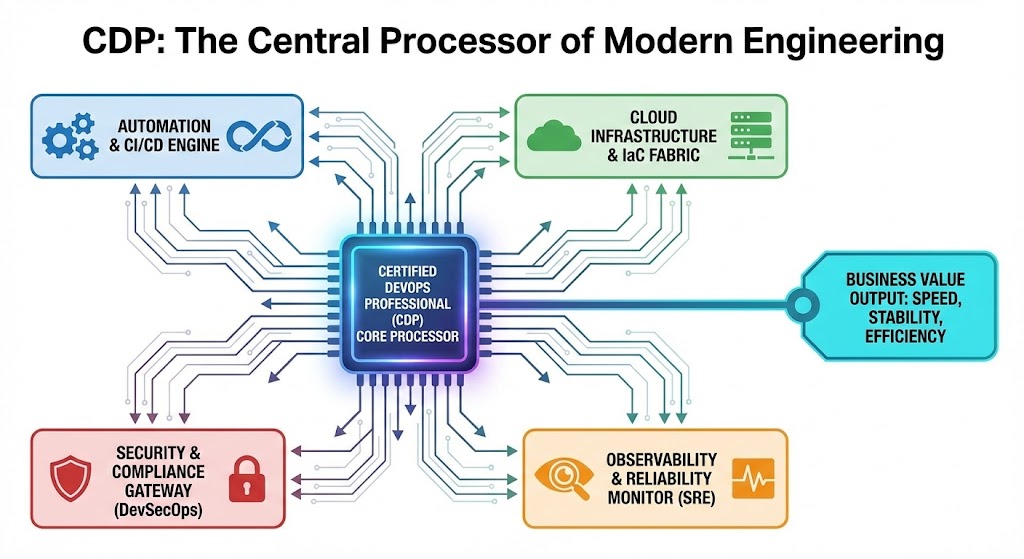
The Certified DevOps Professional (CDP) represents a practitioner-level standard designed to bridge the gap between theoretical knowledge and production-grade implementation. Unlike basic certifications that focus solely on terminology, this program emphasizes the technical workflows required to manage high-availability systems. It exists to provide a structured learning path that mirrors the actual challenges faced in enterprise environments, such as scaling infrastructure and securing CI/CD pipelines. By focusing on the entire lifecycle, it aligns perfectly with the current demand for engineers who can own a feature from code commit to production monitoring.
Who Should Pursue Certified DevOps Professional (CDP)?
Cloud engineers and Site Reliability Engineers (SREs) will find immense value in this certification as it formalizes their expertise in automation and orchestration. Development professionals looking to transition into operations roles or adopt a “you build it, you run it” mindset should also consider this path. For technical managers and architects in India and abroad, the CDP provides a framework to better lead cross-functional teams and implement DevOps culture at scale. Even security and data professionals benefit by understanding the delivery mechanics that support their specialized domains.
Why Certified DevOps Professional (CDP) is Valuable in 2026 and Beyond
The demand for skilled DevOps practitioners continues to outpace supply as enterprises move away from legacy silos toward cloud-native architectures. Achieving the CDP ensures you remain adaptable to the market because it focuses on core principles that outlast specific tool versions or brand hype. This certification signals to employers that you possess a disciplined approach to automation, which is critical for maintaining long-term career longevity in an AI-driven landscape. Investing your time here yields a strong return by positioning you for high-impact roles in organizations that prioritize rapid, stable software delivery.
Certified DevOps Professional (CDP) Certification Overview
The program is delivered via Certified DevOps Professional (CDP) and hosted on DevOpsSchool. This certification program utilizes a rigorous assessment approach that combines objective testing with practical scenarios to ensure candidates can perform in real-world settings. The ownership of the program lies with industry experts who update the curriculum to reflect current enterprise practices and toolsets. Structurally, the program moves from foundational concepts to advanced architectural patterns, ensuring a logical progression for learners at different stages of their professional journey.
Certified DevOps Professional (CDP) Certification Tracks & Levels
The CDP framework offers a clear path through foundation, professional, and advanced levels to suit various experience brackets. The foundation level focuses on core automation and cultural shifts, while the professional level dives deep into orchestration and containerization. Specialized tracks allow engineers to pivot into focused domains like SRE, DevSecOps, or FinOps depending on their organizational needs. This tiered approach ensures that as your career progresses from an individual contributor to a lead or architect, the certification levels provide a matching technical validation.
Complete Certified DevOps Professional (CDP) Certification Table
| Track | Level | Who it’s for | Prerequisites | Skills Covered | Recommended Order | Official Link |
| Core DevOps | Foundation | Associate Engineers | Basic Linux/Git | CI/CD, Culture | 1 | Certified DevOps Professional (CDP) |
| Engineering | Professional | Senior Engineers | 2+ Years Exp | Docker, K8s, IaC | 2 | Certified DevOps Professional (CDP) |
| Operations | SRE | SRE/SysAdmins | Cloud Basics | Monitoring, SLOs | 3 | Certified DevOps Professional (CDP) |
| Security | DevSecOps | Security Engineers | DevOps Basics | Tool Scanning, IAM | 4 | Certified DevOps Professional (CDP) |
| Architecture | Advanced | Leads/Architects | Professional CDP | Scalability, High Availability | 5 | Certified DevOps Professional (CDP) |
Detailed Guide for Each Certified DevOps Professional (CDP) Certification
Certified DevOps Professional (CDP) – Foundation Level
What it is
This certification validates a candidate’s understanding of the fundamental DevOps pillars: Culture, Automation, Lean, Measurement, and Sharing (CALMS). It serves as the baseline for all subsequent specialized tracks.
Who should take it
Junior developers, system administrators, and project managers who need a solid grasp of how modern software delivery teams operate. It is ideal for those new to the DevOps philosophy.
Skills you’ll gain
- Mastery of Version Control Systems using Git.
- Understanding of Continuous Integration (CI) workflows.
- Knowledge of basic shell scripting and automation.
- Comprehension of DevOps cultural shifts and team collaboration.
Real-world projects you should be able to do
- Setting up a basic automated build pipeline for a web application.
- Implementing a branching strategy for a multi-developer team.
- Configuring automated notifications for build successes or failures.
Preparation plan
- 7–14 days: Review core DevOps definitions and Git commands thoroughly.
- 30 days: Complete a basic CI/CD project and study the CALMS model.
- 60 days: Deep dive into Linux administration and container basics for added context.
Common mistakes
- Focusing too much on specific tools rather than the underlying process.
- Underestimating the importance of the cultural and collaborative aspects of the exam.
Best next certification after this
- Same-track option: Certified DevOps Professional (Professional Level).
- Cross-track option: Certified DevSecOps Professional.
- Leadership option: DevOps Engineering Manager.
Certified DevOps Professional (CDP) – Professional Level
What it is
This level confirms your ability to design and manage complex infrastructure using industry-standard tools like Docker, Kubernetes, and Terraform. It focuses on the “Engineer” aspect of DevOps.
Who should take it
Mid-level engineers with at least two years of experience in IT operations or software development who want to specialize in cloud-native infrastructure.
Skills you’ll gain
- Expert-level container orchestration using Kubernetes.
- Infrastructure as Code (IaC) implementation using Terraform or Ansible.
- Advanced monitoring and logging setup.
- Configuration management at scale.
Real-world projects you should be able to do
- Deploying a multi-tier application on a Kubernetes cluster with persistent storage.
- Writing modular IaC scripts to provision entire cloud environments.
- Implementing automated rolling updates and rollbacks for production services.
Preparation plan
- 7–14 days: Intensive lab work focusing on Kubernetes objects and IaC syntax.
- 30 days: Build a complete end-to-end pipeline including security scanning and deployment.
- 60 days: Focus on troubleshooting production scenarios and optimizing resource usage.
Common mistakes
- Skipping the documentation for tool-specific syntax errors.
- Failing to practice real-world troubleshooting in a lab environment.
Best next certification after this
- Same-track option: Certified DevOps Architect.
- Cross-track option: Certified SRE Professional.
- Leadership option: Principal DevOps Consultant.
Choose Your Learning Path
DevOps Path
Engineers following the core DevOps path focus heavily on the delivery lifecycle and developer productivity. You start by mastering version control and CI/CD pipelines before moving into infrastructure automation and containerization. This path is ideal for those who enjoy optimizing the speed and quality of software releases. It requires a balance of coding skills and operational knowledge to ensure seamless transitions between development and production environments. Professionals here often evolve into Platform Engineers who build internal tools for other developers.
DevSecOps Path
The DevSecOps path integrates security into every stage of the automated pipeline rather than treating it as a final hurdle. You learn to implement static and dynamic analysis tools, manage secrets securely, and automate compliance checks. This path is essential for organizations operating in highly regulated industries like finance or healthcare. By choosing this route, you become the bridge between traditional security teams and rapid development cycles. It demands a deep understanding of both vulnerability management and automated orchestration.
SRE Path
The Site Reliability Engineering (SRE) path applies software engineering principles to solve operational problems. You focus on system availability, latency, performance, and capacity management through the lens of Service Level Objectives (SLOs). This path is perfect for those who enjoy deep-system troubleshooting and building self-healing infrastructure. You will spend significant time on monitoring, alerting, and incident response automation. SREs are the guardians of production stability in large-scale distributed systems.
AIOps / MLOps Path
This path addresses the unique challenges of deploying and managing machine learning models and AI-driven operations. You learn to automate data pipelines, manage model versioning, and monitor the health of AI systems in production. As organizations integrate more intelligence into their products, the need for MLOps specialists continues to skyrocket globally. This route requires a solid foundation in traditional DevOps plus specific knowledge of data handling and model lifecycle management. It is a cutting-edge choice for future-focused engineers.
DataOps Path
DataOps focuses on improving the quality and reducing the cycle time of data analytics. You learn to apply DevOps practices to data pipelines, ensuring that data flows from sources to warehouses reliably and automatically. This path is vital for companies that rely on real-time data for decision-making. It involves mastering data orchestration tools and ensuring that data infrastructure is as scalable as application infrastructure. DataOps professionals ensure that data engineers and analysts can work without being hindered by manual bottlenecks.
FinOps Path
The FinOps path centers on the financial management of cloud resources to ensure maximum business value. You learn to monitor cloud spend, optimize resource utilization, and foster a culture of financial accountability among engineering teams. As cloud bills grow, the ability to map technical decisions to cost-efficiency becomes a high-level skill. This path is excellent for engineers who have an interest in the business side of technology. It combines data analysis, cloud architecture, and stakeholder management.
Role → Recommended (Topic name) Certifications
| Role | Recommended Certifications |
| DevOps Engineer | CDP Foundation, CDP Professional |
| SRE | CDP Professional, SRE Specialization |
| Platform Engineer | CDP Professional, Advanced Architecture |
| Cloud Engineer | CDP Foundation, Cloud-Specific Tracks |
| Security Engineer | CDP Foundation, DevSecOps Specialization |
| Data Engineer | CDP Foundation, DataOps Specialization |
| FinOps Practitioner | CDP Foundation, FinOps Specialization |
| Engineering Manager | CDP Foundation, Leadership Track |
Next Certifications to Take After Certified DevOps Professional (CDP)
Same Track Progression
Once you have completed the professional level, the next logical step is moving toward the Architect level within the CDP ecosystem. This involves shifting focus from implementation to high-level system design, disaster recovery planning, and multi-region strategies. Deep specialization in a specific toolset like advanced Kubernetes or specialized cloud provider architectures can further solidify your status as a subject matter expert. Staying within the track allows you to become the go-to person for complex technical challenges within your organization.
Cross-Track Expansion
Broadening your skills by pursuing a cross-track certification like DevSecOps or SRE makes you a more versatile “T-shaped” professional. Understanding how security integrates with delivery or how reliability engineering changes automation priorities provides a holistic view of the enterprise. This expansion is particularly useful for those aiming for lead roles where managing multiple domains is a requirement. It prevents you from becoming siloed and increases your marketability across different types of engineering organizations.
Leadership & Management Track
For those looking to move away from day-to-day coding and into strategic roles, the leadership track is the best option. This focuses on team building, budget management, and implementing DevOps at an organizational level rather than just a technical one. You will learn how to measure the ROI of DevOps initiatives and lead cultural transformations across large departments. This transition is ideal for senior engineers who want to influence the direction of the company and mentor the next generation of talent.
Training & Certification Support Providers for Certified DevOps Professional (CDP)
DevOpsSchool
This provider offers extensive resources and instructor-led training specifically tailored for the CDP curriculum. They focus on hands-on labs and real-world scenarios to ensure candidates are prepared for the technical demands of the certification. Their trainers are often industry veterans who bring practical insights into the classroom setting.
Cotocus
Cotocus provides specialized consulting and training services that align with modern cloud-native standards. They emphasize the integration of various DevOps tools and provide a structured approach to mastering the CDP levels. Their focus is often on enterprise-scale implementations and high-level architectural patterns.
Scmgalaxy
A well-known community and training hub, Scmgalaxy offers a wealth of tutorials, documentation, and practice materials for DevOps enthusiasts. They provide specific support for the CDP by breaking down complex topics into digestible formats. Their platform is a great resource for continuous learning beyond the exam.
BestDevOps
This organization focuses on delivering high-quality training modules that cover the end-to-end DevOps lifecycle. They help candidates prepare for the CDP by providing practical exercises that mimic production environments. Their approach is highly results-oriented, focusing on skill acquisition and career readiness.
devsecopsschool.com
Specifically focused on the security aspect of the delivery pipeline, this site provides the necessary training for the DevSecOps track of the CDP. They cover everything from automated scanning to secure infrastructure coding. It is a primary destination for engineers looking to specialize in security.
sreschool.com
This provider caters to those pursuing the SRE track, offering deep dives into observability, reliability, and incident management. Their curriculum is designed to support the CDP SRE specialization with a focus on keeping systems running at peak performance. They emphasize the engineering side of operations.
aiopsschool.com
Focusing on the intersection of AI and operations, this site provides training for the AIOps track. They teach how to use machine learning to improve operational efficiency and manage AI workloads. It is a specialized resource for engineers entering the world of automated intelligence.
dataopsschool.com
This site supports the DataOps track by providing training on data pipeline automation and data infrastructure management. They help professionals apply DevOps principles to the data domain, ensuring reliable and fast data delivery. Their courses are essential for modern data engineering roles.
finopsschool.com
Catering to the financial side of cloud management, this provider offers training on cloud cost optimization and financial accountability. They support the FinOps specialization within the CDP framework, helping engineers bridge the gap between technical usage and business costs.
Frequently Asked Questions (General)
- How difficult is the Certified DevOps Professional (CDP) exam?The difficulty is moderate to high because it requires a balance of theoretical knowledge and practical application. You cannot pass by simply memorizing terms; you must understand how to implement workflows. If you have hands-on experience with Linux and basic automation, you will find the foundation level manageable. However, the professional and advanced levels require significant time in a lab environment to master tool interactions.
- How much time does it take to prepare for the CDP?Preparation time depends on your starting experience level. For a working engineer with some exposure to Git and Linux, 30 to 60 days of consistent study is usually sufficient for the professional level. Beginners might need three to four months to build the necessary foundational skills. It is important to dedicate at least 10 hours a week to hands-on practice rather than just reading documentation.
- What are the prerequisites for the Certified DevOps Professional (CDP)?The foundation level has no formal prerequisites, though basic computer science knowledge and familiarity with the command line are helpful. For the professional level, it is highly recommended to have at least two years of experience in a technical role. Understanding a programming language like Python or Go and having basic cloud knowledge will significantly accelerate your learning process during the program.
- What is the ROI of getting a Certified DevOps Professional (CDP) certification?The ROI is significant, often manifesting as a salary increase or a move into a more senior role. Companies are willing to pay a premium for engineers who can demonstrate a structured approach to automation and reliability. Beyond the financial aspect, the certification provides you with a clear roadmap for skill acquisition, saving you time that might be wasted on unorganized self-study.
- Should I take the levels in a specific order?Yes, it is highly recommended to follow the sequence from foundation to professional and then to advanced or specialized tracks. Each level builds upon the concepts introduced in the previous one. Skipping the foundation might leave you with gaps in your understanding of DevOps culture, while jumping straight to advanced topics can be overwhelming without a solid grasp of containerization and orchestration.
- How long is the CDP certification valid?Typically, the certification is valid for two to three years, after which you may need to recertify or move to a higher level. This ensures that your skills remain current in an industry where tools and best practices evolve rapidly. Recertification often involves a shorter update exam or proving continuous professional development through advanced courses or industry contributions.
- Is the CDP recognized globally?The Certified DevOps Professional (CDP) is recognized by enterprises and tech firms across India, the US, Europe, and other major tech hubs. Because it focuses on industry-standard tools and universal DevOps principles, the skills you gain are highly transferable across borders. Many global recruitment agencies look for such certifications to validate a candidate’s technical competence during the initial screening process.
- Does the CDP cover specific cloud providers like AWS or Azure?While the CDP focuses on vendor-neutral tools like Docker, Kubernetes, and Terraform, these tools are applicable across all major cloud providers. The principles of CI/CD and IaC remain the same whether you are deploying on AWS, Azure, or Google Cloud. This makes the certification more versatile than a vendor-specific one, as it prepares you for multi-cloud or hybrid-cloud environments.
- What kind of jobs can I get after completing the CDP?Completing the CDP opens doors to roles such as DevOps Engineer, Site Reliability Engineer, Cloud Architect, and Build/Release Engineer. With the professional level certification, you are qualified for mid-to-senior level positions that involve designing and maintaining automated infrastructure. If you choose a specialization like DevSecOps, you can also pivot into specialized security roles within engineering teams.
- Is there a community for CDP certified professionals?Yes, there are several online communities, including those hosted by DevOpsSchool and Scmgalaxy, where you can connect with other professionals. These communities are excellent for networking, sharing job opportunities, and staying updated on the latest industry trends. Engaging with a community helps reinforce what you have learned and provides a support system for troubleshooting real-world technical issues.
- Can a manager benefit from the CDP?Absolutely. While managers may not need to write code every day, understanding the technical workflows and challenges faced by their teams is crucial for effective leadership. The CDP provides managers with the vocabulary and conceptual framework needed to make informed decisions about tool selection and process improvements. It helps them move away from legacy management styles toward more agile and automated approaches.
- How does the CDP compare to other DevOps certifications?The CDP is known for its heavy emphasis on practitioner-level skills and real-world implementation. Some other certifications are more academic or focus exclusively on a single tool. The CDP’s comprehensive approach, covering culture, tools, and specialized tracks, makes it one of the most well-rounded options for professionals seeking a deep, career-long learning path rather than a quick badge.
FAQs on Certified DevOps Professional (CDP)
- What is the primary focus of the CDP curriculum?The primary focus is on the automation of the software delivery lifecycle using modern cloud-native technologies. This includes mastering the integration of developers and operations through continuous processes. It covers everything from code management and automated testing to container orchestration and production monitoring. The goal is to produce engineers who can build robust, scalable, and secure systems with minimal manual intervention.
- Does the CDP include hands-on lab sessions?Yes, the program is designed to be highly practical, featuring numerous lab sessions where you work with actual tools in a simulated environment. You will be required to set up pipelines, configure clusters, and troubleshoot infrastructure issues. This hands-on approach is what distinguishes the CDP from purely theoretical certifications. It ensures that when you enter a professional environment, you have already practiced the tasks you will be expected to perform.
- Are there any coding requirements for the CDP?While you don’t need to be a senior developer, you should be comfortable with basic scripting and understanding code logic. You will encounter YAML for configuration, shell scripts for automation, and perhaps some Python or Go depending on the track. Being able to read and modify code is essential for modern DevOps practices like Infrastructure as Code and automated testing, which are central to the CDP.
- Can I complete the CDP training online?Yes, the training and certification are available in online formats to accommodate working professionals globally. Many providers offer both self-paced modules and live instructor-led sessions. This flexibility allows you to balance your learning with your professional responsibilities. Online labs are also provided, ensuring that you have access to the necessary technical environments regardless of your physical location.
- How does the CDP address the “Sec” in DevSecOps?The CDP framework treats security as a fundamental component of the delivery process rather than an afterthought. It introduces concepts like “shifting left,” which means integrating security checks early in the development cycle. You will learn about automated vulnerability scanning, secure secret management, and identity access management. This ensures that the systems you build are not only fast and reliable but also resilient to threats.
- What role does Kubernetes play in the CDP certification?Kubernetes is a major component of the professional and advanced levels of the CDP. As the industry standard for container orchestration, it is critical for anyone working in DevOps today. You will learn how to deploy, scale, and manage applications within a Kubernetes environment. The certification ensures you understand the core objects, networking, and storage requirements needed to run production workloads on a cluster.
- Is the CDP suitable for someone from a traditional SysAdmin background?It is an excellent path for traditional System Administrators looking to modernize their skill set. The CDP helps transition manual administrative tasks into automated workflows using code. It bridges the gap between old-school server management and modern cloud-native operations. For SysAdmins, this certification is a powerful tool for staying relevant as companies move away from physical hardware toward software-defined data centers.
- How often is the CDP exam updated?The exam and curriculum are updated regularly to stay aligned with the fast-paced nature of the DevOps industry. This means that as new tools emerge or best practices change, the CDP evolves to reflect those shifts. This commitment to currency ensures that the certification remains a valuable and accurate representation of a professional’s skills in the current market. You are tested on what is relevant today, not what worked five years ago.
Final Thoughts: Is Certified DevOps Professional (CDP) Worth It?
From a mentor’s perspective, the Certified DevOps Professional (CDP) is a solid investment for any engineer serious about a long-term career in infrastructure and delivery. It moves past the buzzwords and forces you to confront the technical realities of modern systems. In an era where “DevOps” is often used as a vague marketing term, having a structured certification like the CDP provides a necessary standard of competence. It won’t make you an expert overnight—no certification can—but it provides the map you need to navigate the complex world of automation. If you are willing to put in the hours in the lab and embrace a mindset of continuous improvement, this program will undoubtedly accelerate your professional growth.