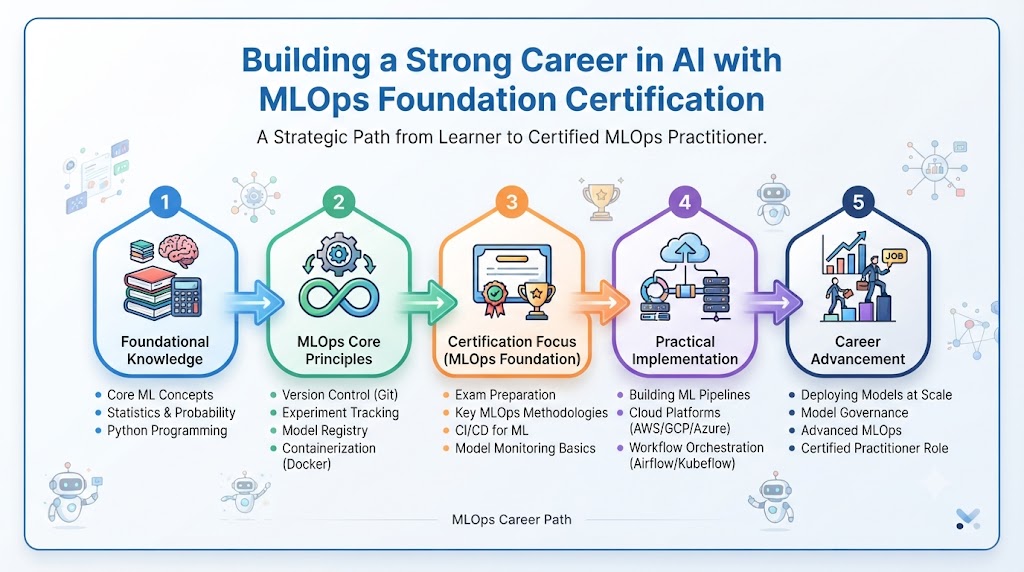
Introduction
Moving machine learning models from a local notebook to a reliable production environment is one of the most critical challenges in modern software engineering. This guide is built specifically for software engineers, site reliability engineers, and platform professionals who need to understand how to bridge the gap between data science and operational engineering. By exploring this structured learning path, technical professionals and engineering managers can make informed career decisions, optimize their infrastructure investments, and build resilient deployment pipelines. This deep dive into the MLOps Foundation Certification program hosted by aiopsschool.com delivers an objective roadmap to mastering automated model deployment, monitoring, and continuous integration in cloud-native ecosystems.
What is the MLOps Foundation Certification?
The MLOps Foundation Certification represents a definitive standard for establishing core competency in managing, deploying, and monitoring machine learning workloads in production. Unlike purely theoretical data science courses that focus heavily on model architecture and mathematical formulas, this program focuses entirely on the operational life cycle of machine learning assets. It exists to address the critical industry need for systematic automated pipelines, robust version control for data, and consistent environment reproducibility. By aligning model deployment with modern DevOps methodologies, the certification ensures that professionals can reliably treat machine learning models as software artifacts within enterprise continuous integration and continuous delivery pipelines.
Who Should Pursue MLOps Foundation Certification?
This certification program is designed for cloud engineers, systems administrators, platform architects, and site reliability engineers who want to expand their capabilities into the artificial intelligence infrastructure domain. It is equally valuable for data engineers who need to understand downstream deployment constraints and data scientists who want to build reproducible, production-ready code. Software developers looking to transition into high-growth infrastructure roles will find that this credential provides a clear, structured gateway into enterprise operations. Globally and across competitive technology hubs like India, companies are actively seeking engineers who can break down structural silos and manage complex model lifecycles at scale.
Why MLOps Foundation Certification
As enterprises rapidly integrate artificial intelligence into their core applications, the demand for structured infrastructure automation has outpaced traditional software delivery models. This certification remains highly valuable because it focuses on foundational engineering principles rather than shifting, proprietary toolsets. The concepts taught—such as data lineage, automated testing, containerized deployments, and telemetry aggregation—ensure long-term career resilience as technologies evolve. Investing time and effort into this program yields direct professional returns by positioning engineers at the center of modern cloud infrastructure strategies and business transformation initiatives.
MLOps Foundation Certification Overview
The program is delivered via the official training infrastructure and hosted on the specialized educational platform. The assessment approach uses practical, scenario-based evaluation techniques designed to test actual engineering logic rather than simple memorization. The structure is built explicitly for working professionals, offering a self-paced, modular format that respects demanding work schedules. Ownership of the certification curriculum lies with industry practitioners who maintain the materials to reflect standard industry architectures and current enterprise platform deployment realities.
MLOps Foundation Certification Tracks & Levels
The certification structure scales logically from foundational concepts to complex enterprise multi-cloud architectures. The introductory track focuses on establishing core vocabulary, deployment patterns, and basic monitoring techniques for engineering teams. The professional level expands into advanced pipeline orchestration, automated validation, and continuous training infrastructure. Specialization tracks allow professionals to align their credentials with specific roles, such as embedding robust security practices for data operations or managing cluster infrastructure costs effectively.
Complete MLOps Foundation Certification Table
| Track | Level | Who it’s for | Prerequisites | Skills Covered | Recommended Order |
| Infrastructure Operations | Foundation | Cloud Engineers & SREs | Basic Linux & Git | Containerization, CI/CD, Basic Telemetry | First Step |
| Architecture & Engineering | Professional | Senior DevOps & Architects | Foundation Level | Automated Retraining, Data Lineage | Second Step |
| Specialized Governance | Advanced | Tech Leads & Security Managers | Professional Level | Compliance, Multi-tenant Security, Auditing | Third Step |
Detailed Guide for Each MLOps Foundation Certification
MLOps Foundation Certification – Foundation Level
What it is
This credential validates an engineer’s core understanding of model lifecycle automation, foundational pipeline building, and containerized deployment strategies. It confirms that the professional can successfully collaborate across data science and infrastructure teams.
Who should take it
Systems operators, junior DevOps engineers, and data analysts who want to formalize their knowledge of basic operational workflows and cloud-native application patterns.
Skills you’ll gain
- Implementation of basic continuous integration pipelines for machine learning code.
- Building and managing container images tailored for model inference environments.
- Configuring standard metrics collection and basic alerting parameters for live endpoints.
Real-world projects you should be able to do
- Package an open-source model into a container and deploy it to a cluster.
- Set up an automated pipeline that runs code linting and basic unit tests on commit.
Preparation plan
- 7–14 days: Review core containerization concepts, basic version control workflows, and the official study documentation thoroughly.
- 30 days: Build three local sample deployment pipelines, configure basic monitoring dashboards, and complete all practice mock assessments.
- 60 days: Dedicate time to studying infrastructure-as-code basics, read production case studies, and complete comprehensive platform lab exercises.
Common mistakes
- Focusing too much on tweaking machine learning model hyper-parameters instead of studying automation infrastructure.
- Neglecting data version control principles and basic API gateway routing rules.
Best next certification after this
- Same-track option: MLOps Professional Level
- Cross-track option: Cloud Platform Architecture Certification
- Leadership option: Technical Product Management Certification
Choose Your Learning Path
DevOps Path
Professionals on this track focus deeply on extending traditional continuous delivery mechanisms to accommodate non-deterministic machine learning models. The emphasis is placed on infrastructure-as-code, deployment strategies like canary and blue-green, and automated testing of artifact boundaries. Engineers learn how to manage complex model registries alongside traditional artifact stores. This path ensures that automated deployments are predictable, repeatable, and completely hands-off.
DevSecOps Path
This path prioritizes the complete security posture of the machine learning lifecycle, from data ingestion to model inference endpoints. Professionals study container vulnerability scanning, secure handling of large training datasets, and model artifact encryption protocols. Attention is paid to preventing adversarial attacks, model poisoning, and data leakage across staging boundaries. The final objective is ensuring that every pipeline step meets stringent enterprise compliance requirements.
SRE Path
Site reliability engineers focus directly on the availability, latency, performance, efficiency, and capacity management of live model endpoints. This path covers advanced monitoring, building custom exporters for custom telemetry, and setting up precise service level objectives. Engineers learn to handle system degradation gracefully, manage automated autoscaling parameters for compute-heavy workloads, and debug distributed inference errors. The goal is maintaining maximum system uptime under highly variable traffic patterns.
AIOps Path
This path teaches engineers how to apply machine learning methodologies directly to internal infrastructure telemetry, logs, and events to automate system operations. Professionals learn to build systems that analyze massive volumes of performance data to predict outages before they occur. It focuses on intelligent alerting, automated root-cause analysis pipelines, and proactive infrastructure remediation patterns. It bridges the gap between infrastructure health and advanced analytical processing.
MLOps Path
This path centers entirely on the lifecycle management of machine learning models within enterprise application ecosystems. Engineers master the continuous integration of code, continuous deployment of model artifacts, and continuous training based on incoming data streams. Special emphasis is placed on tracking data drift, concept drift, and managing specialized hardware resources like graphics processing units. This path connects data science workspaces directly with production-grade runtime systems.
DataOps Path
Data operations specialists focus on the agility, quality, and reliability of the data pipelines feeding upstream training systems. This path covers automated data validation, scalable orchestration of transform workloads, and comprehensive data lineage tracking. Professionals learn to build robust data testing frameworks that catch formatting errors before they disrupt downstream infrastructure. The objective is ensuring a continuous, clean flow of input assets to production systems.
FinOps Path
This track deals directly with the cloud financial management of resource-heavy analytical workloads. Engineers analyze the cost efficiency of distributed model training sessions, optimize storage tiers for massive datasets, and right-size inference clusters. The path emphasizes setting up accurate cost attribution, configuring cost anomaly alerts, and maximizing utilization metrics. It ensures that scaling systems remains financially viable for the enterprise.
Role → Recommended MLOps Foundation Certification
| Role | Recommended Certifications |
| DevOps Engineer | MLOps Foundation + Infrastructure Automation |
| SRE | MLOps Foundation + Advanced Observability Track |
| Platform Engineer | MLOps Foundation + Cloud Architecture Level |
| Cloud Engineer | MLOps Foundation + Container Orchestration |
| Security Engineer | MLOps Foundation + Enterprise DevSecOps Track |
| Data Engineer | MLOps Foundation + Data Pipeline Engineering |
| FinOps Practitioner | MLOps Foundation + Cloud Cost Optimization |
| Engineering Manager | MLOps Foundation + Strategic Operations Leadership |
Next Certifications to Take After MLOps Foundation Certification
Same Track Progression
Advancing further down the primary path involves mastering automated continuous training loops and complex feature store integrations. Engineers dive deeper into multi-region deployments, low-latency micro-inferences, and hardware acceleration techniques. This advanced specialization confirms a professional’s capability to architect large-scale platforms capable of handling hundreds of concurrent pipelines safely.
Cross-Track Expansion
Broadening expertise requires integrating operational workflows with advanced infrastructure-as-code and service mesh environments. Professionals often pursue advanced container orchestration credentials or data engineering pathways to gain a complete view of systems. This ensures the engineer can seamlessly connect raw business databases to highly scalable model runtimes without relying on external architecture support teams.
Leadership & Management Track
Moving into technical leadership involves translating operational metrics into clear corporate business value and managing engineering teams. The focus shifts toward compliance governance, team design patterns, total cost of ownership reduction, and strategic tool selection. This allows senior engineers to transition into principal or director roles, steering corporate cloud strategy and infrastructure roadmaps.
Training & Certification Support Providers for MLOps Foundation Certification
DevOpsSchool offers deep technical training programs focused on complete infrastructure engineering, version control workflows, and automated deployment pipelines for enterprise professionals.
Cotocus provides comprehensive platform consultancy and structured hands-on lab environments that help engineering teams master cloud-native toolchains and implementation strategies.
Scmgalaxy serves as a specialized knowledge base and community hub offering technical deep dives, configuration tutorials, and system administration best practices.
BestDevOps focuses on delivering curated, practical study materials, industry use cases, and targeted bootcamps for modern infrastructure engineering tracks.
devsecopsschool delivers advanced training modules centered entirely on integrating security guardrails, automated scanning, and compliance tracking directly into corporate deployment pipelines.
sreschool provides targeted educational material focusing on systems availability, complex incident response strategies, performance tuning, and service level management.
aiopsschool focuses exclusively on building expertise in machine learning infrastructure architectures, operational frameworks, and automated analytical platforms for modern enterprise systems.
dataopsschool specializes in training professionals to build agile, automated, and high-quality data pipelines that optimize enterprise data delivery workflows.
finopsschool delivers clear educational tracks centered on cloud financial management, cost allocation structures, and structural resource optimization strategies for engineering teams.
Frequently Asked Questions (General)
- What are the primary prerequisites for entering this engineering track? A basic understanding of Linux systems operation, familiarity with command-line interfaces, and a foundational grasp of version control workflows using Git are highly recommended.
- How long does it typically take to prepare for the introductory exam? Most working professionals spending a few hours each week can successfully prepare for the evaluation within thirty to sixty days.
- Is coding experience required to pass the infrastructure evaluation? Basic scripting knowledge in languages such as Python or Bash is highly beneficial for understanding the automation examples used throughout the course.
- What is the core difference between this program and standard data science paths? Data science focuses on algorithm selection, data analysis, and model training, whereas this track focuses exclusively on deployment, scaling, security, and infrastructure monitoring.
- How does this certification impact professional career growth? It opens doors to specialized platform engineering roles, distinct infrastructure titles, and highly technical hybrid operations positions across the enterprise software sector.
- Are cloud-specific platforms required for learning the course material? The core concepts taught are highly vendor-neutral, allowing engineers to apply the structural principles across any public or private cloud provider.
- Does the program cover automated infrastructure provisioning tools? Yes, it touches upon how infrastructure-as-code methodologies are applied directly to configuring the underlying clusters used for training and inference.
- What is the general validity period of the issued certificate? The credential remains fully valid for two years, after which professionals can re-certify to demonstrate alignment with updated platform patterns.
- How are the practical laboratory exercises conducted during training? Labs are hosted in simulated cloud environments where candidates interact with live terminal sessions to fix pipeline issues and configure alerts.
- Can engineering managers benefit from pursuing this fundamental path? Yes, it provides managers with the correct technical vocabulary and strategic framework needed to scope projects and hire skilled engineering teams.
- What is the focus of the continuous testing modules? The modules focus on testing input data formats, validating model output boundaries, and ensuring container application configurations are entirely correct.
- Is there any post-assessment community support available for alumni? Yes, successful candidates gain access to dedicated alumni spaces to discuss career openings, platform architectural challenges, and emerging deployment methodologies.
FAQs on MLOps Foundation Certification
- How does the MLOps Foundation Certification specifically address issues like model performance drift over time? The training path covers the architectural patterns required to deploy continuous monitoring tools that track incoming data against baseline distributions. Candidates learn to configure automated thresholds that trigger alerts or launch containerized retraining pipelines when model inference accuracy decays past acceptable operational parameters.
- What specific deployment patterns are covered under this foundational syllabus? The course material covers containerized microservice deployments, serverless inference endpoints, and basic batch processing architectures. It highlights how to manage routing configurations within an application gateway to safely decouple the underlying machine learning models from frontend consumer microservices.
- Does this program teach candidates how to optimize GPU and TPU hardware allocations? Yes, the curriculum includes specific guidance on resource scheduling and constraint configuration within container orchestration platforms. Engineers learn to allocate specific hardware slices to training jobs while ensuring everyday inference workloads run on cost-effective compute nodes.
- How are data security and access control managed within these pipeline architectures? The course details role-based access control strategies for sensitive datasets, secure environment variable injection for API keys, and isolated network spaces. It trains engineers to protect model weights from unauthorized access while maintaining full visibility for auditing teams.
- What role does GitOps play within the framework of this certification? GitOps is introduced as a core method for managing environment states and model tracking parameters cleanly through configuration repositories. By treating deployment definitions as code, engineers learn to track changes, rollback bad deployments, and maintain a clear audit log.
- How does the curriculum handle the versioning of massive datasets compared to source code? The course explains the use of specialized data versioning tools that create immutable meta-logs pointing to large cloud storage buckets. This allows engineers to track exact dataset states alongside specific code commits without bloating standard source control systems.
- Are open-source automation engines prioritized over proprietary enterprise cloud tools? The framework focuses primarily on open-source cloud-native tools to ensure universal platform skills that can be ported to any modern enterprise stack. This approach prevents vendor lock-in and gives professionals a deeper understanding of underlying system components.
- What mechanisms are taught to ensure minimal downtime during live model updates? The program teaches professionals how to implement structured rolling upgrades, blue-green environments, and canary deployments within an active cluster. This ensures new model versions can be evaluated with live traffic patterns before decommissioning older service instances.
Final Thoughts: Is MLOps Foundation Certification Worth It?
Investing in specialized infrastructure credentials requires a significant commitment of both personal time and professional focus. For engineers operating in modern cloud ecosystems, the ability to orchestrate, secure, and monitor machine learning workloads is quickly becoming a non-negotiable requirement rather than an optional skill. The program provides a clear, reliable path away from ad-hoc manual scripts toward production-grade architectural automation. If your objective is to build sustainable infrastructure, eliminate deployment friction, and advance into technical leadership within high-scale software engineering organizations, this foundational framework offers a direct, highly practical investment in your career trajectory.
