Introduction
The modern engineering landscape has shifted dramatically, moving away from manual deployments toward automated, intelligent, and scalable delivery pipelines. As organizations integrate machine learning into their core business operations, the gap between data science experimentation and production-grade software delivery has become a critical bottleneck. This guide is designed for software engineers, data professionals, and platform architects who want to bridge that gap by pursuing the Certified MLOps Engineer program. Whether you are an individual contributor looking to sharpen your technical edge or a manager building high-performing teams, understanding this certification path provided by aiopsschool is essential. We will examine how this credential serves as a framework for professional growth, technical validation, and career advancement in a cloud-native world.
What is the Certified MLOps Engineer?
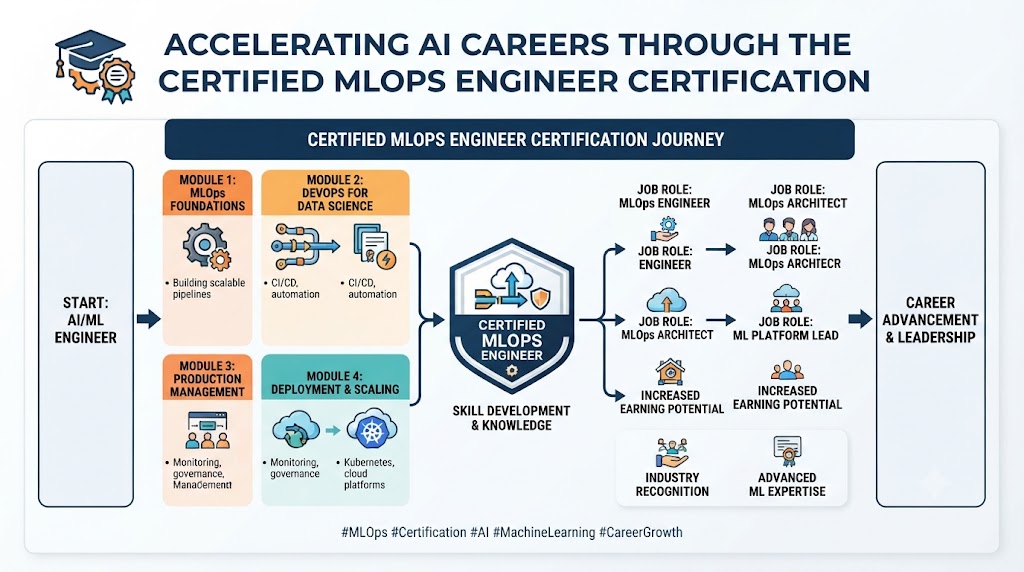
The Certified MLOps Engineer credential represents a specialized validation of an engineer’s ability to manage the lifecycle of machine learning models in production environments. It exists to standardize the practices required to transition models from Jupyter notebooks into robust, monitored, and automated deployment pipelines. Unlike theoretical academic courses, this program emphasizes real-world application, focusing on CI/CD for ML, model versioning, automated testing, and scalable infrastructure. It aligns perfectly with modern enterprise needs where the speed of model delivery must be matched by reliability and observability. By focusing on production-focused learning, the certification ensures that practitioners can handle the complexities of data drift, retraining loops, and automated governance.
Who Should Pursue Certified MLOps Engineer?
This certification is highly relevant for professionals working in roles that sit at the intersection of data science and systems engineering. Software engineers who want to specialize in AI/ML infrastructure will find it invaluable for building stable platforms. SREs and DevOps professionals should pursue this to gain the specialized knowledge needed to treat ML models as production software components. Additionally, data engineers and platform architects will benefit from learning how to build and maintain the underlying infrastructure that supports model training and inference. For engineering managers, this certification provides a benchmark for evaluating team capabilities and ensures that the department adheres to industry best practices. It is equally significant for professionals in India and globally, as the demand for production-ready AI solutions is growing rapidly across all major tech hubs.
Why Certified MLOps Engineer
In the current professional landscape, toolsets evolve rapidly, but the fundamental principles of MLOps remain constant. This certification is valuable because it focuses on these enduring principles rather than fleeting trends, helping professionals stay relevant despite changes in the vendor ecosystem. It provides a structured return on time and career investment by formalizing a skill set that is currently in high demand but low supply. Enterprises are increasingly looking for engineers who can demonstrate expertise in managing the full ML lifecycle, and this credential serves as a verified indicator of that capability. By investing in this path, engineers can distinguish themselves in a competitive market and position themselves for roles that carry greater responsibility and higher impact.
Certified MLOps Engineer Certification Overview
The program is delivered via and is hosted on. The certification follows a structured assessment approach designed to mirror the challenges faced in daily engineering operations. Rather than relying on simple multiple-choice exams, the certification focuses on practical application, ensuring that candidates understand how to implement configurations and manage complex workflows. The ownership of this certification program lies with the platform, which ensures that the curriculum is updated regularly to reflect the current state of technology. The structure is built to cater to different levels of expertise, allowing professionals to start at a baseline level and progress toward mastery as their experience grows.
Certified MLOps Engineer Certification Tracks & Levels
The certification tracks are divided into foundation, professional, and advanced levels to accommodate various career stages. Foundation levels focus on core concepts and basic implementation, while professional levels move into complex orchestration and automated pipeline management. The advanced level is designed for architects and lead engineers who are responsible for designing end-to-end MLOps strategies. Specialization tracks allow engineers to focus on areas like data engineering, infrastructure automation, or model governance, ensuring that the certification aligns with their long-term career goals. These levels are mapped clearly to ensure that as an engineer gains more hands-on experience, they have a clear path to climb the ladder of technical leadership.
Complete Certified MLOps Engineer Certification Table
| Track | Level | Who it’s for | Prerequisites | Skills Covered | Recommended Order |
| MLOps Core | Foundation | Aspiring MLOps | Basic Python | ML Pipelines, Versioning | 1 |
| MLOps Engineering | Professional | DevOps/SRE | MLOps Foundation | CI/CD, Monitoring, Scaling | 2 |
| MLOps Architecture | Advanced | Tech Leads/Architects | Professional Cert | Governance, Strategy | 3 |
Detailed Guide for Each Certified MLOps Engineer Certification
Certified MLOps Engineer – Foundation Level
What it is
This certification validates the fundamental understanding of how machine learning models move through a development pipeline. It covers the basics of version control for data and models, and the standard architecture of an ML pipeline.
Who should take it
It is suitable for software engineers and data analysts who are looking to move into the MLOps space. You should have some experience with basic scripting and a desire to learn about operationalizing machine learning.
Skills you’ll gain
- Understanding of the ML lifecycle
- Versioning of models and datasets
- Basics of containerization for ML models
- Standard pipeline documentation
Real-world projects you should be able to do
- Setting up a simple model registry
- Scripting an automated model training workflow
- Integrating basic unit tests for data validation
Preparation plan
- 7–14 days: Focus on core theory, reading foundational MLOps literature, and practicing basic git workflows for data.
- 30 days: Build a small end-to-end project, manually moving a model from a local machine to a basic CI/CD pipeline.
- 60 days: Review advanced documentation and complete the practice labs provided in the course curriculum.
Common mistakes
Many candidates focus too heavily on data science algorithms while neglecting the engineering aspects like version control and pipeline design.
Best next certification after this
- Same-track: Certified MLOps Engineer Professional
- Cross-track: Certified DataOps Engineer
- Leadership: Engineering Manager Fundamentals
Choose Your Learning Path
DevOps Path
The DevOps path focuses on the automation of the underlying infrastructure that hosts machine learning applications. Engineers learn to manage clusters, implement robust CI/CD, and ensure the reliability of the environments where models are trained.
DevSecOps Path
This path integrates security into the MLOps lifecycle, ensuring that data is encrypted, access is strictly controlled, and models are protected against adversarial attacks. It is critical for industries with high compliance requirements.
SRE Path
The SRE path is about reliability and observability, focusing on how to monitor model performance in production and handle incidents. Engineers learn to define SLIs and SLOs specifically for ML-based services.
AIOps / MLOps Path
This path merges the two disciplines, focusing on using AI to improve operations while simultaneously ensuring that the ML models themselves are operated effectively. It is the most comprehensive path for modern AI-driven enterprises.
DataOps Path
DataOps focuses on the data lifecycle, ensuring that data pipelines are clean, versioned, and accessible. It is the backbone of any MLOps initiative, as models are only as good as the data feeding them.
FinOps Path
The FinOps path deals with the cost optimization of ML infrastructure. It teaches engineers how to balance the high compute costs of training and inference with the business value generated by the models.
Role → Recommended Certified MLOps Engineer Certifications
| Role | Recommended Certifications |
| DevOps Engineer | Certified MLOps Engineer Professional |
| SRE | Certified MLOps Engineer Professional |
| Platform Engineer | Certified MLOps Engineer Architecture |
| Cloud Engineer | Certified MLOps Engineer Foundation |
| Security Engineer | Certified DevSecOps & MLOps |
| Data Engineer | Certified DataOps & MLOps |
| FinOps Practitioner | Certified MLOps Engineer Professional |
| Engineering Manager | Certified MLOps Engineer Architecture |
Next Certifications to Take After Certified MLOps Engineer
Same Track Progression
Once you have mastered the engineering side, look into advanced certifications that cover large-scale distributed training and specialized hardware optimization for AI.
Cross-Track Expansion
Consider expanding your skills into DataOps or FinOps to gain a more holistic view of the cloud-native ecosystem and become a more versatile engineer.
Leadership & Management Track
For those transitioning into leadership, look for certifications that focus on team management, agile delivery in AI projects, and high-level architectural strategy.
Training & Certification Support Providers for Certified MLOps Engineer
DevOpsSchool is a premier provider focusing on deep-dive technical training and certification support for engineering teams.
Cotocus offers specialized workshops and hands-on guidance for professionals looking to master modern infrastructure practices.
Scmgalaxy provides extensive resources for version control and lifecycle management, which are essential for MLOps success.
BestDevOps focuses on delivering high-quality training content that is aligned with the latest industry standards and certification requirements.
devsecopsschool is dedicated to the intersection of security and operations, providing critical training for secure AI deployments.
sreschool offers advanced programs focused on reliability engineering, essential for keeping production models running.
aiopsschool is the primary authority providing structured certification programs and pathways for the MLOps field.
dataopsschool focuses on the data-intensive side of operations, ensuring that practitioners can manage large-scale data pipelines.
finopsschool specializes in cost management and financial operations, helping engineers optimize their cloud usage for ML.
Frequently Asked Questions (General)
- How difficult is the Certified MLOps Engineer program?The program is designed to be challenging but accessible to anyone with a background in engineering, requiring both theoretical study and practical lab work to pass.
- How much time does it typically take to prepare?Depending on your existing experience, you should plan for 30 to 60 days of consistent study and project practice to feel fully prepared for the certification.
- Are there any prerequisites for this certification?While there are no rigid requirements, a background in basic Python, git, and general cloud concepts will significantly lower the learning curve for the program.
- What is the ROI of this certification for my career?The ROI is high, as it formalizes your ability to solve one of the most common and difficult problems in modern tech: getting ML models into stable production.
- Should I take this after or before a general DevOps certification?It is generally better to have a foundational understanding of DevOps before diving into MLOps, as MLOps is essentially an application of DevOps principles to ML.
- Does this certification expire?Certifications typically require periodic renewal or updates to ensure that your skills remain aligned with the rapidly changing landscape of AI technology.
- Is there hands-on lab work included?Yes, the program integrates practical tasks that require you to implement configurations and pipelines, which are essential for true mastery.
- Can this help me transition into a management role?It provides the technical credibility needed to manage teams, but you should eventually supplement it with leadership-specific certifications as well.
- What happens if I fail the assessment?The program usually allows for retakes after a short cooling-off period, which is intended to give you more time to study the areas where you struggled.
- Is this certification recognized globally?Yes, the certification is designed to meet international standards and is recognized by companies across the globe as a mark of competence.
- How do I choose the right track?Choose the track that aligns with your current daily job responsibilities; if you are an SRE, focus on the SRE-related MLOps certifications.
- Where can I find the official syllabus?The full syllabus and all relevant course materials are available directly on the official website linked in the introduction section of this guide.
FAQs on Certified MLOps Engineer
- What specific tools are covered in this certification?The certification focuses on industry-standard tools for pipeline orchestration, model registry, and monitoring, ensuring you can apply your skills in any environment.
- Does this cover LLM operations?Yes, modern versions of the certification incorporate practices for managing large language models, including deployment and monitoring for generative AI.
- How does this help with model drift?The certification teaches you how to implement automated monitoring systems that detect performance degradation and trigger retraining pipelines automatically.
- Is it suitable for cloud-agnostic roles?Absolutely, the principles taught are designed to be applicable whether you are working in AWS, Azure, Google Cloud, or on-premises infrastructure.
- Does the course include coding?Yes, you will be required to write code for pipeline automation and model serving, as this is a practical engineering certification.
- Will this teach me how to build models?It assumes you know how to build models; the focus is entirely on the operational side—making them production-ready, scalable, and reliable.
- What is the difference between this and a data science course?Data science focuses on model creation and accuracy, whereas this certification focuses on the engineering, reliability, and deployment of those models.
- Is this worth it for a small startup engineer?Yes, for a startup, the ability to automate MLOps can save hundreds of hours of manual work and prevent significant production issues.
Final Thoughts: Is Certified MLOps Engineer Worth It?
If you are serious about a career in modern infrastructure, the answer is a definitive yes. This certification is not about collecting a badge; it is about adopting a rigorous, production-first mindset that is essential for any engineer working with machine learning. You will gain a clear framework for how to automate, monitor, and scale models, which is exactly what employers are looking for right now. Approach this with the goal of actually building the projects required, rather than just passing the test. If you are ready to move beyond the experimental phase of AI and into true engineering, this path will serve you well.
